Roger Casement

On this day in 1916, Roger Casement (once Sir Roger Casement) was convicted by the British crown for high treason. Roger Casement was an anomaly. He was a foreign office diplomat who could never quite get what he was after. He was knighted for his humanitarianism but was trying to broker arms deals. He believed in Irish Republicanism but some of his comrades believed he was too moderate while others believed he was too extreme. He was a rumored sex tourist who traveled to hide and indulge in his homosexuality. And despite having no foreknowledge of the upcoming Easter Rising – being that he was NOT a member of the IRB and they did not fully trust him – he was still convicted of high treason and some of the charges that led to his death were that he helped to plan the rebellion.

It was surprising that he heard of it at all. Casement had been out of the country and then was in the north and kept in the dark by the Republican Brotherhood. He was arrested 3 days before the Rising began – after failing to get Germany to agree to send reinforcements into Ireland to fight the British – and after a whole shipment of German arms heading into Ireland was intercepted. His case was difficult because he was in Germany when such ‘crimes’ happened, but they were relentless in his prosecution.

His supporters at trial were the likes of Sir Arthur Conan Doyle, W.B.Yeats and George Bernard Shaw. Perhaps the revolutionaries weren’t sure about him, but the popular writers of the day sure seemed to be. On June 29th, 1916, he was stripped of knighthood upon his conviction and sentenced to a death by hanging.

His appeals failed. By the time he was hanged, he had converted from Protestant to Catholic and his priest thought he should be considered a saint. He was buried in quicklime at the prison after his death. In 1965, he was repatriated to Ireland and laid to rest with full honors and a state funeral in the Republican Plot at Glasnevin Cemetery. However, Casement’s last wish was to be buried at Murlough Bay on the North Antrim coast and it has yet to be fulfilled. The government released his remains only on condition that they not be brought into Northern Ireland. Oddly enough, the 1965 British Cabinet record of the decision still refers to him as Sir Roger Casement.

Perhaps someday he will get his wish.


On the off chance

that there are any  of you in the USA looking to further your Irish studies as I am, here’s a great resource. I find it incomprehensible that there are no studies programs here in San Francisco and unfortunately, you must be far richer than I to go to Berkeley or any of the other main schools that this lists, but it’s still a great chance to explore the options. Thanks Irish Central!

http://www.irishcentral.com/news/education/The-definitive-list-of-Irish-Studies-programs–United-States-and-Canada-.html

Paul Hill remembers Gerry Conlon…

Here, Paul Hill, a fellow Guildford Four member and a leading human rights campaigner based in the US, remembers his friend Gerry Conlon.

I was awoken this grey morning (rather fitting) by the constant ringing of my phone to be informed of the death of Gerry Conlon my fellow member of the Guildford Four.

Doors I had hoped would remain closed began to open in my memory.

It’s incredibly difficult to try to explain to someone exactly what the loss of 15 years of one’s life is like.

Or indeed to ask someone to comprehend having to endure those years as an innocent person, in the hostile environment that was the English prison system.

The simplest way is to think of everything one has achieved in the years between 20 and 35. A career, a home, a marriage, children. We had none of those.

Gerry was a young man who loved life ,music, football. He would have been the first to tell you he had no interest whatsoever in politics.

The background of what he went to prison for is well documented, as is the injustice he suffered,

But the baggage he carried from that is often overlooked, baggage that one can never check.

The mental scars, not visible, remained unhealed. They eat away at one’s being and reopen constantly.

Gerry fought the demons that an injustice unleashes, but I know that he mostly fought those alone and in the dead of night.

People have expressed the opinion that Gerry must have been an incredible man. No, he was not. He was an ordinary man who suffered an incredible injustice.

No doubt we shall have those who (just like after his release) will extol his virtues, whilst having done nothing themselves whilst he was incarcerated,

If I could be so bold, and on behalf of Gerry, I would like to thank all those very ordinary people who believed in him when (unlike today) it was not politically hip to do so. Irish America always stood with us — thank you. Irish governments and Irish embassies did not.

I want to thank the folks who stood in the rain outside the British Embassy, who were accused of being the fellow travelers of terrorists,

The ordinary folk in Ireland who were harassed and photographed by the special branch for having the courage to attempt to right a grievous injustice.

We have come a long way along a harsh, painful road.

Gerry helped us all along that journey.

He was a man of immense humor and a big football fan, no doubt glued to the World Cup.

I know he would give a wry smile knowing England went out before him.

Here is his family’s statement. It captures far more eloquently that I can what Gerry represented.

“He brought life, love, intelligence, wit and strength to our family through its darkest hours. He helped us to survive what we were not meant to survive. We recognise that what he achieved by fighting for justice for us had a far, far greater importance – it forced the world’s closed eyes to be opened to injustice; it forced unimaginable wickedness to be acknowledged; we believe it changed the course of history.

-Paul Hill

http://www.irishcentral.com

Gerry Conlon R.I.P.

Gerry Conlon may be the single most influential person when it comes to who got me into studying Irish politics. The Guildford Four case was riveting for me and it showed just how cruel and scared absolutely everyone was in the heart of the conflict known colloquially as the Troubles. His case was a close second to the Easter Rising of 1916 in my favorite stories of tragic Irish triumph.

On June 21st, 2014 at 4AM California time, I found out that Gerry Conlon had passed away and I actually shed a tear. This marked the first time I  cried over a celebrity passing away since Johnny Cash, and I am pretty sure that it only happened those two times. I was heartbroken and I almost got up then to write about it but I wasn’t awake enough  to articulate the utter sadness of this news.

For those that may not know his story, early in 1975, Gerry Conlon and three other young adults were arrested in connection to the IRA bombing of the Guildford Pub. Despite having nothing to do with the IRA or the bombings, they were convicted and sentenced to life in prison…thankfully, since if they’d been sentenced to death, they all would have been dead before their convictions were quashed. Before they were eventually released, another seven innocent people were convicted of aiding them in this incident – including many of Conlon’s family members and his father, Giuseppe Conlon. Guiseppe never strayed from proclaiming his innocence and he remained hopeful that the miscarriage of justice would be overturned, but Gerry did not. Gerry did not have the fortitude of belief of his father.

Guiseppe Conlon died in prison an innocent man. Years and years later, his son – who found the fighter in himself shortly after the tragic death of his dad, eventually walked out of the courthouse through the front door over fifteen years later when his conviction was quashed, proving to the world that the Guildford Four and the Maguire Seven had been wrongly convicted. The blockbuster movie “In the Name of the Father” was based on these real life events and is an amazing film. If you haven’t seen it, go find it now. Seriously. It took over fifteen years for the police to admit they had made mistakes and purposefully suppressed evidence in order to convict these men and women…none of whom fit any profile or had any paramilitary or political ties.

I was sixteen when they released Gerry and I remember seeing the footage of him leaving the courthouse. It was one of my first forays into Irish politics – and it was a story that led to another, to another, and to another. More than twenty-five years later, I can point to Gerry Conlon as one of the reasons that I fell in love with Irish history. His story had a profound effect on my psyche. Unfortunately his story does not have the Hollywood ending that he so deserved. He struggled with depression, suicide, and addiction since the day he was finally released – and really, who wouldn’t? I cannot find fault in the need to try to erase what has happened to you and your family in whatever way you can. Still, Conlon made it to sixty years of age and was a published author and an activist in other cases that he felt were rigged or unfair. He died on this day in 2014 in Belfast and even now I am still a little teary as I write those words. I wish I had met him – it actually was a thing I had hoped to do someday – just to tell him what a profound impact his story had on shaping who I am and what my interests are. Sixty is too young for many but for Gerry Conlon it was a pretty amazing feat, given that he spent over 15 of them wrongly convicted in the harshest prisons.

His family says it better than anyone else could. In a statement issued through his lawyer Gareth Peirce, they said: “He brought life, love, intelligence, wit and strength to our family through its darkest hours. He helped us to survive what we were not meant to survive. We thank him for his life and we thank all his many friends for their love.”

Rest in Peace Mr. Conlon. Your story and your fight will forever be inspiring and triumphant. I am sorry you lived it and I am thankful for the impact it had on me.  I hope you see your father again.

John Sands, father of Bobby Sands

On this Father’s Day I am very saddened to hear the news that John Sands, the father of famed hunger striker and Irish martyr Bobby Sands, has passed away. I cannot imagine the pain of a father losing a child and I hope that how Bobby has been remembered and the love of the rest  of his family made his life easier after the loss of his son.  I also hope that son’s beautiful smile was the first he saw in his afterlife for that would be a happy Father’s day indeed.

Rest in Peace sir.

His memorial service will be held  Tuesday, 17th June, at St Agnes’ Chapel, Andersonstown Road, in Belfast.


Michael Gaughan

Michael Gaughan, an IRA man died 40 years ago today while on hunger strike in Parkhurst Prison. When people think of hunger strikers, the name that almost always comes to mind is Bobby Sands, but there have been countless male and female prisoners who have used that form of protest throughout the years. When Michael asked for political status and was denied, he like many others before and after him, went on a hunger strike.

The demands were political status, the chance to wear his own clothes, a guarantee of education and release from solitary confinement and a transfer to an Irish prison. He joined a strike already in effect in support of Delours and Marian Price who wanted the same. As usual, these demands were ignored by the British Government.

At that time, it was Britain’s policy to force feed inmates. This was often done by forcing a block between the teeth to hold the mouth open while a tube was passed through a hole in the block into the throat. This brutal method often resorted in broken or loose teeth and lacerations in the throat, both of which Michael’s brother John attested to. Michael was force fed 17 times during the course of his strike, but his weight still dropped and his health declined.

There is a controversy surrounding his death. The last time he was force fed was June 2nd, 1974 and he was dead at age 24 by the next day. Prison officials stated that he died of pneumonia due to his declining health, but the Gaughan family stated that he died after prison doctors injured him fatally when food lodged in a lung punctured by a force-feeding tube.

Following his death the policy of force feeding prisoners came to an end and the government said they would meet the demands that he had been fighting for, since only a week before they had met the demands of Loyalist prisoners who were on a hunger strike. In an all too familiar move, the British reneged on their promises to the Irish prisoners, though not the Loyalist ones, soon after making them.

Michael Gaughan is remembered in song and history. “Take me Home to Mayo,” is also known as “The Ballad of Michael Gaughan,” and has been recorded by many Irish musicians, including the Wolfe Tones and Christy Moore.


“I die proudly for my country and in the hope that my death will be sufficient to obtain the demands of my comrades. Let there be no bitterness on my behalf, but a determination to achieve the new Ireland for which I gladly die. My loyalty and confidence is to the IRA and let those of you who are left carry on the work and finish the fight.” – Michael Gaughan

Rest in Peace Sir.

B October 5th, 1949  D June 3rd, 1974

Memorial Day

Here in the U.S. Memorial Day means a three day weekend to most people. Many either forget, are opposed or are simply untouched by the idea of war and those who fight them. As a woman who is obsessed with the politics of another land and disagrees almost entirely with her own country’s foreign policy, Memorial Day is a strange one. Still, while I am opposed to war and I despise the greed from which almost all of them spring, I do not oppose those who fight them. I absolutely hate the fact that they are necessary – but I do not hate them. And I can hardly honor the patriot dead of one country without honoring my own, so here it is.

Those who are sent on a mission and who do not return should be honored, not just on Memorial Day but every day. Those lucky enough to come back should be cherished and cared for – and those who thrust them into the world should be forced to join them, in order to better understand what they’ve done.

Cheers to you…. and thank you for your service. May you never be forgotten.

Stand up For James Connolly

 I’m sure that they’ll argue that he was Scottish born. I’m sure they’ll denigrate his socialist beliefs. Neither dispute the fact that he stood for Ireland when others didn’t – and included rich, poor, male and female equally in all of his philosophies. Write. Call. Stop this ridiculousness.
At 6pm on Sunday, 18th of May 2014, RTÉ1 Radio’s History Programme is asking the question: “Is James Connolly a false 1916 Icon?” Don’t let them degrade the winner of the Public Poll to choose the Greatest Irishman Ever. We need to flood RTÉ’s Inbox with support for James Connolly. Please take time to E-Mail: history@rte.ie saying that you support James Connolly as a National Irish Icon.
Image

Protect Moore Street!

On the off chance you are in Dublin this weekend, or you have the ear of an Irish politician, you should help protect Moore Street. It is home to one of the only outdoor markets left in Dublin, but aside from that it is also where the rebels of 1916 made their last stand and escape from the GPO before surrendering to stop civilian casualties. Developers want to replace all that history and street vending with another mall, though there are more than a few in the area and more hotels. Stand up and link arms for history, street vendors, farmers and locals. You can find more information via these 2 links

http://www.occuworld.org/news/817530

https://www.facebook.com/events/1537009746526361/Image

Image

Proclamation

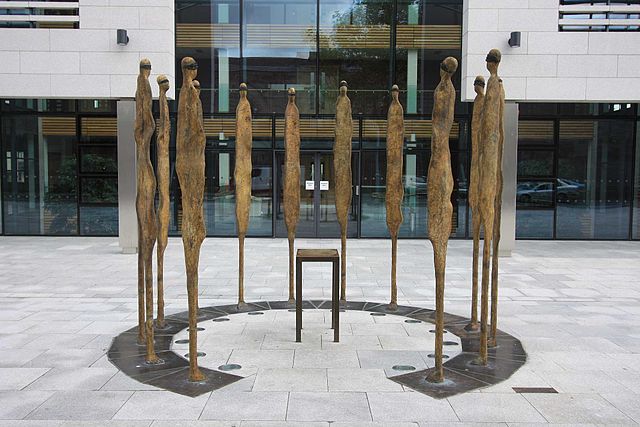
When I visited Kilmainham Gaol in December, it was a bit like a pilgrimage for me. I knew that I would be walking through the notorious place I had been reading about for 20 years and that my Irish history knowledge would only be improved by going…but I didn’t really want to. I knew it’d be hard for me as I am a sensitive girl and I left my traveling companions elsewhere in order to do it alone. I was highly emotional, particularly when I visited “Last Words“, the exhibit on the top floor of the prison.

As I left the gaol, I really needed to collect myself. My makeup was runny from tears I had barely held back in the exhibit and my head was full of things I wanted to remember and write down. Most of all, I wanted a cigarette. I crossed the street to have one and to not fall apart in front of a major tourist attraction and found myself surrounded by humanoid, creepy bronze statues whose chests were full of bullet holes. In the split second it took me to put two and two together, I realized 2 things. These were the creepiest statues I had ever seen and I had come to the wrong place to collect myself, as it made me even more emotional and teary.

I don’t know if I like Rowan Gillespie or not. On one hand I believe he’s a genius. On the other, his work hits me in a visceral way that makes me uncomfortable. This is Proclamation, another place I had to add to the Atlas Obscura. It’s getting quite full of Irish places these days….

http://www.atlasobscura.com/places/the-proclamation-sculpture

Image