Mutiny at Kildare

(Or that one time when Ireland’s New Police Force Turned on Itself)

In May of 1922, Ireland was trying to be reborn and rebuilt. The ink on the Anglo-Irish Treaty was still drying, the English were slowly shipping their bags north, and a brand-new Irish Free State was trying to figure out how to stand up without falling down. It was, to put it gently, a chaotic time. 

The Anglo-Irish Treaty of 1921 ended the Irish War of Independence against England, but it came with strings attached. Some of Ireland would become a Free State, but it would not be a fully independent republic. It would remain within the British Commonwealth. Members of the new Irish Parliament would have to swear an oath of allegiance to the Crown and six counties in the north of Ireland would belong entirely to the English. For some Irish people, these were reasonable compromises. For the revolutionaries who had lived and fought through several uprisings for a united and free Ireland, it was a betrayal of everything they had bled for. The Treaty resulted in a split that not only cut straight through Ireland itself, but also through the hearts of its citizens. On one side you had the new government. On the other there were the anti-Treaty folk, who were loyal only to a completely free Ireland and by May 1922, that split was starting to explode into something bitter and violent. To make matters worse, the new government needed a police force and an army quickly. An Garda Síochána was being assembled from scratch, and its ranks included veterans of the War of Independence and the Easter Rising. Some of these recruits despised the Treaty they were now being asked to defend while others genuinely believed it was a good deal. This fundamental disagreement was irreconcilable and fights broke out often, even though this force was supposed to be unified. It wasn’t good for cohesion or morale and the foundational argument was largely ignored by the powers that be because they needed experienced people and they thought they could persuade even the strongest rebel hearts to fight and work for them. They were wrong.

The departing British troops handed over barracks and armories to the burgeoning Irish police forces and the new Irish army on their way out. These changeovers were widely viewed as the new state reclaiming possession of its own territory but the buildings were old, poorly maintained, and less than ideal. When the gardaí recruits came to the barracks in Kildare, everything seemed to go wrong. It was raining and their bedding was soaking wet. Their quarters were cramped and previously used as stables so it smelled terrible and there was dirt and dung everywhere. This didn’t feel like a grand entrance into a glorious new force. In fact, it felt like an insult to many of them and soon after their arrival, everything came to a head. 

Seven out of eight groups of trainees revolted and seized control of the post. They aligned themselves with the Irish Republican Army and handed out munitions to anti-Treaty forces in the area. They held the barracks for weeks. It was not a planned operation but it was effective. It also indicated something much more unsettling. There was a crack running through the foundation of the state’s armed forces. The mutiny made it clear that the lines between the new police, the National Army, and the Irish Republican Army were not clean and though a conflict between them was inevitable, it would affect everyone, not just those who signed up for it. Many of the people who suddenly found themselves at odds had fought side by side against the English for generations. Some of them were brothers, sisters, cousins, other family members, or the oldest of friends who had spent their entire lives together. But now the Irish “free” state was potentially asking them to point their guns at each other over a Treaty many didn’t agree with, and not everyone could or would do it. 

Eventually the Free State moved to retake the barracks. Their first attempts to regain control failed but gradually (and with the help of Michael Collins) the mutiny was suppressed. This rebellion was rather brief but not insignificant. Mutiny inside your own forces is a very different kind of problem than an enemy at the gates. It raises questions that are hard to answer quickly like who, exactly, the enemy is and how do you deal with your own forces when they oppose you? The new Irish state was reeling and the mutiny was one of the first actions that kicked off the Irish Civil War. It forced the government to make hard choices about loyalty and discipline and despite their efforts to pacify the island, Ireland was torn apart. 

The mutiny at Kildare was a small event, usually overshadowed by the larger battles in the Irish Civil War but sometimes tiny things have a way of carrying the weight of an entire era. This act of defiance led to huge shifts and lasting policy changes. Some would say it’s one of the reasons that the gardaí still predominantly operate without firearms. These men had been too unpredictable and who’s to say that there wouldn’t be more? By the end of the civil war, the idea of a heavily armed and militarized police force was no longer being considered in most of Ireland. If only the entire world had followed suit.

These days the Irish Civil War is often called the forgotten war, which is a strange thing to say about a conflict that shaped Irish politics for the rest of the twentieth century. The party divisions it created have lasted for generations and the decisions they made then still haunt the island today. The conflict asked very difficult questions. How do people who once believed in the same thing, but who are now on opposite sides of it, define loyalty? Where is the line between duty and conscience? How do you cope when atrocities are committed both by and on the people you love? And in the end, how can you ever be expected to forget the unforgettable? These questions did not have satisfactory answers in Ireland in 1922…and over a century later, they still don’t.

Easter Commemorations

It’s pretty shameful how long it has taken to write another post in this blog. I look back and think, how did I have time to write so much just a few years ago? I haven’t lost my passion for Irish history and I continue to visit every chance I get. I still devour every bit of history and culture that I can and I research and learn things all the time but I don’t seem to write about it as much. The idealism and romanticizing of Ireland that I was certainly guilty of at times has evolved into a more realistic, more moderate, and steadfast love of the country and its history. I don’t write about it much anymore and that’s what makes this morning unusual. I got up to go to the Easter Rising Commemoration here in the San Francisco Bay Area as I’ve done in the past, but instead of heading to the grave of a Fenian who was also a corrupt cop and a horrible racist, I am sitting here in the mood to burn bridges and actually writing again. I guess that’s because I find it hard to believe that in one of the most liberal areas in the entire United States, the annual Easter Rising commemoration honoring Ireland’s Patriot Dead is still at the gravesite of a revolutionary but terrible human, who had nothing in common with the leaders of the Rising except for their love of Ireland.

I’ve written about Thomas Desmond before, after the first time I went to the Bay Area commemoration. Back then I cared about fitting into the San Francisco Irish community somehow and my piece on the city’s awfully corrupt and horrendously racist sheriff was timid. It did speak some truth about the man, but I wrote it without calling out their choice of a hero. The Irish Proclamation espouses equality, socialism, and freedom – ideals that Thomas Desmond certainly did not practice in his every day life so many years and commemorations later I feel like it’s time to find a better option. San Francisco has a long history of Irish Republicanism and surely we can find another, less conservative and less controversial person to visit annually, while remembering the Rising. I know that many Fenian heroes and Republican soldiers are often complicated and not always great examples of the idealism that the Proclamation calls for, but in an area that is known for historically supporting the cause and for giving refuge to many immigrants, including the exiled Irish, there has to be a better option than an anti-immigrant, corrupt cop. In my humble opinion, it’s time to look for one.

Until that time, I’ll wear my Easter lily with pride here in the Bay Area and will continue to commemorate the men and women who fought for Irish freedom by learning and occasionally writing about them. For me, how we honor them and where we honor them matters, so Thomas Desmond’s grave is no longer an option for me. Instead, I’ll enjoy some Irish music at my local, tell everyone there who asks why I’m wearing a lily, and I’ll raise a glass or two to the Boys and Girls of the Old Brigade, who fought for a united and free Ireland so bravely during Easter week in 1916 and beyond.

Hoorah me boys for freedom

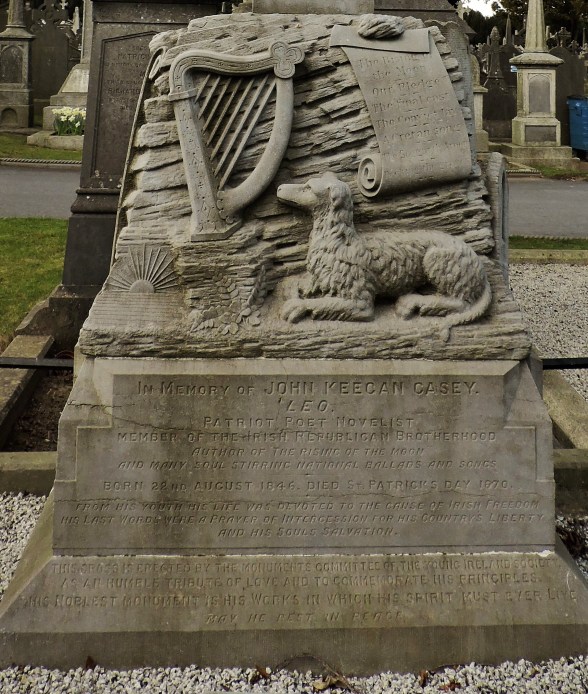
On this day in 1846, the Poet of the Fenians was born in County Westmeath, Ireland. John Keegan Casey was born at the tail end of An Gorta Mor – Ireland’s Great Hunger – so he knew desperation, injustice, and poverty at a very early age. The plight of everyone around him shaped him and ultimately motivated him to use his gift for poetry and song to inspire people to rise up against the English. His voice was heard far and wide and he wrote The Rising of the Moon, one of Ireland’s most popular and enduring “rebel” tunes at the tender age of fifteen.

John Keegan Casey’s words soon spread to all corners of Ireland thanks to The Nation, Ireland’s most popular Nationalist publication. They inspired defiance and rebellion everywhere they were heard. Though he used a nom-de-plume (Leo) while writing for The Nation, his identity was becoming well known anyway. It was further revealed when he chose to publish a book of his collected works, many of which had previously appeared in the publication. Not content to stop with his words, John moved to Dublin shortly after his book was published to put himself squarely in the Fenian movement. He was a prolific Nationalist speaker and a central organizer in Dublin before the Fenian Uprising of 1867.

That uprising failed and John Keegan Casey soon found himself sitting in the notorious Mountjoy prison. The English authorities imprisoned him without trial and clearly hoped that if he was locked away the power of his words would fade. They did not, but John did. He was malnourished and dispirited and his weakened body would trouble him for the rest of his life. He was confined for eight months and one of the conditions of his release was that he would leave Ireland, living in quiet exile in Australia. He opted for living in disguise in Dublin instead. The authorities may have broken his body, but they definitely didn’t break his mind.

Sadly, John Keegan Casey’s failing health meant that he only had a few years left in him. It is thought that he never fully recovered from his stint in Mountjoy and a fall from a cab did him in. He passed away at the young age of twenty-four. Thousands and thousands of mourners turned out to honor the Fenian poet in Dublin and his memorial stone in Glasnevin Cemetery is still visited regularly. It is adorned with nearly every Irish symbol you can imagine, including a wolfhound to symbolize John’s undying loyalty to Ireland. His songs continue to be sung across the island (and the rest of the world) to this day. His life was tragically short, but his words are still going strong over 150 years later.

The Mighty Margaret Skinnider

When you listen to or read accounts (including my own) of Margaret Skinnider’s life it’s immediately clear that she was a fighter and a warrior. She was brave and devoted to Irish freedom. She was gravely wounded in the Easter Rising but somehow survived her injuries to continue fighting for Ireland, for recognition and pensions for women, and for Irish workers for the next five decades or so. Her fierceness has inspired many and we’ve all rushed to applaud Skinnider’s fighting spirit, using it to highlight and recognize the important (and often atypical) roles that Irish women played throughout history.

It’s pretty common knowledge that Margaret Skinnider was a teacher, a revolutionary, a union boss, a devoted suffragist, a deadly sniper, a commanding officer, an explosives expert, a smuggler and so much more. We’re used to seeing her as a dedicated, cross-dressing, sharp shooting freedom fighter so it might be a little jarring to hear one of her best friends say that Skinnider was love and kindness incarnate and that she was gentle. Sure she was a soldier who spent most of her life fighting for one cause or another but she was also full of empathy and love, kindness and compassion – and many of the historical narratives (including my own) overlook those aspects of Skinnider’s life.

This is part of a bigger problem. In our rush to make sure that women are counted among the heroes of history, we often highlight only the fiercest and more traditionally “male” aspects of them. We tell tales of how they outsmarted others and how they aggressively fought for something and proved themselves worthy of remembrance and praise. We often ignore their traditionally “feminine” sides in favor of a glorious and heroic tale. The famous photo of Margaret dressed as a boy with a cigarette dangling out of her mouth is a perfect example of that. We remind people that that she was a female sniper and one of only two women who wore a soldier’s uniform during the Easter Rising, and we set her apart from the hundreds of other women who were there in their Easter skirts and dresses. There were many other brave women on active duty and they each brought their own fighting spirit and individual set of skills…some of them even saved Skinnider’s life after she’d been shot multiple times. These women are just as worthy of remembrance whether we know their names and stories yet or not, even if they had more traditional roles. Margaret’s exciting and unusual tale has become more popular in recent years but in telling it we’ve done her a disservice. We’ve all celebrated her deeds but most of us ignored the other aspects of her life. It’s less common knowledge that Skinnider was as gentle, loyal and loving as she was aggressive. She lived a long life full of love, music and long lasting friendships. Her favorite song about Ireland was a somewhat sappy love song called The Jackets Green. She was a lesbian in a committed and life long relationship in an era when that was not only frowned upon, but illegal. Mary McAuliffe’s newish book about Margaret Skinnider uncovers that love story and much more. It is an overdue biography that focuses on Skinnider’s life as a whole, rather than highlighting one or two of her legendary acts. It gives our inspiring hero her entire life back, long after she passed away.

Which brings us to the point, dear readers. On this day in 1971, the mighty Margaret Skinnider threw off this mortal coil. She is buried in the Republican 1916 plot at Glasnevin Cemetery, where she rests next to many of her dearest friends and comrades. To remember her today, why not listen to this interview with Mary McAuliffe where she talks about some of the lesser known aspects of Skinnider’s life or you can listen to Margaret tell her own story of Easter week right here. If you’re like me and you still haven’t been able to break up with the written word, you can find Skinnider’s own 1917 propaganda masterpiece, Doing My Bit For Ireland in various places on the web and in bookstores throughout Ireland. While you’re at it keep an eye out for Margaret Skinnider by Mary McAuliffe as well.

The Mighty Anne Devlin

There are so many important women in Irish history that I could work the rest of my life (which I probably will) and not get to them all. That said, Anne Devlin is the one who started it all. Without Anne I may never have had the jump start I needed to begin writing again. I may never have started a blog and certainly would not have written a book. But it’s not all about me – without Anne Devlin, numerous rebellions in Ireland could have been compromised. Important uprisings would not have happened. Patriots would most certainly have been jailed or killed. Her fortitude and silence against all odds and various forms of torture probably saved thousands of lives, though it cost her dearly.

On this day in herstory, Anne Devlin Campbell passed away – long after her incarceration in one of the most notorious dungeons and prisons in Ireland. It’s amazing that she lived so long given her brutal treatment there. She was an elderly, broke washerwoman living in relative obscurity when she died, but she was never broken. This is some of her tale that I wrote and continue to repost every year in remembrance of this powerful woman.

Continue reading

The Poet of the Fenians

The remarkably short life of John Keegan Casey was full of lyrical rebellion and inspiring, seditious poetry. His pen was at least as dangerous as the sword, if not more so and it made him a warrior and a target at a remarkably young age. His best known work is “The Rising of the Moon“, which he reportedly penned at the tender age of just fifteen and it is still in heavy rotation to this day.

Continue reading

Read This

I’m just popping on for a minute to link to an amazing article that was written a year ago, but I found only recently.  I’ve been struggling with a post that is similar for a few years, but this one says it more succinctly (and with less of a frustrated and horrified tone) than I have been able to. It’s worth a read no matter what side of the puddle you’re on regardless of when it was written, given that right-wing bigotry is still spreading throughout the world. Well done Ms. Markey.

WHAT THE HELL HAPPENED TO IRISH AMERICA?!?

Sorcha MacMahon is Born

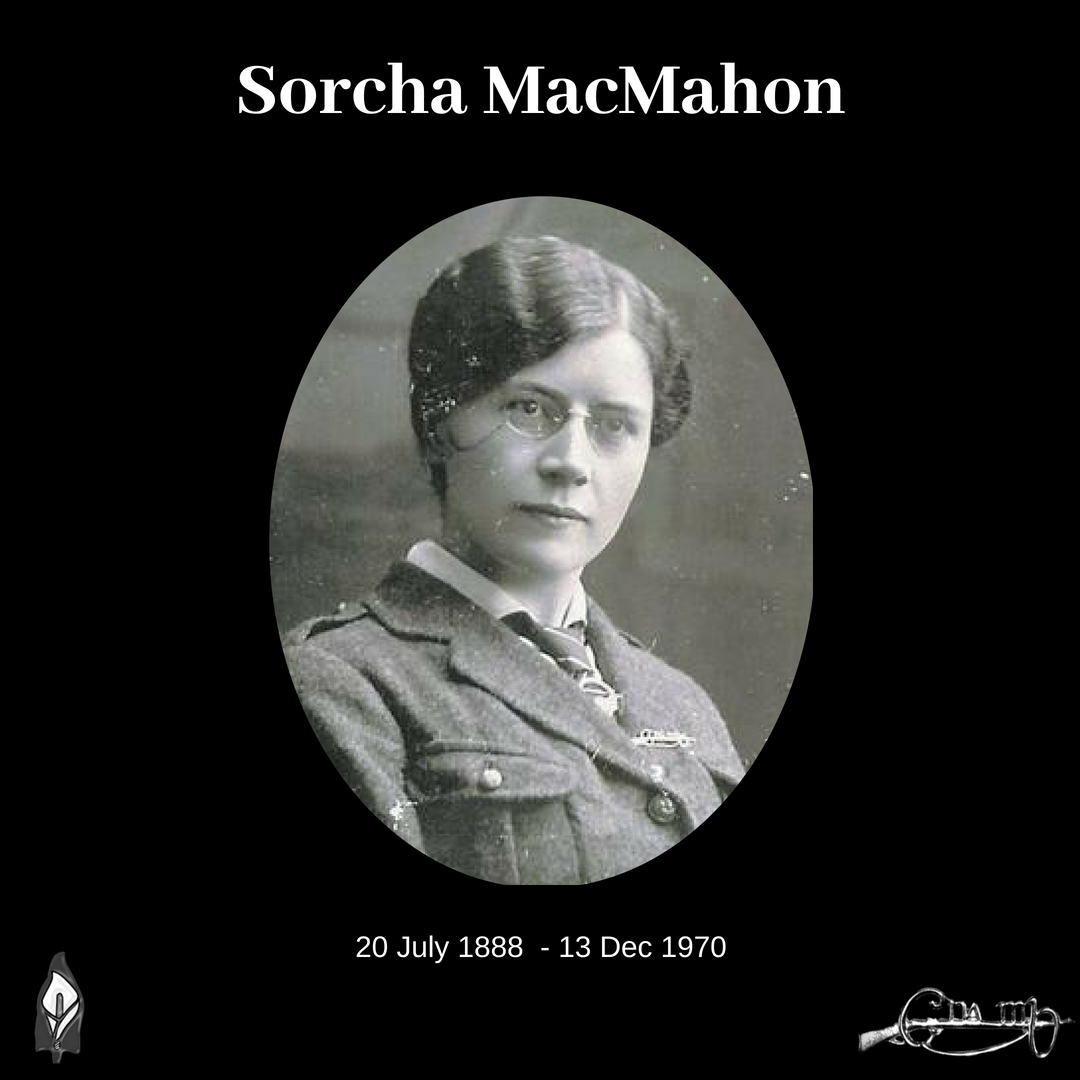
Sorcha MacMahon was born on this day in 1888 and was one of seven children. Unlike many who had to learn the Irish Language later in life through private instruction or the Gaelic League, Sorcha was raised speaking it. Irish was the family’s first and preferred language and she was more than fluent in it at an early age. When she finished school, she left the family home in Monaghan and headed for Dublin where she began working as a bookkeeper. She also worked for the central branch of Cumann na mBan, a women’s organization dedicated to Irish independence. She was the group’s secretary and she was trained in nursing and first aid – skills that she passed on to many of the other women. Many said that she was one of the most efficient and devoted members of the group.

Sorcha MacMahon

Her dedication to Irish independence led Sorcha straight into the Easter Rising of 1916 and when it was over, she took a position that had her working directly with Michael Collins for years. For more about this brave woman, please CLICK HERE.

A Tale of Two Fenians

Stephen O’Donohoe was a poor law clerk in Dublin. He was a family man with four children who struggled to get ahead but only barely managed to scrape by. Like many, he blamed the English rule in Ireland for his woes. He was one of thousands of men who joined the Fenian Brotherhood, a group dedicated to overthrowing the government and getting the English out of his country.

Thomas Farrell was from Williamstown and was a confectioner by trade. He joined the Fenian Brotherhood as well, and while it’s not clear if these two men knew each other, what is certain is that they are now tied together for all of eternity.

Continue reading

John O’Mahony

Many of Ireland’s great Fenians scattered to the wind to avoid prison when their various uprisings failed. More than few of them ended up on America’s shores and promptly set about creating organizations that furthered the Irish cause within the United States. One of those powerful men was John O’Mahony, the founding member of the Fenian Brotherhood in America.

Continue reading