John Sands, father of Bobby Sands

On this Father’s Day I am very saddened to hear the news that John Sands, the father of famed hunger striker and Irish martyr Bobby Sands, has passed away. I cannot imagine the pain of a father losing a child and I hope that how Bobby has been remembered and the love of the rest  of his family made his life easier after the loss of his son.  I also hope that son’s beautiful smile was the first he saw in his afterlife for that would be a happy Father’s day indeed.

Rest in Peace sir.

His memorial service will be held  Tuesday, 17th June, at St Agnes’ Chapel, Andersonstown Road, in Belfast.


Michael Gaughan

Michael Gaughan, an IRA man died 40 years ago today while on hunger strike in Parkhurst Prison. When people think of hunger strikers, the name that almost always comes to mind is Bobby Sands, but there have been countless male and female prisoners who have used that form of protest throughout the years. When Michael asked for political status and was denied, he like many others before and after him, went on a hunger strike.

The demands were political status, the chance to wear his own clothes, a guarantee of education and release from solitary confinement and a transfer to an Irish prison. He joined a strike already in effect in support of Delours and Marian Price who wanted the same. As usual, these demands were ignored by the British Government.

At that time, it was Britain’s policy to force feed inmates. This was often done by forcing a block between the teeth to hold the mouth open while a tube was passed through a hole in the block into the throat. This brutal method often resorted in broken or loose teeth and lacerations in the throat, both of which Michael’s brother John attested to. Michael was force fed 17 times during the course of his strike, but his weight still dropped and his health declined.

There is a controversy surrounding his death. The last time he was force fed was June 2nd, 1974 and he was dead at age 24 by the next day. Prison officials stated that he died of pneumonia due to his declining health, but the Gaughan family stated that he died after prison doctors injured him fatally when food lodged in a lung punctured by a force-feeding tube.

Following his death the policy of force feeding prisoners came to an end and the government said they would meet the demands that he had been fighting for, since only a week before they had met the demands of Loyalist prisoners who were on a hunger strike. In an all too familiar move, the British reneged on their promises to the Irish prisoners, though not the Loyalist ones, soon after making them.

Michael Gaughan is remembered in song and history. “Take me Home to Mayo,” is also known as “The Ballad of Michael Gaughan,” and has been recorded by many Irish musicians, including the Wolfe Tones and Christy Moore.


“I die proudly for my country and in the hope that my death will be sufficient to obtain the demands of my comrades. Let there be no bitterness on my behalf, but a determination to achieve the new Ireland for which I gladly die. My loyalty and confidence is to the IRA and let those of you who are left carry on the work and finish the fight.” – Michael Gaughan

Rest in Peace Sir.

B October 5th, 1949  D June 3rd, 1974

Memorial Day

Here in the U.S. Memorial Day means a three day weekend to most people. Many either forget, are opposed or are simply untouched by the idea of war and those who fight them. As a woman who is obsessed with the politics of another land and disagrees almost entirely with her own country’s foreign policy, Memorial Day is a strange one. Still, while I am opposed to war and I despise the greed from which almost all of them spring, I do not oppose those who fight them. I absolutely hate the fact that they are necessary – but I do not hate them. And I can hardly honor the patriot dead of one country without honoring my own, so here it is.

Those who are sent on a mission and who do not return should be honored, not just on Memorial Day but every day. Those lucky enough to come back should be cherished and cared for – and those who thrust them into the world should be forced to join them, in order to better understand what they’ve done.

Cheers to you…. and thank you for your service. May you never be forgotten.

Protect Moore Street!

On the off chance you are in Dublin this weekend, or you have the ear of an Irish politician, you should help protect Moore Street. It is home to one of the only outdoor markets left in Dublin, but aside from that it is also where the rebels of 1916 made their last stand and escape from the GPO before surrendering to stop civilian casualties. Developers want to replace all that history and street vending with another mall, though there are more than a few in the area and more hotels. Stand up and link arms for history, street vendors, farmers and locals. You can find more information via these 2 links

http://www.occuworld.org/news/817530

https://www.facebook.com/events/1537009746526361/Image

Image

Proclamation

When I visited Kilmainham Gaol in December, it was a bit like a pilgrimage for me. I knew that I would be walking through the notorious place I had been reading about for 20 years and that my Irish history knowledge would only be improved by going…but I didn’t really want to. I knew it’d be hard for me as I am a sensitive girl and I left my traveling companions elsewhere in order to do it alone. I was highly emotional, particularly when I visited “Last Words“, the exhibit on the top floor of the prison.

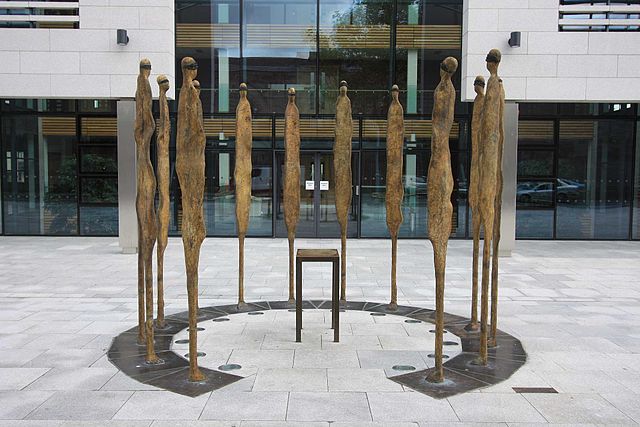
As I left the gaol, I really needed to collect myself. My makeup was runny from tears I had barely held back in the exhibit and my head was full of things I wanted to remember and write down. Most of all, I wanted a cigarette. I crossed the street to have one and to not fall apart in front of a major tourist attraction and found myself surrounded by humanoid, creepy bronze statues whose chests were full of bullet holes. In the split second it took me to put two and two together, I realized 2 things. These were the creepiest statues I had ever seen and I had come to the wrong place to collect myself, as it made me even more emotional and teary.

I don’t know if I like Rowan Gillespie or not. On one hand I believe he’s a genius. On the other, his work hits me in a visceral way that makes me uncomfortable. This is Proclamation, another place I had to add to the Atlas Obscura. It’s getting quite full of Irish places these days….

http://www.atlasobscura.com/places/the-proclamation-sculpture

Image

May 12th

Today marks the end of the anniversaries of the 1916 Executions. James Connelly was shot May 12th, 1916. He was carried into the prison yard and tied to a chair, due to injuries that would have killed him in a day or 2 anyway. Instead of letting nature take its course, they tied him to a chair and the firing squad shot him.

Last winter, a Sinn Fein guide mentioned rumors that he was already dead when they brought him into the yard, which was the first I had heard of the possibility. It wouldn’t surprise me  – after all, they were only posturing and proving a point by executing him, despite his feebleness and injuries. Either way, the 12th marks the anniversary of his death – and this photo was taken in December at the mass grave site in Arbour Hill. I quite like the leaves in the cracks – and while I sat at the grave, a feral tabby cat jumped right into my lap and started purring like mad, at just the perfect time.

It was a great way to spend  the afternoon.

Rest in Peace Mr. Connolly and all of your cohorts too.

Image

Remembering the Leaders of 1916

Remembering the Leaders of 1916

This plaque rests on the wall above the execution site in Kilmainham Gaol

As we come to the end of the anniversaries for the execution dates in 1916, I have to stop and ponder the logic of the British government throughout history. The Rising was not popular and it was rife with miscommunication and leadership wars. If the government had not executed the leaders, making them martyrs, it may have been a footnote in history. They have made this mistake time and time again, almost as if they either WANT to concede their empire or as if they want the struggle to continue.

Whenever the people get sick of the fighting and membership of Republican fighters is down, they do something so wrong and so tyrannical that suddenly, there’s a giant surge in the ranks. This happened in 1916. It happened in Derry when the Army shot 26 peaceful protesters. It happened again when Bobby Sands and the other hunger strikers lost their fight and died in prison. Depending on how the dust settles, it may happen again in the aftermath of Gerry Adam’s arrest just weeks before elections. You would think that SOMEONE over the puddle would be more strategic and learn from their historical mistakes.

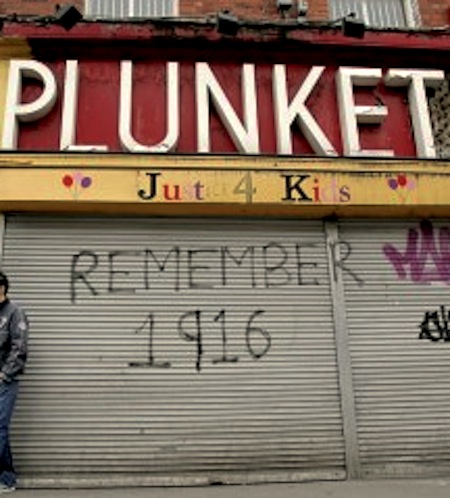
One of their biggest mistakes, was letting Grace Gifford and Joseph Plunkett get married the night before they executed him in 1916 at Kilmainham. It is a tragic love story of star crossed lovers – one that tugs on the heartstrings of anyone and everyone, even those who didn’t approve of the Rising. They were married in the prison chapel and were only allowed ten minutes of supervised time as husband and wife before the crown shot Joseph Plunkett the morning after the wedding. They were taunted and watched for the entire 10 minutes and yet, by all accounts, they only had eyes and ears for each other. 10 minutes of bittersweet joy before their love was destroyed – and as Shakespeare can attest to – that makes for an undying, sympathetic story that the whole world can stand behind, rebel or not.

Grace was a strong woman. She was the daughter of a mixed marriage (Catholic and Protestant) and was an unlikely rebel. She tried to make a living as an illustrator and a political cartoonist. She was to be married to Joseph Plunkett on Easter Sunday – plans that were made before she had any knowledge of the Rising. She insisted on the wedding in the prison chapel when she learned that her fiance was to be executed on May 4th, 1916. On May 3rd, she bought her own wedding ring and went to the jail to marry her love, despite her parents’ objections, knowing that she was to be a widow just hours later. She never remarried and remained Grace Gifford Plunkett for the rest of her days – a shining example of a dedicated Republican woman and a walking reminder of her tragic love story. She was known as Ireland’s tragic bride and she returned to Kilmainham Gaol as a prisoner years later.

Plunkett was a poet and a signatory on the Proclamation of Independence. Already a romantic and philosophical man, his wedding to Grace and their story of tragedy and dedication made their love a flash point of the rising that continued to burn after he was executed. Their 98th anniversary was just days ago.

Kilmainham has reopened as a museum and a tourist location. One of the first places you will visit there is the prison chapel where they were married. A projector displays their photos above the altar at the start of the tour and you will also see both of their cells while visiting. Hers still has one of her more famous paintings on the back wall – one of Mary, showing that her adoption of Joseph’s Catholic faith stuck even after her husband was killed.

On the 3rd floor of the Gaol is an unnerving and heartbreaking exhibition of ‘Last Words’ – featuring the letters, mementos, and other possessions of Republican prisoners and rebel leaders. The letters from the prison to Grace are almost as gut-wrenching as the correspondence between her and her future husband in the days leading up to their wedding and his death. It is impossible to stand in the room without feeling the power of their story and the shadow of their love that remains. It was also impossible for me to be there without tears streaming down my face for almost the entire tour.

So happy anniversary to Grace and Joseph. If there’s any justice in the world, they found each other again in their version of the afterlife and maybe someday soon, the free Ireland they both believed in will finally come to fruition.

ImageImageImageImage


The Star-Crossed Lovers of 1916

An Gorta Mor


So there I was, going for a walk through Dublin in the middle of the night, like you do. I was so focused on the gorgeous ship that I was headed toward that when I bumped into “someone” I apologized. Turns out I was apologizing to the 2nd creepiest set of statues/sculpture that I have ever seen…and I was in the middle of it.

Famine Monument


Ireland is a mecca for memorials, historical places and public sculpture, but few are as somber, creepy and potent as the Famine Monument on the bank of the River Liffey in Dublin.

The Famine Memorial sculpture was created by Rowan Gillespie and unveiled in 1997. The sculptures consist of emaciated men and women trudging along the banks of the river, with various expressions of sadness, despair and determination. To really drive the point home, the bronze sculptures also include a starving dog walking behind the people. They are one of the most photographed public art pieces in all of Ireland and to stumble across them after midnight on a long night in December was disconcerting to say the least.

This sculpture is a permanent memorial to the many people who emigrated because of Ireland’s Great Famine. It’s built on the departure site of the Perseverance, one of the first famine ships to leave the area in 1846. The ship’s captain was a 74 year old man who quit his office job to transport the starving people from Dublin to America. All passengers arrived safely and the Perseverance was one of the first of thousands of ships to make that epic crossing. Statistics estimate that even today there are more Irish people living outside of Ireland than within its borders, and this haunting piece is a stark reminder of when that emigration began and why.

Just a few steps away from the sculpture is a tall ship moored in the water that is set up as a famine museum. The Jeanie Johnston is a replica famine boat and is a fitting backdrop for the memorial statues. They are gorgeous, haunting and creepy and if you have a chance to visit them, do so.


jeanie


Death Culture – American v. Irish

Over the last few weeks I have been thinking a lot about death. On my travels to Ireland, I realized just how differently death is dealt with there, rather than America. Perhaps because it is a much older country and Ireland has always had such a spiritual side – be it pagan or religious – death in that place is vastly different than here. There are graveyards everywhere. Even when the church that used to stand is in ruins and the elaborate grave markers are no longer legible, there are flowers and visitors to the cemetery, or little notes and quiet conversations with the dead. It is not as if the culture is a death worshiping one, because it is not – it is simply that the memories are longer and the respect for both ancestry and friendship runs deep in the veins of those who live.

As we traveled, taking pictures of gorgeous ruins, elaborate graves and old churches, we ran into enough people sitting quietly in the middle of nowhere and speaking in low Gaelic to the friend or relative in the ground that we started getting uncomfortable with our intrusions. This was on us though and the way that our culture views death – I don’t think that we offended anyone by our presence in the medieval graveyards. While I am sure that some of those conversations were about the crazy girls with the cameras and how odd it was to see them in December, we never got a scandalous glance – just a few shakes of the head or confused looks and some who clearly wondered if we too were visiting a long-lost friend or family member.

As we explored the ruin of Lislaughtin, there were many people and many notes to visitors, such as a bar that was carved with the words, “kindly kneel and pray” – a polite suggestion that reminded you of where you were and that the space should be full of reflection, remembrance and respect. It was hard not to listen to the ancient women speaking in soft Gaelic to their loved ones that were interred there, or to try to figure out who they were. Instead, we felt like intruders and snuck out quietly.

I think we were wrong to feel that way. I believe that our culture has a different idea of what death is and that being raised here, we felt uncomfortable in the presence of those who simply see death as a different way to honor a life that touched theirs. It is not as if we were disrespecting the grounds or the people in them with our presence – we were stunned by the history and the beauty of the place – yet we still felt like our presence there was unsanctioned somehow, and I think that is due to the fact that our culture views death as the end of someone. We see their grave as a sad obligatory place to spend their birthday or a holiday. Many in our culture do not view it as a place to tell stories or catch up with a spirit, or a place of enlightenment or beauty.  For us, it is a sad reminder of who WE lost and an uncomfortable moment of where WE will eventually be, which is not something our self-centric society is OK with. We do not see it as a peaceful and holy spot for THEM to rest, or a thing to reflect on except in how their loss pertains to us.

The short attention span of Americans and lack of a long history seeps into our lives in the strangest of ways. I believe this to be one of them. We are so into ourselves and our lives that once one is over, we still make the ghost about those of us that remain. We either hang on to them with a clutched fist, parading our pain for years to come until it integrates with who we fundamentally are or we turn off and become numb to the process of death or grief. We demand information, sympathy and respect for what we have gone through – but often, we do not give the same to those we have lost, unless it is a sad anniversary, important date or birthday. Either we become brittle and judge everyone for not understanding our pain or we cling to the memories of that person so much that we forget we have a responsibility to live ourselves, if only so that we have stories to tell them when and if we meet again or spend a day at a graveyard.

Some of us put our dead on an impossible pedestal, suddenly turning them into the saints we aspire to be until we forget who they really were or what conflicts we may have had with their personalities or traits. We use them as a  marker in our own lives, to judge who we were before and after they were gone, and we wear our badges of how much sadness we feel without them – using this as an excuse to judge or to pull away from others who can’t possibly understand our loss or our feelings. We hang their pictures up on social media as proof of how we still remember, never once thinking of how that may affect other people, when they come across the feed. We vaguebook about feelings, about deaths, and about who, how or where we are in our emotional state and we have no consideration for whether we should do these things and no concept of how it may affect others or our relationships with them. It’s now, now, now – all the time and gods forbid if anyone judges or questions that instant gratification.

The lesson I learned while traveling, is that the person in the ground, ocean, urn, or cannon is someone that we can carry with us every day without the misery, loss or badge of fucked up baggage. That person is still a person, separate from how they affected us – and when you take the ego and the demand out of the equation, you are left with someone you liked, loved or perhaps didn’t even care for – but who touched you somehow, and perhaps it could be better for them to hear it themselves. It may also be better for us to tell them, rather than the “friends” we have on an internet site.

Don’t get me wrong, EVERYONE grieves differently, just as everyone loves and lives differently – and far be it from me to judge anyone on how they do it. I’m just thinking out loud here about the differences that I have seen while traveling through parts of the world that can’t rely on the internet and how I saw them deal with their losses without that tool. There’s a ritual side to actually stepping away from the screens and heading out to a place for the memories and the visits that just isn’t possible to convey on the internet – and I liked being reminded of that and seeing it firsthand.

I guess that is what this post is about, more than anything else. In this day and age, we find out on Facebook when a friend or acquaintance has passed, or when our loved ones are hurting, remembering or grieving. The separation that brings is getting harder and harder to erase as the instant information culture booms and the paranoia and anxiety that brings is palpable. Sending a (hug) is not the same as holding that person in your arms no matter what, and feeling that lack of human connection has been harder since traveling to a place that doesn’t have that constant demand for instant information or gratification. The mirror was hard to look in to, as I have been guilty of all these things too – and what I learned there is that FOR ME, it is not OK.

It is a lesson that I hope stays with me for a long, long time.Image