A small perfume bottle sailed over the wall of Mountjoy Prison in Dublin on Oct. 30th, 1921. Was it caught on the other side? Did it shatter when it hit the ground? We only know one thing about it once it was thrown. It was a signal. Within minutes, a rope ladder appeared where the bottle went over and four Irish Republican women were there to make good use of it. They climbed one by one out of Ireland’s notorious prison before vanishing into the city. It’s almost too perfect, like an unbelievable Hollywood movie, but that is pretty much the story of how this escape happened.
Linda Kearns was the first woman over the wall, partly because her health had been deteriorating in custody. She was a nurse from County Sligo who had used her medical skills to treat wounded IRA men during the War of Independence, often transporting men and arms under the cover of her work. She was arrested nearly a year before the escape while transporting arms, and imprisonment in Mountjoy had not been kind to her health. Aileen Keogh from County Carlow went second. May Burke from County Limerick third. Both of these women were members of Cumann na mBan who had been imprisoned after they were found with “revolutionary materials” according to the powers that be. Eithne Coyle, an activist from County Donegal went last which had to have been nerve-wracking. Imagine having to watch three others go before you, knowing that every extra minute increased the chance of your discovery and decreased your own chances of making it out. Coyle stayed calm though and managed to get herself over the wall as well. After all, these women were not accidental revolutionaries. They had been soldiers in their own right, aiding in the fight for Irish Freedom for years which is why their comrades in the Irish Republican Army were outside the walls, waiting to ferry them to safehouses all over the city.
The coordinated escape did not happen by luck. Communications were established with the IRA on the outside. Signals like the thrown perfume bottle were agreed upon. Devil’s Night, the night before Halloween, was chosen as the date of their escape. That night was perfect because the female prison population was involved in a football match that evening. Cork was set against the rest of Ireland and the rest of Ireland won, which meant the celebrations were particularly loud and enthusiastic, providing the perfect distraction for the women’s escape. They went to the appointed spot and threw the perfume bottle over the wall. When a rope ladder came back, they climbed out into freedom and no one noticed. The celebrations continued in the prison as the four women disappeared.
Kearns returned to active service as a nurse while also fundraising. She later became a politician and spent years fighting for women’s equality and the nursing profession. Keogh and Burke both returned to their units and were active members of the Republican forces throughout the Irish Civil War. Coyle would go on to become the National President of Cumann Na mBan and remained a staunch Irish Republican for the rest of her life.
The Anglo-Irish Treaty would be signed just weeks after the women’s escape in December 1921, bringing a complicated and contested end to the Irish War of Independence but before that happened, the women were reunited briefly in an Irish Republican Army training camp in County Carlow. When they were there, three of them (May Burke, Eithne Coyle and Linda Kearns) were photographed holding rifles while standing on a British flag. This photograph became a massively popular piece of propaganda in the years to come. This escape from Mountjoy was not just a logistical success. It was a statement and to be flaunting their freedom with a picture like this? It was humiliating for their captors. Linda Kearns, Eithne Coyle, May Burke, and Aileen Keogh had refused to cooperate with or even acknowledge English authority at every stage, and their escape was their defiance made physical and irrefutable. It embarrassed the prison staff. It also demonstrated something that tends to get quietly edited out of history – that many women were not supporting the Irish revolution from the sidelines and they didn’t watch it from the safety of their homes. They were in it fully. These four women were imprisoned for their various roles and as soon as the opportunity came, they climbed over the wall and went right back to fighting for the cause.
They may or may not have stayed in touch with each other in the following years, but on Devil’s Night in 1921, these four women worked together as a cohesive unit to escape Mountjoy, giving a group middle finger to England and showering the authorities in humiliation and bad press. So on this Devil’s night 105 years later, let’s get inspired by them. Their fighting spirit was never suppressed by what the world threw at them or by the authorities that tried and failed to contain them. I think celebrating that kind of defiance is especially important today.
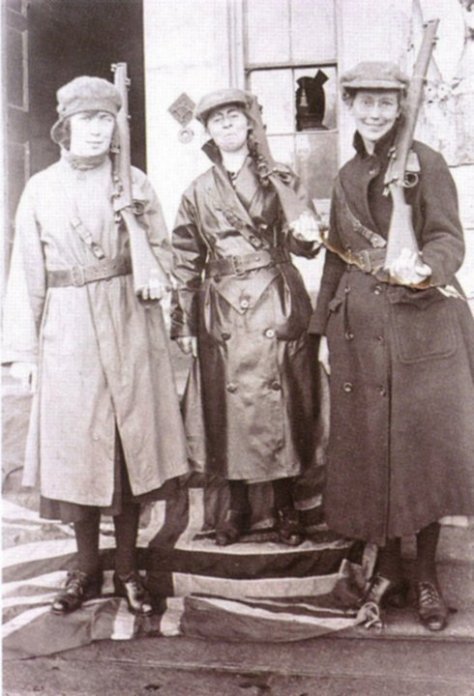
May Burke, Eithne Coyle and Linda Kearns
Keep your chins (and your fists) up and never let the fash keep you down.


You must be logged in to post a comment.