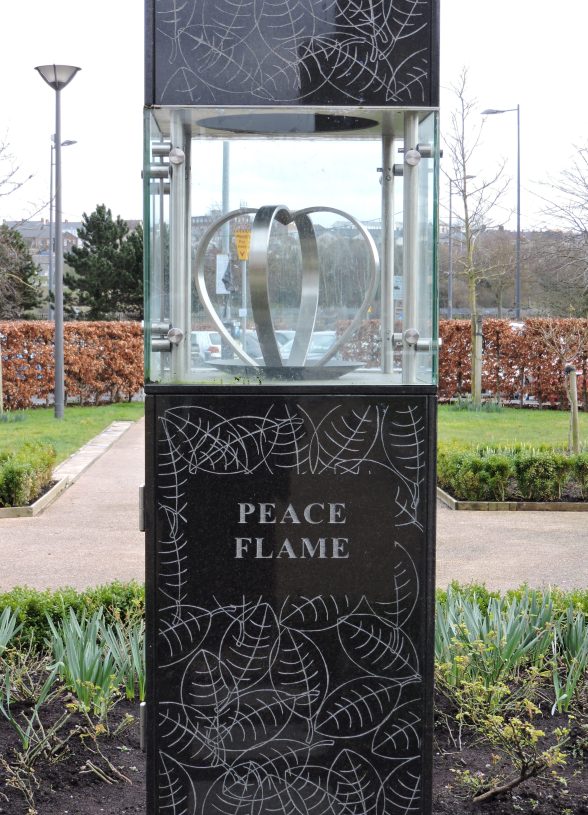
The Peace Flame

Glass enclosed sculpture on black pillar that says the words Peace Flame

Derry is a city that knows what it means to burn.

In August 1969, the Battle of the Bogside transformed the city’s streets into a war zone. Petrol bombs flew through the air. CS gas filled the alleyways. Those three days of violence marked the beginning of a conflict that would claim over 3,500 lives across the North of Ireland. Over the next few years, civil rights activists began a long campaign against the gerrymandering in the region and the discrimination against Catholics. Organizers looked across the ocean for inspiration. They saw the marches in Selma in the United States. They heard Martin Luther King Jr. speak of justice and nonviolent resistance. The movement in Derry borrowed that language deliberately, because it fit. Derry’s Catholics faced discrimination in housing, employment, and voting rights, similar to what African Americans were facing in the US. The parallels were not metaphorical. They were structural and intentional.

On Jan. 30th, 1972 a large civil rights march made its way through Derry. English soldiers opened fire on the unarmed protestors, killing 14 innocent people and injuring many more. The Crown defended the killings adding to the injustice and radicalization of the city. Calls for both violence and peace rose, each shouting louder than the one before. Derry was an open wound, full of trauma, anger, and fear for decades to come.

That history is embedded in the city to this day. It lives in the murals of the Bogside, in the names on memorials and walls, on the gravestones of the city cemetery, and in the hearts of all who call it home. This is why a symbol of peace in the town carries such weight. The Peace Flame is in the center of a purpose-made tiny garden next to the Guildhall. It is housed in a glass enclosure, sheltered from the wind but visible to anyone who passes. A pillar bears the words plainly: Peace Flame. No ambiguity or abstraction, just the thing itself, named loudly and ever present.

It was unveiled on this day in 2013 as part of a five day peace conference. The keynote speaker was Martin Luther King III, the son of the man whose own civil rights movement had inspired Derry activists for nearly fifty years. His presence was not just ceremonial, it was also a full circle moment. The thread that ran from the U.S. civil rights movement to the Bogside in Derry was being acknowledged openly, by someone who carried that legacy in his blood.

The ceremonial lighting featured children from both sides of the divided town. That choice was poignant. While the adults in the crowd carried the memories and the scars, the children could carry the hope for a peaceful future. They will decide the future of the north of Ireland so it was fitting that they were involved in the town’s efforts to promote both the city and the flame as a beacon of peace.

This was the first peace flame in Ireland. It has had to deal with technical issues and multiple vandalism incidents that affect the flame but whether it happens to be lit or not when you walk through the garden, it’s hard to ignore the symbol. Seeing it in the heart of Derry is both heavy and optimistic, much like the town itself.

It also seems like a light that is holding steady even when the future is uncertain and the past refuses to stay quiet. Installing the peace flame did not fix or erase what happened here; instead it shone a light on all the tragedies and pierced through the darkness of the past, lighting the way to a better and shared future in the region. May it shine bright in the hearts of all who pass it by.

Mutiny at Kildare

(Or that one time when Ireland’s New Police Force Turned on Itself)

In May of 1922, Ireland was trying to be reborn and rebuilt. The ink on the Anglo-Irish Treaty was still drying, the English were slowly shipping their bags north, and a brand-new Irish Free State was trying to figure out how to stand up without falling down. It was, to put it gently, a chaotic time. 

The Anglo-Irish Treaty of 1921 ended the Irish War of Independence against England, but it came with strings attached. Some of Ireland would become a Free State, but it would not be a fully independent republic. It would remain within the British Commonwealth. Members of the new Irish Parliament would have to swear an oath of allegiance to the Crown and six counties in the north of Ireland would belong entirely to the English. For some Irish people, these were reasonable compromises. For the revolutionaries who had lived and fought through several uprisings for a united and free Ireland, it was a betrayal of everything they had bled for. The Treaty resulted in a split that not only cut straight through Ireland itself, but also through the hearts of its citizens. On one side you had the new government. On the other there were the anti-Treaty folk, who were loyal only to a completely free Ireland and by May 1922, that split was starting to explode into something bitter and violent. To make matters worse, the new government needed a police force and an army quickly. An Garda Síochána was being assembled from scratch, and its ranks included veterans of the War of Independence and the Easter Rising. Some of these recruits despised the Treaty they were now being asked to defend while others genuinely believed it was a good deal. This fundamental disagreement was irreconcilable and fights broke out often, even though this force was supposed to be unified. It wasn’t good for cohesion or morale and the foundational argument was largely ignored by the powers that be because they needed experienced people and they thought they could persuade even the strongest rebel hearts to fight and work for them. They were wrong.

The departing British troops handed over barracks and armories to the burgeoning Irish police forces and the new Irish army on their way out. These changeovers were widely viewed as the new state reclaiming possession of its own territory but the buildings were old, poorly maintained, and less than ideal. When the gardaí recruits came to the barracks in Kildare, everything seemed to go wrong. It was raining and their bedding was soaking wet. Their quarters were cramped and previously used as stables so it smelled terrible and there was dirt and dung everywhere. This didn’t feel like a grand entrance into a glorious new force. In fact, it felt like an insult to many of them and soon after their arrival, everything came to a head. 

Seven out of eight groups of trainees revolted and seized control of the post. They aligned themselves with the Irish Republican Army and handed out munitions to anti-Treaty forces in the area. They held the barracks for weeks. It was not a planned operation but it was effective. It also indicated something much more unsettling. There was a crack running through the foundation of the state’s armed forces. The mutiny made it clear that the lines between the new police, the National Army, and the Irish Republican Army were not clean and though a conflict between them was inevitable, it would affect everyone, not just those who signed up for it. Many of the people who suddenly found themselves at odds had fought side by side against the English for generations. Some of them were brothers, sisters, cousins, other family members, or the oldest of friends who had spent their entire lives together. But now the Irish “free” state was potentially asking them to point their guns at each other over a Treaty many didn’t agree with, and not everyone could or would do it. 

Eventually the Free State moved to retake the barracks. Their first attempts to regain control failed but gradually (and with the help of Michael Collins) the mutiny was suppressed. This rebellion was rather brief but not insignificant. Mutiny inside your own forces is a very different kind of problem than an enemy at the gates. It raises questions that are hard to answer quickly like who, exactly, the enemy is and how do you deal with your own forces when they oppose you? The new Irish state was reeling and the mutiny was one of the first actions that kicked off the Irish Civil War. It forced the government to make hard choices about loyalty and discipline and despite their efforts to pacify the island, Ireland was torn apart. 

The mutiny at Kildare was a small event, usually overshadowed by the larger battles in the Irish Civil War but sometimes tiny things have a way of carrying the weight of an entire era. This act of defiance led to huge shifts and lasting policy changes. Some would say it’s one of the reasons that the gardaí still predominantly operate without firearms. These men had been too unpredictable and who’s to say that there wouldn’t be more? By the end of the civil war, the idea of a heavily armed and militarized police force was no longer being considered in most of Ireland. If only the entire world had followed suit.

These days the Irish Civil War is often called the forgotten war, which is a strange thing to say about a conflict that shaped Irish politics for the rest of the twentieth century. The party divisions it created have lasted for generations and the decisions they made then still haunt the island today. The conflict asked very difficult questions. How do people who once believed in the same thing, but who are now on opposite sides of it, define loyalty? Where is the line between duty and conscience? How do you cope when atrocities are committed both by and on the people you love? And in the end, how can you ever be expected to forget the unforgettable? These questions did not have satisfactory answers in Ireland in 1922…and over a century later, they still don’t.