The Nicest Girl in Dublin

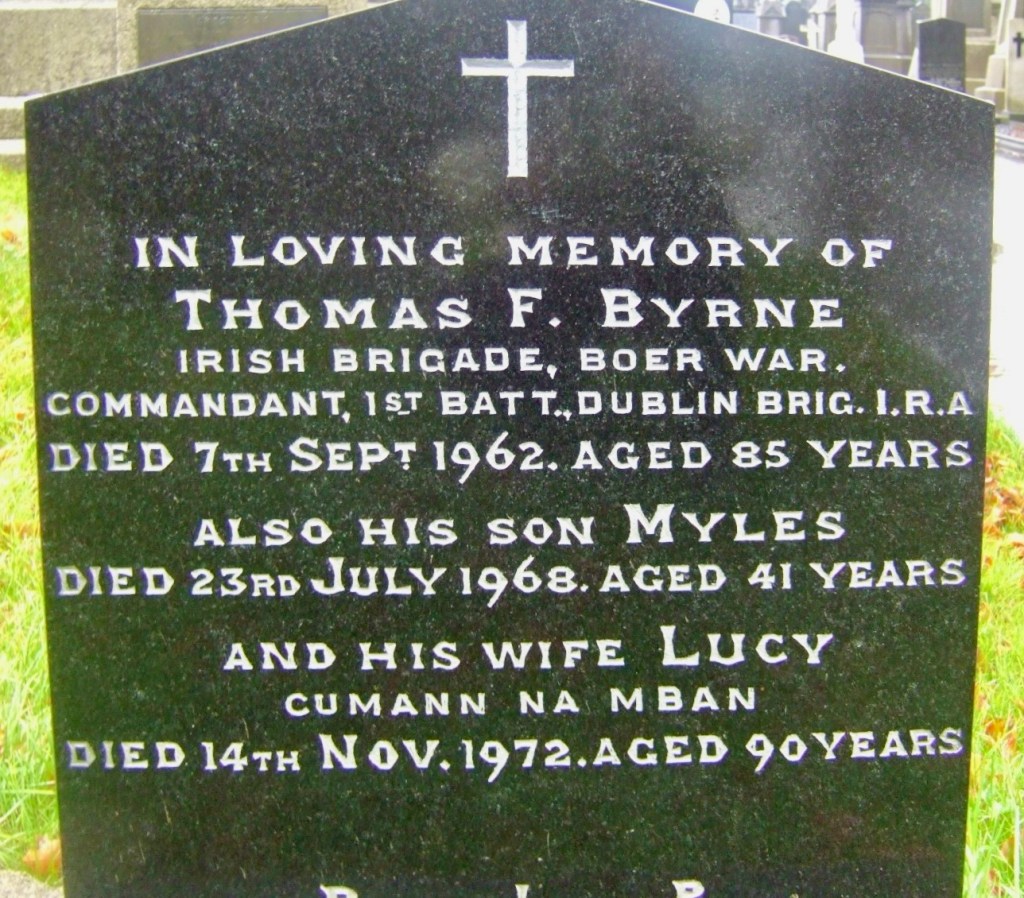
Lucy Agnes Smyth was generous and kind, but she also had a backbone of steel. She was eager to learn, steady under pressure, and she was an incredibly capable woman at a time when many would consider that a rare combination. Con Colbert, one of the men who would be executed for his role in Ireland’s Easter Rising, once called her “the nicest girl in Dublin.” He meant it as a compliment (which it was) but the phrase also undersells her considerably. Lucy Agnes Smyth was not simply nice. She was fluent in Irish at a time when speaking it was an act of cultural resistance. She was a proud member of Cumann na mBan and a trained nurse who ran toward danger rather than away from it when she showed up at the GPO during Easter Week in 1916 to care for the wounded long after many others had retreated. “Nice” doesn’t quite cover it.

What we know about Lucy’s early life tells us that she was shaped by an Ireland that was waking up to itself. The Gaelic Revival was not abstract to her but something she was immersed in from a young age. She loved the Irish language intensely, much like Ireland itself. When Cumann na mBan formed as a women’s Republican organization, Smyth brought her whole self to it, eventually becoming the group’s 1st Lieutenant. She earned those stripes in 1916. She risked her life multiple times during the Easter Rising, carrying arms out of a house that was about to be raided, taking secret messages across the city, and eventually tending the wounded in the General Post Office headquarters. She was one of the women who kept the garrison running while the world outside was coming apart and when James Connolly was shot, she helped tend to his wounds.

One of the other men she looked after in the GPO was Tom Byrne, a Volunteer who would later become her husband. There is something quite extraordinary about that detail. In the middle of a revolution, in a building that would be rubble within days, two people briefly met and interacted, and from this meeting came an eventual marriage. At that moment though, there probably wasn’t any thought of love or weddings. Lucy was tending to the people who had been hurt and when Tom’s garrison arrived at headquarters after marching for days, Lucy gave him some warm water to soak his feet before moving on to care for all the others. It was a small act of kindness that he remembered. He remembered her too.

And then there was Con Colbert. He and Lucy had been close, close enough that many believed they would have married had he not been executed by the English. It was clear he thought of her before his death, since he asked Father O’Mahoney to help him deliver a large package to Smyth. Unfortunately, the parish priest handed the parcel off to another and Lucy never received it so we can only speculate about what he wanted her to have and how he truly felt about her. She had some letters from him that she shared with his sister, but as far as I can tell, Lucy did not speak publicly about her feelings for him even after he was gone. Instead, she threw herself back into her work with Cumann na mBan and remained very active in the organization through the Irish War for Independence and beyond. Cumann na mBan members like her were essential to the Republican movement though they’ve been largely written out of its official history. Lucy was part of that infrastructure of resistance and in 1919, years after she gave him some warm water for his feet, she married Tom Byrne. It seems that the revolution she had given herself to had also given her something back.

The newlywed pair continued fighting for Ireland and each of them ended up imprisoned at various times for their continued roles in that struggle. Both were commended for their service with medals and honors. They went on to have many children, though some of their kids’ lives were tragically cut short. Despite the hardship, the tragedy of losing a child or two, the separations, and everything else life had thrown at her, Lucy remained kind and committed to both her family and to Ireland, proving what Con Colbert had said about her years before was probably right-she was the nicest girl in Dublin…but I suspect that she was nice in the way that a river is nice: refreshing and pleasant on the surface but absolutely fierce and unstoppable underneath.

Lucy Agnes Smyth Byrne passed away on this day in 1972. She is buried in Glasnevin cemetery with her husband and son.
A Perfume Bottle and Some Rope: The Mountjoy Escape of 1921

A small perfume bottle sailed over the wall of Mountjoy Prison in Dublin on Oct. 30th, 1921. Was it caught on the other side? Did it shatter when it hit the ground? We only know one thing about it once it was thrown. It was a signal. Within minutes, a rope ladder appeared where the bottle went over and four Irish Republican women were there to make good use of it. They climbed one by one out of Ireland’s notorious prison before vanishing into the city. It’s almost too perfect, like an unbelievable Hollywood movie, but that is pretty much the story of how this escape happened.

Linda Kearns was the first woman over the wall, partly because her health had been deteriorating in custody. She was a nurse from County Sligo who had used her medical skills to treat wounded IRA men during the War of Independence, often transporting men and arms under the cover of her work. She was arrested nearly a year before the escape while transporting arms, and imprisonment in Mountjoy had not been kind to her health. Aileen Keogh from County Carlow went second. May Burke from County Limerick third. Both of these women were members of Cumann na mBan who had been imprisoned after they were found with “revolutionary materials” according to the powers that be. Eithne Coyle, an activist from County Donegal went last which had to have been nerve-wracking. Imagine having to watch three others go before you, knowing that every extra minute increased the chance of your discovery and decreased your own chances of making it out. Coyle stayed calm though and managed to get herself over the wall as well. After all, these women were not accidental revolutionaries. They had been soldiers in their own right, aiding in the fight for Irish Freedom for years which is why their comrades in the Irish Republican Army were outside the walls, waiting to ferry them to safehouses all over the city.

The coordinated escape did not happen by luck. Communications were established with the IRA on the outside. Signals like the thrown perfume bottle were agreed upon. Devil’s Night, the night before Halloween, was chosen as the date of their escape. That night was perfect because the female prison population was involved in a football match that evening. Cork was set against the rest of Ireland and the rest of Ireland won, which meant the celebrations were particularly loud and enthusiastic, providing the perfect distraction for the women’s escape. They went to the appointed spot and threw the perfume bottle over the wall. When a rope ladder came back, they climbed out into freedom and no one noticed. The celebrations continued in the prison as the four women disappeared.

Kearns returned to active service as a nurse while also fundraising. She later became a politician and spent years fighting for women’s equality and the nursing profession. Keogh and Burke both returned to their units and were active members of the Republican forces throughout the Irish Civil War. Coyle would go on to become the National President of Cumann Na mBan and remained a staunch Irish Republican for the rest of her life.

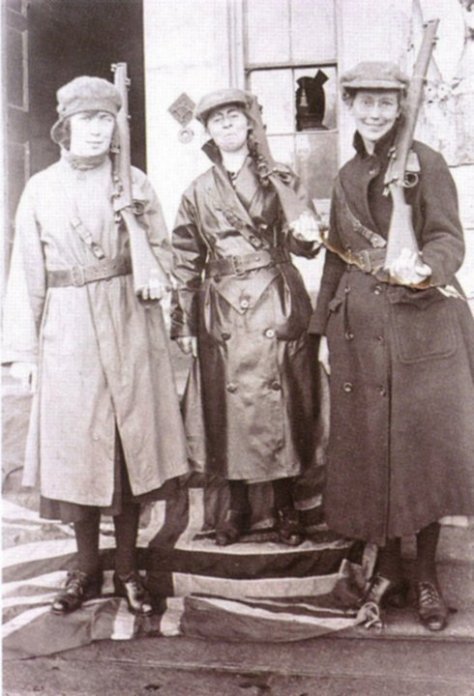
The Anglo-Irish Treaty would be signed just weeks after the women’s escape in December 1921, bringing a complicated and contested end to the Irish War of Independence but before that happened, the women were reunited briefly in an Irish Republican Army training camp in County Carlow. When they were there, three of them (May Burke, Eithne Coyle and Linda Kearns) were photographed holding rifles while standing on a British flag. This photograph became a massively popular piece of propaganda in the years to come. This escape from Mountjoy was not just a logistical success. It was a statement and to be flaunting their freedom with a picture like this? It was humiliating for their captors. Linda Kearns, Eithne Coyle, May Burke, and Aileen Keogh had refused to cooperate with or even acknowledge English authority at every stage, and their escape was their defiance made physical and irrefutable. It embarrassed the prison staff. It also demonstrated something that tends to get quietly edited out of history – that many women were not supporting the Irish revolution from the sidelines and they didn’t watch it from the safety of their homes. They were in it fully. These four women were imprisoned for their various roles and as soon as the opportunity came, they climbed over the wall and went right back to fighting for the cause.

They may or may not have stayed in touch with each other in the following years, but on Devil’s Night in 1921, these four women worked together as a cohesive unit to escape Mountjoy, giving a group middle finger to England and showering the authorities in humiliation and bad press. So on this Devil’s night 105 years later, let’s get inspired by them. Their fighting spirit was never suppressed by what the world threw at them or by the authorities that tried and failed to contain them. I think celebrating that kind of defiance is especially important today.

Keep your chins (and your fists) up and never let the fash keep you down.

The Mighty Margaret Skinnider

When you listen to or read accounts (including my own) of Margaret Skinnider’s life it’s immediately clear that she was a fighter and a warrior. She was brave and devoted to Irish freedom. She was gravely wounded in the Easter Rising but somehow survived her injuries to continue fighting for Ireland, for recognition and pensions for women, and for Irish workers for the next five decades or so. Her fierceness has inspired many and we’ve all rushed to applaud Skinnider’s fighting spirit, using it to highlight and recognize the important (and often atypical) roles that Irish women played throughout history.

It’s pretty common knowledge that Margaret Skinnider was a teacher, a revolutionary, a union boss, a devoted suffragist, a deadly sniper, a commanding officer, an explosives expert, a smuggler and so much more. We’re used to seeing her as a dedicated, cross-dressing, sharp shooting freedom fighter so it might be a little jarring to hear one of her best friends say that Skinnider was love and kindness incarnate and that she was gentle. Sure she was a soldier who spent most of her life fighting for one cause or another but she was also full of empathy and love, kindness and compassion – and many of the historical narratives (including my own) overlook those aspects of Skinnider’s life.

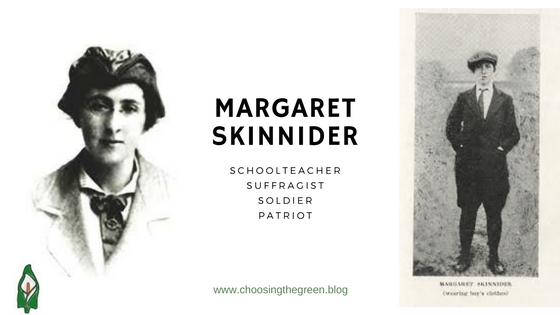
This is part of a bigger problem. In our rush to make sure that women are counted among the heroes of history, we often highlight only the fiercest and more traditionally “male” aspects of them. We tell tales of how they outsmarted others and how they aggressively fought for something and proved themselves worthy of remembrance and praise. We often ignore their traditionally “feminine” sides in favor of a glorious and heroic tale. The famous photo of Margaret dressed as a boy with a cigarette dangling out of her mouth is a perfect example of that. We remind people that that she was a female sniper and one of only two women who wore a soldier’s uniform during the Easter Rising, and we set her apart from the hundreds of other women who were there in their Easter skirts and dresses. There were many other brave women on active duty and they each brought their own fighting spirit and individual set of skills…some of them even saved Skinnider’s life after she’d been shot multiple times. These women are just as worthy of remembrance whether we know their names and stories yet or not, even if they had more traditional roles. Margaret’s exciting and unusual tale has become more popular in recent years but in telling it we’ve done her a disservice. We’ve all celebrated her deeds but most of us ignored the other aspects of her life. It’s less common knowledge that Skinnider was as gentle, loyal and loving as she was aggressive. She lived a long life full of love, music and long lasting friendships. Her favorite song about Ireland was a somewhat sappy love song called The Jackets Green. She was a lesbian in a committed and life long relationship in an era when that was not only frowned upon, but illegal. Mary McAuliffe’s newish book about Margaret Skinnider uncovers that love story and much more. It is an overdue biography that focuses on Skinnider’s life as a whole, rather than highlighting one or two of her legendary acts. It gives our inspiring hero her entire life back, long after she passed away.

Which brings us to the point, dear readers. On this day in 1971, the mighty Margaret Skinnider threw off this mortal coil. She is buried in the Republican 1916 plot at Glasnevin Cemetery, where she rests next to many of her dearest friends and comrades. To remember her today, why not listen to this interview with Mary McAuliffe where she talks about some of the lesser known aspects of Skinnider’s life or you can listen to Margaret tell her own story of Easter week right here. If you’re like me and you still haven’t been able to break up with the written word, you can find Skinnider’s own 1917 propaganda masterpiece, Doing My Bit For Ireland in various places on the web and in bookstores throughout Ireland. While you’re at it keep an eye out for Margaret Skinnider by Mary McAuliffe as well.

The Mighty Anne Devlin

There are so many important women in Irish history that I could work the rest of my life (which I probably will) and not get to them all. That said, Anne Devlin is the one who started it all. Without Anne I may never have had the jump start I needed to begin writing again. I may never have started a blog and certainly would not have written a book. But it’s not all about me – without Anne Devlin, numerous rebellions in Ireland could have been compromised. Important uprisings would not have happened. Patriots would most certainly have been jailed or killed. Her fortitude and silence against all odds and various forms of torture probably saved thousands of lives, though it cost her dearly.

On this day in herstory, Anne Devlin Campbell passed away – long after her incarceration in one of the most notorious dungeons and prisons in Ireland. It’s amazing that she lived so long given her brutal treatment there. She was an elderly, broke washerwoman living in relative obscurity when she died, but she was never broken. This is some of her tale that I wrote and continue to repost every year in remembrance of this powerful woman.

Continue reading →

Maura Meehan and Dorothy Maguire

In the wee hours of the morning of October 23rd, 1971, the British Army rolled into the Falls area of Belfast with the intention of raiding houses and arresting anyone they suspected of criminal or “dissident” activities. It was a regular occurrence in the area and the residents had various ways of warning each other when the army was around. Runners would spread the word ahead of the vehicles and the Women’s Action Committee (WAC) would bang trash bin lids on the streets as an early alarm system. Sometimes people would blow whistles or sound horns from their cars as well which was exactly what two sisters, Maura Meehan and Dorothy Maguire, left a party to do on that early Autumn morning. When one of Meehan’s children asked where she was headed she told him that she’d be right back, as she grabbed a handheld horn and headed to a car outside. These words were the last she ever spoke to her family.

Continue reading →

Anne Devlin

There are many, many women in Irish history who never get the recognition they deserve for their contributions to it. Anne Devlin may be the most egregious example of that. Her strength and dedication to the Irish cause was truly like no other.

Continue reading →

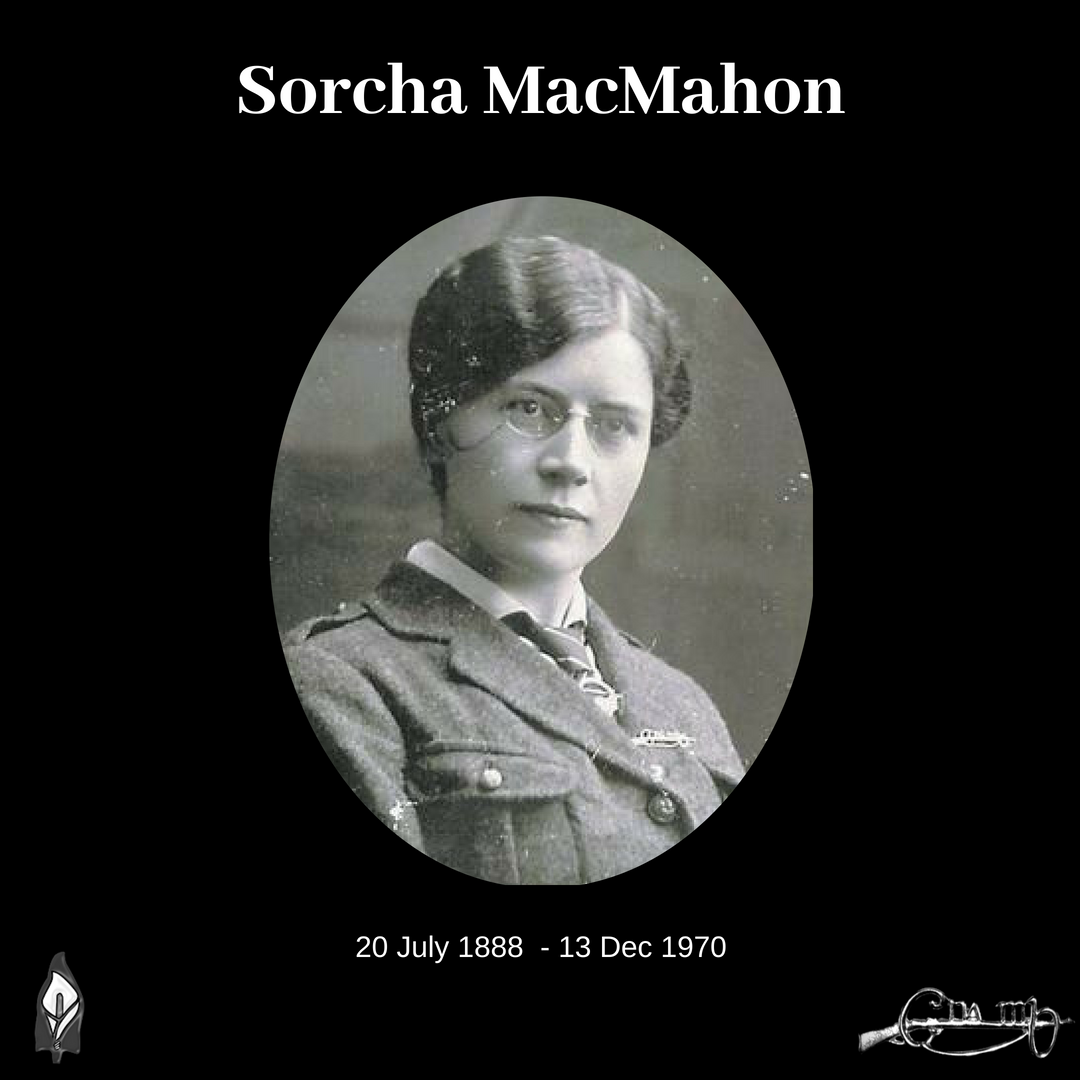
Sorcha MacMahon is Born

Sorcha MacMahon was born on this day in 1888 and was one of seven children. Unlike many who had to learn the Irish Language later in life through private instruction or the Gaelic League, Sorcha was raised speaking it. Irish was the family’s first and preferred language and she was more than fluent in it at an early age. When she finished school, she left the family home in Monaghan and headed for Dublin where she began working as a bookkeeper. She also worked for the central branch of Cumann na mBan, a women’s organization dedicated to Irish independence. She was the group’s secretary and she was trained in nursing and first aid – skills that she passed on to many of the other women. Many said that she was one of the most efficient and devoted members of the group.

Sorcha MacMahon

Her dedication to Irish independence led Sorcha straight into the Easter Rising of 1916 and when it was over, she took a position that had her working directly with Michael Collins for years. For more about this brave woman, please CLICK HERE.

Fantasy Island

Everyone has that place in their head. One place that they’ve fallen in love with whether or not they’ve ever been there. One place that serves as a goal or a dream and becomes a fantasy location where everything would suddenly be perfect. Many never reach that imagined place or if they do, they quickly find that the perceived nirvana in their head doesn’t match the reality in any way. We often romanticize or fantasize about other places because after all, the grass is always greener on the other side.

Continue reading →

The mighty Margaret Skinnider

On the third day of Ireland’s Easter Rising, a woman got off her bicycle at St. Stephen’s Green and delivered the message she’d been hiding to the rebel leaders inside. Then she took off her skirts, put on a homemade uniform, picked up a rifle and headed to the roof of the building to take her turn as a deadly sniper. In between shots, Margaret Skinnider formed a plan for a bombing mission that would make the area safer for her comrades and fellow rebels.

Attempting to execute that plan nearly killed her when Ms. Skinnider was shot three times on this day in 1916. Her grave wounds earned her the distinction of being the only woman who was so seriously wounded in the rebellion and it cemented her place in Irish history. You cannot have a project that involves women in the Easter Rising without including Margaret’s near death experience so today belongs to her.

Continue reading →

The garden shot

On the second day of the Easter Rising, Kathleen Clarke fretted and wandered around the house, wondering how her husband Tom was doing. He was one of the leaders of the insurrection and was in the General Post Office headquarters with the other commanders, miles away from his wife. Kathleen had been asked to stay out of the fight by her husband who was counting on her to keep their business going, their family healthy, and if necessary, to protect his legacy when the Rising was over. She couldn’t do any of that if she took part in the battle and was arrested or hurt – so as unbearable as it must have been for her, she stayed at home.

Miraculously, the Clarke home wasn’t raided or attacked in any way on the first night of the rebellion. Kathleen spent a restless night in her home and then headed out to the garden in the morning to distract herself from what was happening around her. Planting and tending the garden was one of her favorite hobbies. April 25th, 1916, was a warm day and the ground was parched so she took a can of water with her when she started planting. Kathleen had just put it on the ground when she heard a hissing sound and her instincts kicked in. She ducked and remained still for quite some time. When she finally got up, she looked around to see what had made the sound. The bucket she had been holding seconds before had two bullet holes in it and the water was seeping onto the ground.

The Clarke house was not in the thick of the fighting but there were a lot of bullets flying throughout Dublin that week. In theory one of them could have randomly gone through the backyard at precisely that moment…but many (including the lady herself) think that Kathleen Clarke was deliberately targeted because of her husband’s actions and her own support for a free Ireland. She never found out whether she had been purposely fired on or not – but her own brush with death over Easter week did not stop her from accomplishing all of the plans she and her husband had made before it began. She immediately started a fund for the dependents of Volunteers and she kept her own family afloat, even after the English executed her husband for his role in the Rising. Easter Week cost her a child, a husband, and nearly her own life but she refused to let these losses cripple her and she never wavered in her support and her own fight for a free and independent Ireland.