If you somehow knew who Adolph Hitler would become and what he would do, would you murder him before he could do his damage? This rhetorical question is asked by personality tests, psychologists, and Philosophy professors all the time to gauge the morality of their subjects. Many otherwise peaceful people have quickly answered yes. So then the quandary becomes about where the boundary lies and when we become OK with murder or assassination. When you use someone as horrible as Hitler, the odds are guaranteed to have an emotional and reactionary response. When taken out of the hypothetical realm, odds are that most people would say they are against preemptive murder, no matter what the circumstances are. There are laws against that kind of thing in almost every civilized nation – including Britain – but on this day in 1988, British soldiers ignored them.
Continue reading
Tag Archives: The Troubles
Remembering Máire Drumm
And now for a different Máire. Máire Drumm was born into a staunchly Republican family. She was lucky enough to have had a mother who was active in the War for Independence and the Irish Civil War, so the concept of strong women who could fight and lead was instilled in her from birth. Perhaps it was also the reason she knew she could grow up to be a commander in Cumann Na mBan and the Vice President of Sinn Fein. She settled in Belfast in 1942 and began fighting on behalf of Republican prisoners, which she did for many years to come. It was in this role that she met Jimmy Drumm, a Republican prisoner who would later become her husband.
A very important question
Peter Taylor has been extensively covering the Troubles and their aftermath for decades. In his new and fascinating report, he asks, Who Won the War? Who indeed…
It’s amazing how much can change, and how little truly does over the course of a lifetime. If you have the time and the inclination, this is worth a watch.
The Holy Cross Blockade
The beginning of September is a nightmare for parents. They say that getting their kids ready for learning and getting back into the swing of the school year is always the hardest during the first week. There’s a lot of pressure already on everyone. So what happens when an actual battle is being waged every day on top of that and your little girls are being attacked? Well, everything and everyone explodes – just ask the people in the area of Ardoyne, near the interface.
Operation Banner launched, 1969
Operation Banner is the official name for the nearly forty years that the British Army was officially deployed in the North of Ireland. It was launched on this day in 1969, in part because of the Battle of the Bogside and the riots and protests that it set off in the rest of the north.
It was clear that the Royal Ulster Constabulary could not handle (and did not tolerate) the rising voices of the Civil Rights movement, nor could it control the protests and riots that unfolded during that time. The civil unrest was made worse by the obvious bias that the RUC had against Catholics, Nationalists, and Republicans. Originally those communities welcomed the Army, thinking the soldiers would be more impartial and supportive. It soon became apparent that was not the case and as the British Army paired up with the RUC, a gradual souring took place within the community. This led to an uptick in those willing to fight against them and the enrollment in the Irish Republican Army and other paramilitary groups boomed.
Battle of the Bogside Begins, 1969
45 years ago the Nationalist people in the Bogside area of Derry began a legendary fight with the British authorities that is widely regarded as one of the first events of the Troubles in the North of Ireland. The violence, rioting and battle began on August 12th, 1969 and was ignited by an ill-conceived decision to allow the Apprentice Boys to parade near the Nationalist and Catholic areas of Derry.
The authorities saw no reason to stop the oppressive parade that had been happening annually for years. What made this year different than others though was the political climate, which they were not in the habit of paying attention to. The Civil Rights movement was gaining traction all over the North and had led to many skirmishes in Derry already that year. The level of dissatisfaction in the Catholic and Nationalist areas including the Bogside, was already palpable and growing stronger every day. In 1969, Catholics made up more of the population than any others but the Protestant Minority still held all the key positions in government and power so they had no recourse for injustices they faced. Many flooded into the civil rights movement in order to have a voice – and those voices were getting stronger and stronger, despite being ignored by the leadership of the city.
It was under this kind of tension that the parade was not only allowed to happen, but it was going to happen right in their faces. It was the spark that sent the Bogside over the edge. In the days leading up to the parade, many attempts were made within the area to keep residents calm and a request was sent to the Apprentice Boys and the government to either cancel or to reroute the march. The plea was refused and the attempts for calm became plans for defensive maneuvers.
Continue reading
Operation Demetrius
It sounds like a mysterious and enticing thing, Operation Demetrius, so grand…like a top secret cocktail party or a James Bond tryst. It wasn’t – it was just a pretty name for a terrible thing that caused all kinds of problems. It’s better known as Internment and the British introduced it to Northern Ireland on this day in 1971.
The arrests began around 4AM. Witnesses report brutality, abuse, and unnecessary destruction by the police while they searched for their suspects. Other than damage to their homes, the police brought damage to their bodies as well, strapping some to armored vehicles as human shields and wielding batons and other weapons even when they were not resisting. Those arrested were subjected to sleep deprivation, starvation, forced nudity, burns and other forms of torture, all of which were sanctioned by the British government.
Continue reading
The Irish Origin of Rubber Bullets
Ireland is famous for many things. Rolling green hills and natural beauty, monolithic tombs, castles, faeries and lore, wool, turf, and whiskey are just the first that come to mind. But it has many more dubious claims to fame as well – and one of those is the notorious rubber bullet.
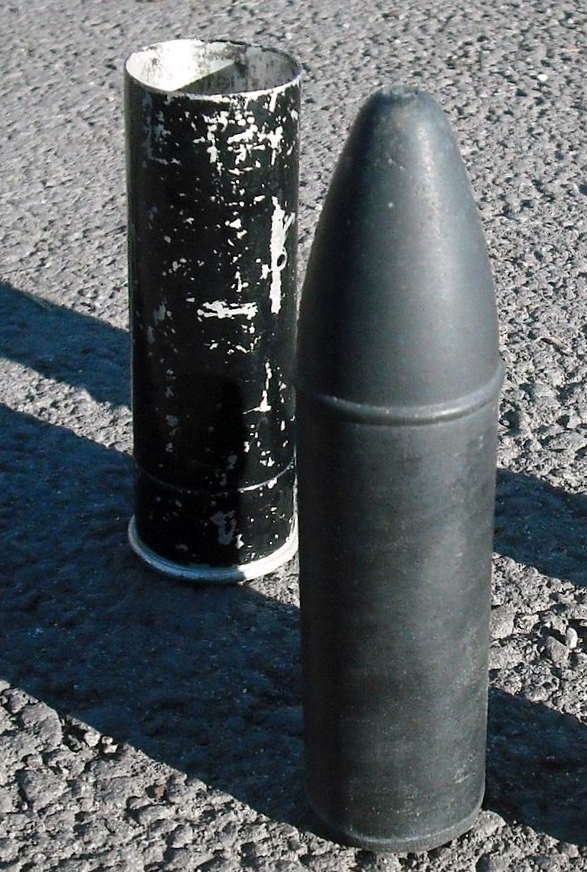
The rubber bullet
This little guy was designed by the British government specifically for use in Northern Ireland as a crowd control tool against rioters. Those pesky people who wanted civil rights were causing problems and just wouldn’t stop. Because the British soldiers had fired on them numerous times and caused a significant number of deaths in the region, the government decided to give them a different option. They unveiled these totally better, non-lethal rounds (eye roll) so that they could hurt people but not kill them. The rounds were created to cause scars and pain, but in theory, they would not cause death. They were used for the first time on August 2nd, 1970.
Miami Showband Massacre
Throughout history there are not many instances that one can absolutely prove that a horrible crime was just a part of a scheme that would have led to something much, much worse. The Miami Showband killings in Ireland is one of those times and it is an appalling lesson of just how brutal and insane the Troubles could get. It is also a clear cut example of how involved the authorities were in some of the most heinous crimes of the era.
Showbands were quite a popular phenomenon in Ireland. The uniqueness of the showband was documented in the film “The Commitments” which was popular throughout the world. These bands usually had five to ten members and were loved for playing showtunes, pop music, jazz and down home rock n roll greats. Many played the favorite traditional tunes of the area as well and they were extremely popular from the 50s right up until the mid-seventies. It’s amazing how quickly attendance and participation waned when one was targeted so ruthlessly by the paramilitaries of the UVF. Continue reading
Gerry Conlon R.I.P.
Gerry Conlon may be the single most influential person when it comes to who got me into studying Irish politics. The Guildford Four case was riveting for me and it showed just how cruel and scared absolutely everyone was in the heart of the conflict known colloquially as the Troubles. His case was a close second to the Easter Rising of 1916 in my favorite stories of tragic Irish triumph.
On June 21st, 2014 at 4AM California time, I found out that Gerry Conlon had passed away and I actually shed a tear. This marked the first time I cried over a celebrity passing away since Johnny Cash, and I am pretty sure that it only happened those two times. I was heartbroken and I almost got up then to write about it but I wasn’t awake enough to articulate the utter sadness of this news.
For those that may not know his story, early in 1975, Gerry Conlon and three other young adults were arrested in connection to the IRA bombing of the Guildford Pub. Despite having nothing to do with the IRA or the bombings, they were convicted and sentenced to life in prison…thankfully, since if they’d been sentenced to death, they all would have been dead before their convictions were quashed. Before they were eventually released, another seven innocent people were convicted of aiding them in this incident – including many of Conlon’s family members and his father, Giuseppe Conlon. Guiseppe never strayed from proclaiming his innocence and he remained hopeful that the miscarriage of justice would be overturned, but Gerry did not. Gerry did not have the fortitude of belief of his father.
Guiseppe Conlon died in prison an innocent man. Years and years later, his son – who found the fighter in himself shortly after the tragic death of his dad, eventually walked out of the courthouse through the front door over fifteen years later when his conviction was quashed, proving to the world that the Guildford Four and the Maguire Seven had been wrongly convicted. The blockbuster movie “In the Name of the Father” was based on these real life events and is an amazing film. If you haven’t seen it, go find it now. Seriously. It took over fifteen years for the police to admit they had made mistakes and purposefully suppressed evidence in order to convict these men and women…none of whom fit any profile or had any paramilitary or political ties.
I was sixteen when they released Gerry and I remember seeing the footage of him leaving the courthouse. It was one of my first forays into Irish politics – and it was a story that led to another, to another, and to another. More than twenty-five years later, I can point to Gerry Conlon as one of the reasons that I fell in love with Irish history. His story had a profound effect on my psyche. Unfortunately his story does not have the Hollywood ending that he so deserved. He struggled with depression, suicide, and addiction since the day he was finally released – and really, who wouldn’t? I cannot find fault in the need to try to erase what has happened to you and your family in whatever way you can. Still, Conlon made it to sixty years of age and was a published author and an activist in other cases that he felt were rigged or unfair. He died on this day in 2014 in Belfast and even now I am still a little teary as I write those words. I wish I had met him – it actually was a thing I had hoped to do someday – just to tell him what a profound impact his story had on shaping who I am and what my interests are. Sixty is too young for many but for Gerry Conlon it was a pretty amazing feat, given that he spent over 15 of them wrongly convicted in the harshest prisons.
His family says it better than anyone else could. In a statement issued through his lawyer Gareth Peirce, they said: “He brought life, love, intelligence, wit and strength to our family through its darkest hours. He helped us to survive what we were not meant to survive. We thank him for his life and we thank all his many friends for their love.”
Rest in Peace Mr. Conlon. Your story and your fight will forever be inspiring and triumphant. I am sorry you lived it and I am thankful for the impact it had on me. I hope you see your father again.
 Choosing the Green
You must be logged in to post a comment.