Lucy Agnes Smyth was generous and kind, but she also had a backbone of steel. She was eager to learn, steady under pressure, and she was an incredibly capable woman at a time when many would consider that a rare combination. Con Colbert, one of the men who would be executed for his role in Ireland’s Easter Rising, once called her “the nicest girl in Dublin.” He meant it as a compliment (which it was) but the phrase also undersells her considerably. Lucy Agnes Smyth was not simply nice. She was fluent in Irish at a time when speaking it was an act of cultural resistance. She was a proud member of Cumann na mBan and a trained nurse who ran toward danger rather than away from it when she showed up at the GPO during Easter Week in 1916 to care for the wounded long after many others had retreated. “Nice” doesn’t quite cover it.
What we know about Lucy’s early life tells us that she was shaped by an Ireland that was waking up to itself. The Gaelic Revival was not abstract to her but something she was immersed in from a young age. She loved the Irish language intensely, much like Ireland itself. When Cumann na mBan formed as a women’s Republican organization, Smyth brought her whole self to it, eventually becoming the group’s 1st Lieutenant. She earned those stripes in 1916. She risked her life multiple times during the Easter Rising, carrying arms out of a house that was about to be raided, taking secret messages across the city, and eventually tending the wounded in the General Post Office headquarters. She was one of the women who kept the garrison running while the world outside was coming apart and when James Connolly was shot, she helped tend to his wounds.
One of the other men she looked after in the GPO was Tom Byrne, a Volunteer who would later become her husband. There is something quite extraordinary about that detail. In the middle of a revolution, in a building that would be rubble within days, two people briefly met and interacted, and from this meeting came an eventual marriage. At that moment though, there probably wasn’t any thought of love or weddings. Lucy was tending to the people who had been hurt and when Tom’s garrison arrived at headquarters after marching for days, Lucy gave him some warm water to soak his feet before moving on to care for all the others. It was a small act of kindness that he remembered. He remembered her too.
And then there was Con Colbert. He and Lucy had been close, close enough that many believed they would have married had he not been executed by the English. It was clear he thought of her before his death, since he asked Father O’Mahoney to help him deliver a large package to Smyth. Unfortunately, the parish priest handed the parcel off to another and Lucy never received it so we can only speculate about what he wanted her to have and how he truly felt about her. She had some letters from him that she shared with his sister, but as far as I can tell, Lucy did not speak publicly about her feelings for him even after he was gone. Instead, she threw herself back into her work with Cumann na mBan and remained very active in the organization through the Irish War for Independence and beyond. Cumann na mBan members like her were essential to the Republican movement though they’ve been largely written out of its official history. Lucy was part of that infrastructure of resistance and in 1919, years after she gave him some warm water for his feet, she married Tom Byrne. It seems that the revolution she had given herself to had also given her something back.
The newlywed pair continued fighting for Ireland and each of them ended up imprisoned at various times for their continued roles in that struggle. Both were commended for their service with medals and honors. They went on to have many children, though some of their kids’ lives were tragically cut short. Despite the hardship, the tragedy of losing a child or two, the separations, and everything else life had thrown at her, Lucy remained kind and committed to both her family and to Ireland, proving what Con Colbert had said about her years before was probably right-she was the nicest girl in Dublin…but I suspect that she was nice in the way that a river is nice: refreshing and pleasant on the surface but absolutely fierce and unstoppable underneath.
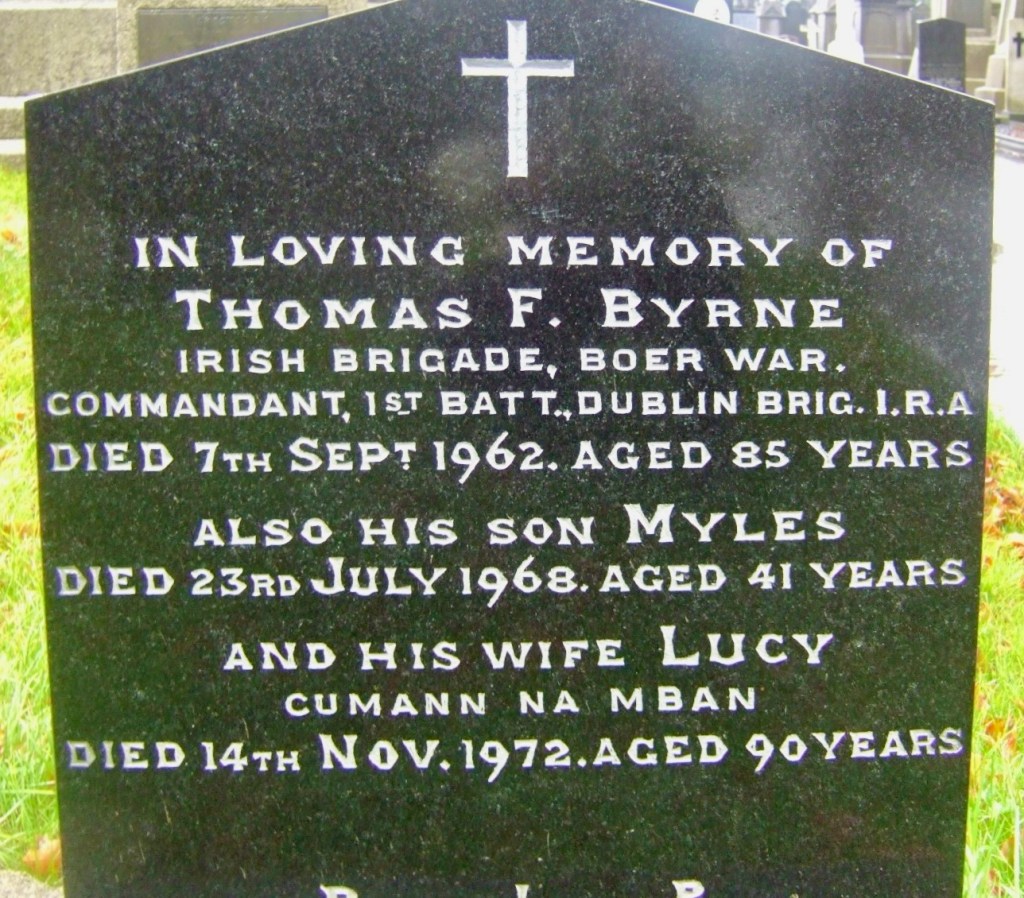
Lucy Agnes Smyth Byrne passed away on this day in 1972. She is buried in Glasnevin cemetery with her husband and son.


You must be logged in to post a comment.