On this day in 1953, theatre owners and cinema houses all across Dublin unanimously decided against showing the Queen of England’s coronation film. It was not illegal to show it – in fact, there were at least a few places other than the theatres that quietly held secret viewing parties, but the mainstream movie houses were more concerned with staying in business and staying upright than they were with viewing or celebrating Queen Elizabeth’s pomp.
Category Archives: Irish History
Some little treats about James Connolly
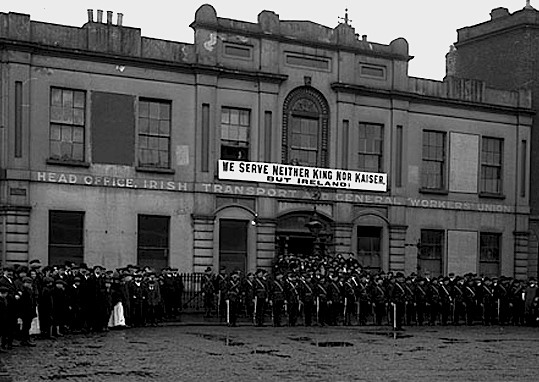
On June 5th, 147 years ago, James Connolly was born. Although he later became an Irish symbol of Republicanism, he was not born in Ireland – and in many ways, he did not fit in the Republican movement. He was born in Scotland and was a devout socialist who was profoundly engaged in the causes of Labor and Equality first and foremost. He was certainly an enemy of the state and an energetic agitator, but many of the tenets he adhered to and espoused, were not quite in line with his partners in the Irish Republican Brotherhood.
Since today is his birthday, here are some little things that you may or may not know about Mr. James Connolly.
Margaret Skinnider
Margaret Skinnider was a woman like no other, and I take every opportunity that I can to write about her. She is one of my biggest heroes – not just because she was a warrior and an intellectual but also because she was humble and quick. Without her contributions, many aspects of the Easter Rising may never have come to fruition but because she was not born in Ireland and she was a woman, it has been very hard to find anyone who gives her the full recognition she deserves in the history of the Rising.
64 Women

The number of women arrested and questioned in 1916 for their roles in the Easter Rising up until today, 99 years ago, was 64. The paper published their names a week later on the 29th of May, and many believed this number to be the total number of women involved. They could not have been more wrong.
In all, over 200 women are known to have been involved in the Dublin Uprising. More than half are not included on this list – and many more have been lost in time – leaving some to believe that even the higher estimates are lower than they should be. Since many of the documented women are often ignored anyway, we may never have an accurate number altogether but at least there are a few pieces of hard evidence of their involvement, including this tiny clipped article.
In the years leading up to the Centenary celebration, many books and documentaries have made a decent effort to include and acknowledge the female fighters of 1916. I hope they will continue to highlight the women’s fight both for Ireland and for the recognition they deserve in the aftermath. Cheers ladies.
Learn Something!!

‘Irish Lives in War and Revolution: Exploring Ireland’s History 1912-1923‘ was the name of the online class that I just completed thanks to the partnership between Trinity College and Futurelearn. It certainly lived up to its title, but not in the way I expected. Gone were the heroic tales of Patrick Pearse, Constance Markievicz, or Michael Collins. In their places were the voices, letters, and stories of the average person, struggling to get through his or her life in Ireland during periods of protracted conflict. It featured soldiers and volunteers pretty equally and it was really well constructed. I had a fascinating six weeks and I can’t even begin to tell you how much inspiration it gave me or how many historical events have a new twist (or ten) to think about after taking the course. Thousands of people worldwide took this class online, so I guess the first thing that must be said is way to go Ireland – people like you! And the next is a huge thank you to the teachers, mentors and researchers because this class was really enjoyable and educational.
James Connolly’s execution

On this day, 99 years ago, James Connolly was executed by the English for his role in the Easter Rising of 1916 and his death caused anger to explode all over Ireland. This is not to say that the death of Sean MacDiarmada who was executed on this day as well for the same reasons, was any lesser of a sore point to be mad or upset about, or that any executions before them were either. In fact, the decision to kill the leaders after secret trials still haunts the British to this day. It is only the fact that James Connolly was driven to his death in Kalmainham Gaol by ambulance and shot after being tied to a chair that makes his execution any different from the other leaders.
Bobby Sands, MP

“They have nothing in the whole imperial arsenal that can break the spirit of one Irishman who doesn’t want to be broken”
– Bobby Sands.
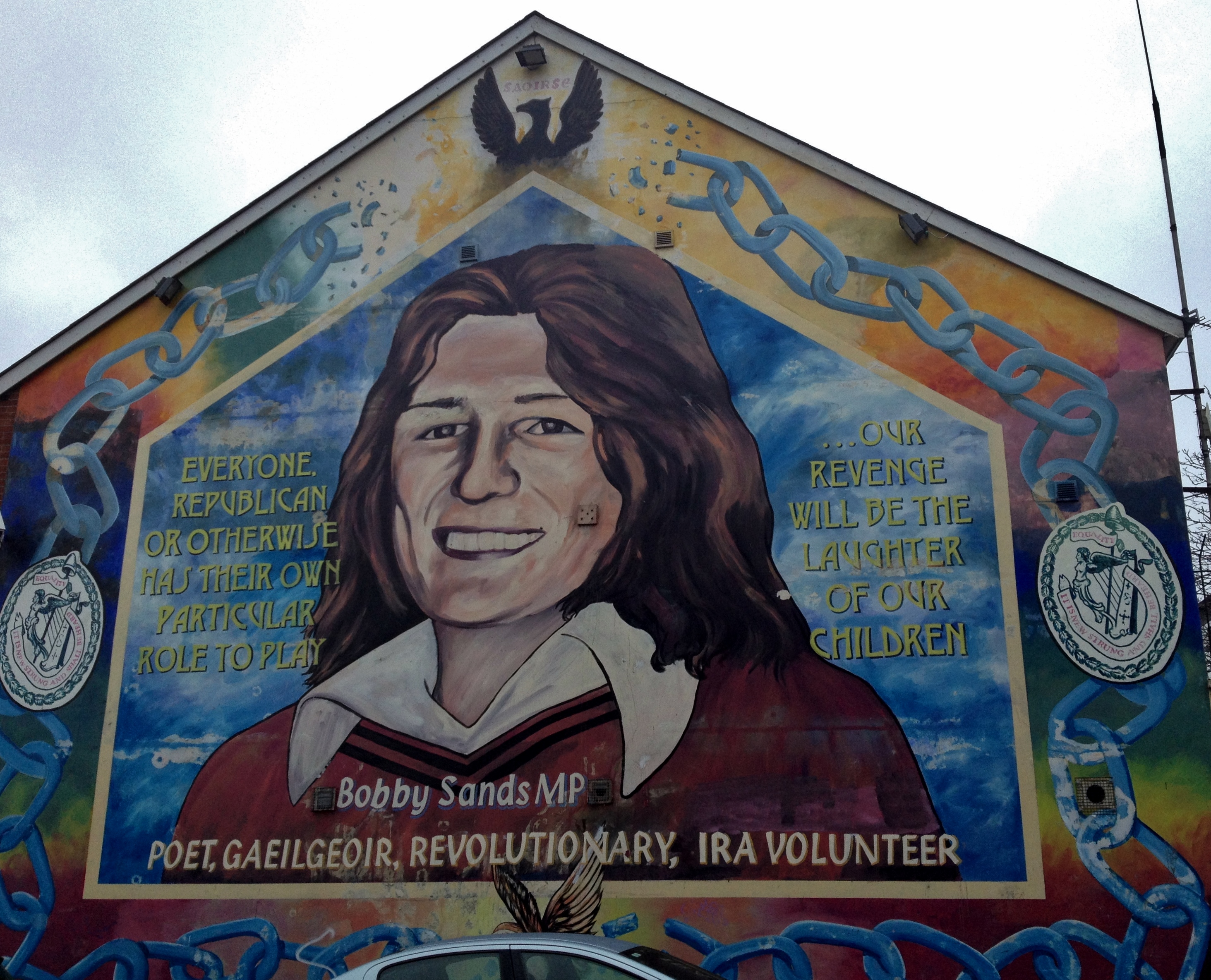
Bobby’s smile. Belfast, 12/12/13
Bobby Sands was elected MP while languishing in prison on hunger strike. His newly elected position did not save him from death. He died 34 years ago today on the H blocks in the Maze. His funeral was attended by over 100,000 people and was seen worldwide, sparking international protests against the British government in other countries as well as Ireland. Countless stories, movies, and songs have been inspired by his life, and he remains an icon of Ireland to this day. Here’s a wonderful example of the music inspired by him from the great Black 47. Rest in peace, Bobby.
The executions begin

On this day, 99 years ago, the fateful decision to execute the leaders of the 1916 Easter Rising in Ireland came to fruition. The men were taken from their cells and killed for their role in the uprising during Easter week. The signatories of the new Irish Proclamation had anticipated their deaths since before the Rising began – and while it’s probably not accurate to say they longed for them, they did know that their executions would galvanize many people in Ireland.
The executions began on May 3rd and the last was three months later. By August 3rd when Roger Casement was hanged outside of Ireland’s borders, 16 men had been executed for their roles in the uprising.
he signatories were shot in the yard at Kilmainham Gaol in Dublin. Today a cross marks the spot where they were killed and ironically, the Gaol now houses a museum dedicated to many Irish Nationalists and Republicans who were once killed or jailed there. It is a booming tourist destination.

The Cost of the Rising
As my commemoration of the 1916 Easter Rising closes out for the year, I feel that it is important to acknowledge that this conflict, like any other, had a downside. Many Irish people suffered unimaginable pain and loss because of the death and destruction that rained down on Dublin during that fateful week. There’s no real way to discern how many lives were touched by the dark side of revolution nor is it possible to gauge how long that devastation lasts. We can look at statistics and see numbers of injuries, buildings lost, and fatalities – but they do not tell us how many left Dublin or Ireland altogether because of those things, or how many families are still touched by the loss, pain, or injuries of their ancestors.
What we do know is that over 425 people died in the rising (not including the executions of the leaders) and 38 of them were children. Another thousand more were injured. More than half off these injuries and deaths were innocent bystanders and civilians. 179 buildings were damaged beyond repair or utterly razed. One hundred thousand people – roughly a third of the entire population – were given assistance in the aftermath of the conflict.
The Foreign Fighters of 1916
Now that some of the Women of 1916 have been highlighted, it’s time to move on to another group that has been largely left out of the history books when it comes to The Easter Rising. Many brave rebels are celebrated throughout the world every year at this time…but what is ignored by most is that the fighters were not exclusively Irish. There were more than a hundred foreign soldiers who assisted in the Rising and while some were 2nd or 3rd generation Irish there were others who had no Irish blood whatsoever. They came from all over Europe and the rest of the world to join forces against the English and were some of the fiercest warriors in the conflict.
 Choosing the Green
You must be logged in to post a comment.