The Peace Flame

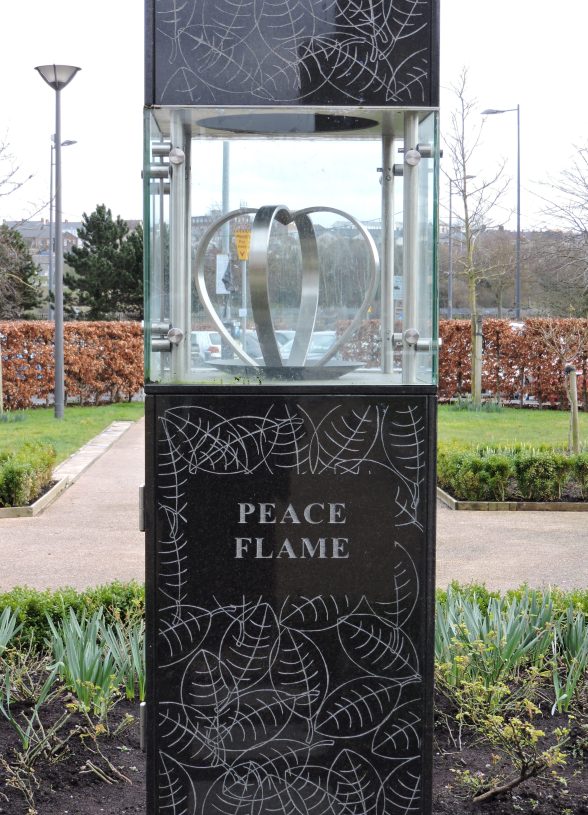
Glass enclosed sculpture on black pillar that says the words Peace Flame

Derry is a city that knows what it means to burn.

In August 1969, the Battle of the Bogside transformed the city’s streets into a war zone. Petrol bombs flew through the air. CS gas filled the alleyways. Those three days of violence marked the beginning of a conflict that would claim over 3,500 lives across the North of Ireland. Over the next few years, civil rights activists began a long campaign against the gerrymandering in the region and the discrimination against Catholics. Organizers looked across the ocean for inspiration. They saw the marches in Selma in the United States. They heard Martin Luther King Jr. speak of justice and nonviolent resistance. The movement in Derry borrowed that language deliberately, because it fit. Derry’s Catholics faced discrimination in housing, employment, and voting rights, similar to what African Americans were facing in the US. The parallels were not metaphorical. They were structural and intentional.

On Jan. 30th, 1972 a large civil rights march made its way through Derry. English soldiers opened fire on the unarmed protestors, killing 14 innocent people and injuring many more. The Crown defended the killings adding to the injustice and radicalization of the city. Calls for both violence and peace rose, each shouting louder than the one before. Derry was an open wound, full of trauma, anger, and fear for decades to come.

That history is embedded in the city to this day. It lives in the murals of the Bogside, in the names on memorials and walls, on the gravestones of the city cemetery, and in the hearts of all who call it home. This is why a symbol of peace in the town carries such weight. The Peace Flame is in the center of a purpose-made tiny garden next to the Guildhall. It is housed in a glass enclosure, sheltered from the wind but visible to anyone who passes. A pillar bears the words plainly: Peace Flame. No ambiguity or abstraction, just the thing itself, named loudly and ever present.

It was unveiled on this day in 2013 as part of a five day peace conference. The keynote speaker was Martin Luther King III, the son of the man whose own civil rights movement had inspired Derry activists for nearly fifty years. His presence was not just ceremonial, it was also a full circle moment. The thread that ran from the U.S. civil rights movement to the Bogside in Derry was being acknowledged openly, by someone who carried that legacy in his blood.

The ceremonial lighting featured children from both sides of the divided town. That choice was poignant. While the adults in the crowd carried the memories and the scars, the children could carry the hope for a peaceful future. They will decide the future of the north of Ireland so it was fitting that they were involved in the town’s efforts to promote both the city and the flame as a beacon of peace.

This was the first peace flame in Ireland. It has had to deal with technical issues and multiple vandalism incidents that affect the flame but whether it happens to be lit or not when you walk through the garden, it’s hard to ignore the symbol. Seeing it in the heart of Derry is both heavy and optimistic, much like the town itself.

It also seems like a light that is holding steady even when the future is uncertain and the past refuses to stay quiet. Installing the peace flame did not fix or erase what happened here; instead it shone a light on all the tragedies and pierced through the darkness of the past, lighting the way to a better and shared future in the region. May it shine bright in the hearts of all who pass it by.
Apologies dear readers

I must beg your pardon, if you’re still here. I can’t even believe how long it has been since I’ve had a minute to breathe, let alone write and research. It turns out that the greedy landlord problem is growing on both sides of the puddle – and I have recently been a victim of it myself. I lived in the same place for nearly two decades until this month when I was forced out of what might have been the last affordable place in the Bay Area.

Continue reading

Lie Lie Lie

It still amazes me when people ask me why I like being in Ireland so much – and why I pretty much never go anywhere else. Aside from all my regular and well documented answers, here’s another one. It’s hard to maintain a sense of humor when you live under the cheeto-dusted tangerine and his psycho policies every day – so finding something like this that makes you belly-laugh is important.

Without further ado, coming to you live from Killarney….


Thanks for the laugh – and the new theme song!

The unsinkable Katie Gilnagh

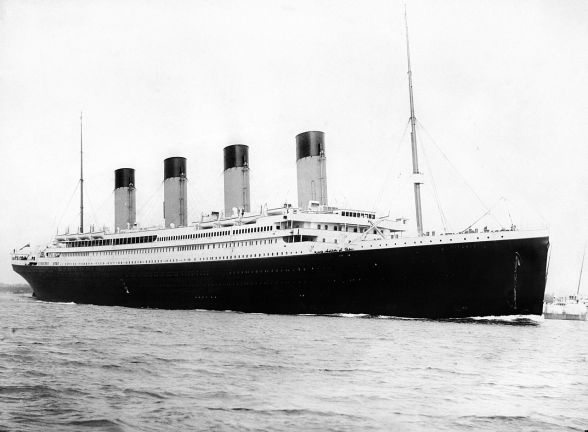
Many of Ireland’s brave sons and daughters had to leave Ireland for one reason or another. One of those daughters was Katherine “Katie” Gilnagh who was just seventeen years old when her sister sent for her to come to the United States. She caused a bit  of a stir before she left home by having her palm read. The astute (or gifted) fortune-teller told Katie that she’d be crossing water soon and that there’d be a lot of danger, but that no lasting harm would come to her. Soon after the reading, Miss Gilnagh left her family in Cloonnee, Co. Longford and boarded the RMS Titanic as a third-class passenger, bound for America.

Continue reading

The Gate to Hell

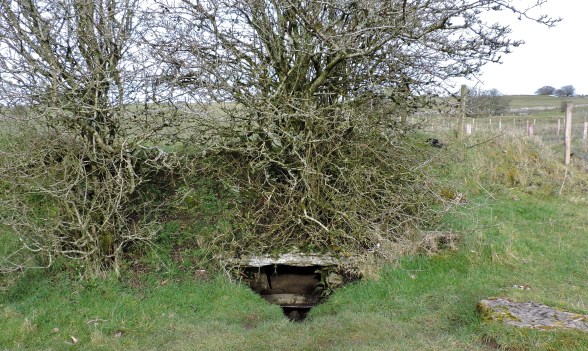
Ireland has a complicated relationship with religion. Many of its troubles in the last few hundred years are ultimately based in religious conflict and the church has ruled much of the island for centuries. But it wasn’t always so and some of its most-visited and well-known landmarks predate the Christian takeover of the island. Everywhere you go you can see signs of the old ways peeking through the hedges if you are looking for them. Many good Catholics will cross themselves or roll their eyes when they talk about the faeries but they also leave bowls of milk outside to appease them. You’ll still find iron in many doorways, though perhaps the reason it was placed there has been forgotten. As Samhain (more commonly known as Halloween) approaches, seasonal offerings left in fields, forts, tombs, and shrines increase all over Ireland. This time of year may not be the sanest time to go to the gateway to hell, but it certainly is the most appropriate one if you want to meet The Morríghan and her dark minions on one of the only nights they can escape the underworld.

Continue reading

The Irish Hunger Memorial

The Irish Hunger Memorial stands on the edge of the Hudson River in New York City.  It commemorates the journey that many thousands of Irish men, women, and children made to America while fleeing An Gorta Mór – Ireland’s Great Hunger. It is a stunning site that has seen its fair share of controversy and closures, but there’s finally some good news for New York’s little piece of Ireland.

Continue reading

San Francisco’s temporary Gaeltacht

Learning Irish is a struggle for me. I’ve tried many programs, and dutifully play with my Irish Rosetta Stone weekly but it is somewhat joyless and difficult without another Irish speaker to practice with. So when the advertisement for the 18th annual Irish Immersion weekend at the United Irish Cultural Center in San Francisco, California came across my radar, I planned on trying to find a way to attend.

This was not my first attempt but the Immersion’s price tag is a bit steep so I’ve never made it before….and probably wouldn’t have made it this time either except that my registration fee was a birthday gift from a dear friend I always go to Ireland with. Kathleen’s theory is that one of us needs to learn Irish in preparation for the inevitable day that we move to Ireland – and I thought I was pretty up to the task. I felt pretty confident about what I already knew when I walked in but I quickly learned that it is one thing to know some phrases or a lot of vocabulary and another altogether to be able to carry on a coherent conversation. I was even more intimidated when I realized that some of ár múinteoirí were prominent and well-known Irish speakers in Ireland, who bring the language to life every day.

Continue reading

The Death of Innocence

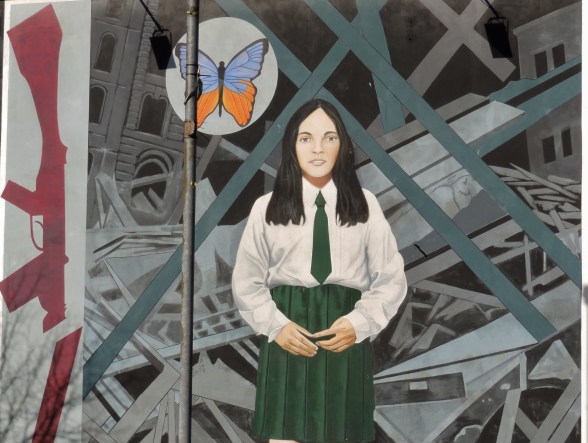
Annette McGavigan was only eleven years old when the Troubles erupted in the North of Ireland. Her home was in Derry, one of the major flashpoints of the Troubles and a stronghold of the Provisional Irish Republican Army. She and the other children of the area witnessed more conflict than any child should within those first few years. She would have seen the British Army rolling into her city, bringing CS gas, rubber bullets, violence and protest with them. Riot after riot broke out and civil rights marches, anti-internment protests, and anti-police incidents were frequent and violent. These things probably became rather commonplace over the next few years for Annette and the other children who were growing up in areas like Creggan, Little Diamond, and the Bogside.

On Sept. 6th, 1971, when Annette was only fourteen, Catholic schools were closed in Derry. Teachers were taking part in a week-long anti-internment program. This left the schoolchildren with free time. Some joined the protests and riots and others stayed in. Once a small riot had ended on the edge of the Bogside, Annette and her friends went out to collect the leftovers of the violence. Children regularly gathered rubber bullets, gas canisters and more after each riot in Derry and this day off from school gave Annette the perfect opportunity to hunt for these dangerous souvenirs. As the young girl in a school uniform picked up an empty cartridge, a shot rang out. She likely never knew what hit her.

Continue reading

Call to Action

No matter where you are in Ireland, Dublin is not usually more than a few hours away. Yes, if you don’t have a car (and who can with those insurance rates?) it can be a hassle to get to, but nearly every region has some form of direct transportation in and out of Dublin. That’s important because I’m about to suggest that you take advantage of those routes and hightail it over to the city this weekend.

Continue reading

O’Connor Family Mystery

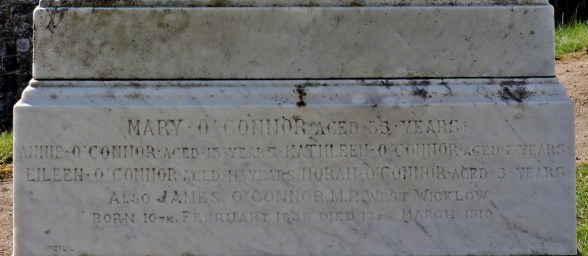
On June 30th, 1890 a horrible tragedy struck the O’Connor family in County Dublin. John O’Connor  was a well-known journalist and Nationalist politician. He was the M.P. of West Wicklow and a family man who had a loving wife and five young children. This seemingly adoring family was torn apart when almost all of them were fatally poisoned. Only John O’Connor and one of his daughters survived.

Continue reading