Blessed are the Peacemakers

Here’s one that on the face of it, might not normally fit in my blog. I usually rail against the PUP and many loyalist factions and traditions but I always try to give credit where credit is due. David Ervine is one person who deserves that credit and I write that without hesitation, if only to show how similar both sides of the divide in the North of Ireland may be. At the end of the day, I am a firm believer in peace, empathy, and understanding. I also believe that while fundamental change is incredibly difficult, some people can accomplish it. I may be naive, hippy-ish, or simply too far removed from the first-hand experience but I believe David Ervine managed to pull it off.

Continue reading

Mandela

Today would be Nelson Mandela’s 96th birthday. Once a warrior branded a terrorist, he then became the leader of South Africa and a recipient of the Nobel Peace Prize. He died while I was in Belfast, and people were leaving fresh flowers under his mural. Here’s a lovely picture of the mural, with the flowers underneath to celebrate today which is Nelson Mandela day.

flowers on the mural

flowers on the mural


“For to be free is not merely to cast off one’s chains,

but to live in a way that respects and enhances the freedom of others”

~Nelson Mandela

Minister of State

Since my return from Ireland I have been trying to figure out what I could do for work in order to move there. Unfortunately, I do not have a background in Tech which seems to be one of the only fields where business is thriving in the Emerald Isle, so I have been hunting for other ways. It turns out that I just needed to apply for the Minister of State/Gaeltacht affairs position, since apparently the job requires very little knowledge of Irish and does not require fluency in the language.

Seriously?! It is my impression that if you are put in charge of Gaeltacht Affairs, you should be able to conduct business or resolve conflict in Irish, since you are representing that language and the people who speak it. Perhaps I have that wrong and Joe McHugh will do just fine but I don’t think I’m mistaken in what the job requirements should be.
If I am though, I would like to formally announce that I am applying for the job. After all,
Tá beagán Gaeilge agam.

:head hits desk:

The Death of the Countess

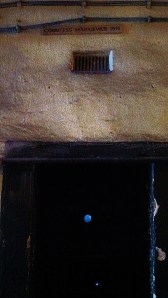
Her cell at Kilmainham, following the Easter Rising. I should mention the tour guide let me go back to take this picture, despite not usually allowing it, because I begged

“I do wish you lot had the decency to shoot me.” -Constance Markievicz, 1916.

Constance Markievicz may have wanted to die like her compatriots for her role in the Easter Rising but the English wouldn’t execute a woman. In the end, they may have wished they had, for the Countess had another 11 years to continue being a thorn in their side. She went straight into an even more political role, creating a world where women were more equal to the men, remaining staunchly Republican and inspiring thousands of people, including myself, throughout the years since. She is one of my favorite heroes.
Continue reading

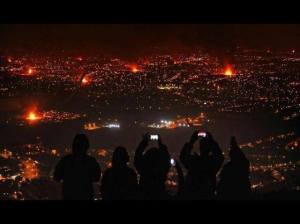
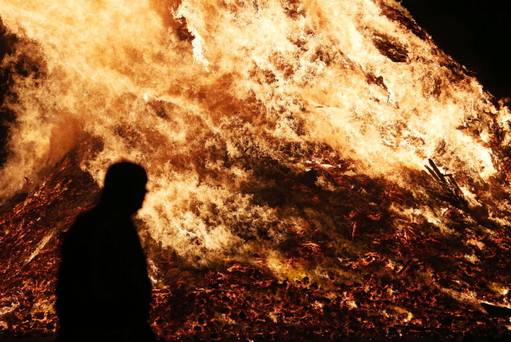
The Fires of Belfast

Beautifully intimidating….if not for the symbolism, this would be a beautiful sight.

bonfires

This picture taken last night was reposted from the lads over here –
The Irish Brigade

the rest were taken from the web:

310KB9+7798484jpg

310KB9+77174jpg_3

310KB9+77134jpg_2

310KB9+7714484jpg

452049700

11th night

11th night

The face of sectarianism

I already posted a pretty lengthy opinion on the Orange Order parades so I won’t rehash it now. However, the planned “graduated protests” and the threats of real violence from Protestant leaders prove again that these people have failed to lead at all. If you ‘cannot guarantee’ that your own parades will be peaceful and you are in fact promising that they won’t, what right to you have to call yourself a leader? A sane party host would take responsibility for their guests and cancel the party themselves if things were sure to get out of hand. They would not be falsely ringing their hands, shrugging their shoulders and standing by while their home got destroyed. Leaders who cannot lead should be fired from their jobs no matter which side they adhere to.

And then there’s this.

Vandalized Mary

And this.

Effigy of Gerry Adams

These disgusting crimes put the question of “heritage and tradition” to rest, unless tradition has always been hate-filled supremacy and heritage has always been power over and at the extent of someone else. It is time to put an end to these truly vile events. It’s time to call it what it is – which in these cases, is a celebration of sectarianism, hatred and entitlement.

And please, if you are reading this from the North, do the right thing. Put pressure on the authorities to charge these things as the hate crimes that they are but for the next 48 hours, try to take the high road. Whether you are marching, protesting, or protecting yourselves, try to stay peaceful no matter what and keep each other safe. Respect should be granted to all humans, regardless of which side of the divide you stand on. I hope everyone and everything (except the hateful bonfires) are still standing on the 13th, as unlikely as that seems to be. My thoughts are with you from across the puddle.

July 12th Parades

Everyone likes a parade. I get it. They’re all pomp and circumstance – people showing off their heritage, their music, their flags. There are parades worldwide for what seems like every single little excuse that anyone can find. Some are big, some are small, some are downright silly, and some threaten a fragile balance.

The marching season in the North of Ireland falls into the last category. July 12th is a day that roughly half of the population celebrates the victory of William of Orange (a Dutch King, by the way) over the English King James II. It’s a huge holiday which is steeped in irony, when you think about it. This is a bunch of people who violently insist on being considered British that take to the streets to celebrate a Dutch victory over their own historical ruler. Label that one for storage in the “Things that make you go hmmmm” file.

The truth is, they are really celebrating the defeat of Catholicism. James II was a Catholic and when the Dutch king defeated him, Protestants were granted great wealth and positions of power. It opened the door for instant change – one that Protestants in the area have enjoyed for centuries.
Continue reading

July 2nd belongs to The Irish Brigade

Today I give you a story of the Irish in America during the Civil War. Throughout American history the Irish have always had a connection to discrimination – first being discriminated against  (No Catholics, No Irish) and then gaining a generalized reputation for discriminating against others. Part of this stems from their own persecution that developed into a deep distrust of anyone outside of their own communities. Some of it is just the age old misconceptions of the Irish in general – that they’re all devoted to shenanigans, violence and little else.

If you buy into those generalizations, you may assume that the Irish Brigade fought for the Confederacy in the Civil War. Thankfully, you’d be totally wrong. They were a highly effective tool for the North, though many were conflicted and unsure of their allegiance. The Union promised them more freedoms and rights, even if they had to fight for them – but many also worried that emancipation would involve more people who would challenge them in their struggles to find even the lowliest of jobs. But in the end, the Fighting Irish committed to the North and when they did, the North gained a company of men that were brilliant fighters who seemingly would never give up.

The Irish Brigade was nearly decimated more than once but they continued to fight even when they lost more than half their numbers. In the battle of Fredericksburg, their numbers fell from 1600 to a measly 256. It was during that battle that General Robert E. Lee allegedly referred to the Irish company as the “Fighting 69th”. They bled through some of the biggest battles of the Civil War and were disillusioned, tired, and only about 500 strong on July 2nd, in 1863, when they fought in the battle of Gettysburg.

As they prayed near Cemetery Hill before they went into battle, the soldiers knew that they were grossly outnumbered and likely to die. They made their stand in a place that would henceforth be known as the Wheatfield, where they were part of an attack designed to stall the Confederate forces that were advancing. The Brigade initially forced them back, fighting dirty with all they had – hands, knives, bayonets, clubs, and muskets. It was such a fierce melee that one of their opponents was quoted as saying that it was “the hottest and sternest struggle of the war.” Ultimately, after losing over one third of their already skeletal numbers they were pushed back, but their ferocity had slowed the South enough that the Union line held until reinforcements arrived.

In the end, during the entire Civil War, only 2 other Union brigades lost more people than the Irish. There is a beautiful statue of a Celtic cross with a mourning Irish Wolfhound that’s been raised on the battlefield in Gettysburg to commemorate their sacrifice. Gettysburg is hallowed ground to many but near the cross you can almost hear the battle cry of the Brigade – Fág an Bealach, which means Clear the Way. And the nickname that General Lee had given the unit, has stuck around for more than a century, living on even now. The Wolfe Tones wrote a song about them that the Dropkick Murphys have resurrected and covered. Also, since 1907, the Fighting 69th has been a unit in the National Guard Of New York. They have fought in both World Wars and served with distinction in almost every conflict to this day.

  Gentlemen, thank you for your service.
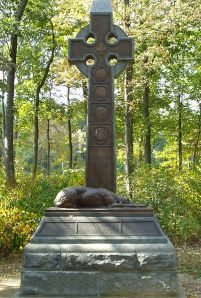
 

In Memorium, Irish Brigade
In Memorium, Irish Brigade


Tom Barry’s Birthday

On this day in 1897 Thomas Bernadine Barry was born in Killorglin, Co. Kerry, one of a whopping 14 children. Eighteen years later or so he joined the British Army – an unlikely move that would aid in his future as one of the most respected and strategic IRA commanders in history. While serving in the British army he received news of the 1916 Rising but was unable to return to Ireland until the war he was fighting for Britain had come to an end in 1919.

Upon his return, he got involved in the Volunteer movement. One year later became the commander of the Flying Column 3rd West Cork brigade. He had asked for total autonomy in decision-making and it was given, with a warning that any success or failure would be his responsibility alone. (No pressure!) He then began planning the Kilmichael ambush, a significant political and strategic move that became a touchstone in the War of Independence.

The ambush occurred one week after the first Bloody Sunday. (Yes, I said the first –  there have been multiple, unfortunately) It boosted IRA morale and garnered even more respect for Tom Barry and his tactics. It also brought him to the attention of Michael Collins, who was suddenly aware that he had both a strong ally and some fierce competition.

Michael Collins called for Barry to come to both Dublin and London during the Treaty negotiations. It is said that one of the first things the British wanted was Tom Barry himself. Michael Collins refused, though he later claimed that he had been tempted to give Barry to them. When the treaty was ratified – over Barry’s objections due to the partitioning of the Island – he continued to fight on the behalf of the Anti-Treaty IRA until he was imprisoned by Collins’ Irish Free State Army.  He escaped and continued to command in various locations until the Anti-Treaty IRA was defeated and he was captured once again.

Upon his release, he spent a term as the IRA Chief-of-Staff and served as general superintendent of the Cork Harbor Commission for nearly 40 years. Still an unrepentant Republican, at the age 62 he traveled to the United States in the hopes of gaining funds and support for a united Ireland. His one wish and lifetime goal was to end the partition of Ireland. He died in 1980 and was buried at St. Finbarr’s Cemetery in Cork. Though St. Finbarr’s cemetery has one of the largest Republican plots in the area, Tom Barry is not interned in it but instead is buried nearby.

‘In the end Gerry Conlon won’

Yesterday the funeral of Gerry Conlon was held in Belfast. He was a great inspiration to me as I have said before here: https://lightandthunder.wordpress.com/2014/06/21/gerry-conlon-r-i-p/

A fantastic article on the service and his life was posted in the Irish Times. Once again, I am reminded of how far away from Ireland I am – and of where I’d be if I were not.   Suaimhneas síoraí

‘In the end Gerry Conlon won – the victory was his’.