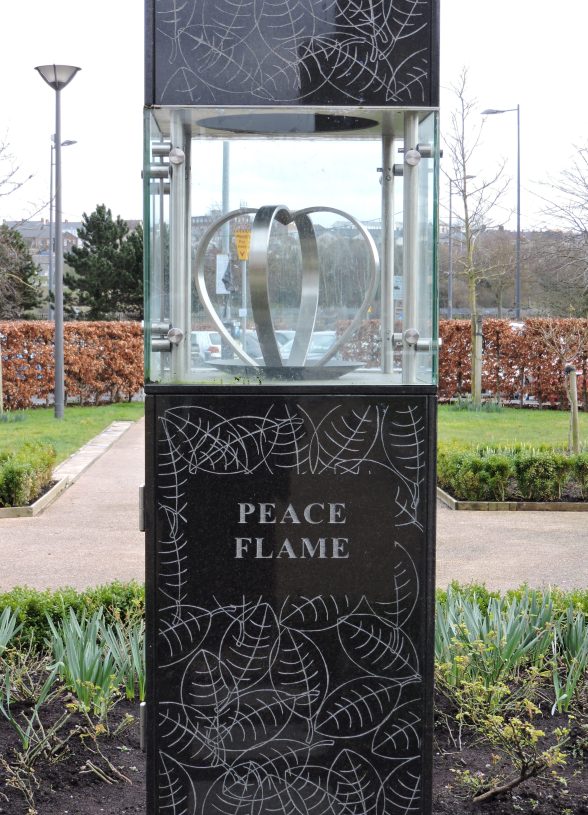
The Peace Flame

Glass enclosed sculpture on black pillar that says the words Peace Flame

Derry is a city that knows what it means to burn.

In August 1969, the Battle of the Bogside transformed the city’s streets into a war zone. Petrol bombs flew through the air. CS gas filled the alleyways. Those three days of violence marked the beginning of a conflict that would claim over 3,500 lives across the North of Ireland. Over the next few years, civil rights activists began a long campaign against the gerrymandering in the region and the discrimination against Catholics. Organizers looked across the ocean for inspiration. They saw the marches in Selma in the United States. They heard Martin Luther King Jr. speak of justice and nonviolent resistance. The movement in Derry borrowed that language deliberately, because it fit. Derry’s Catholics faced discrimination in housing, employment, and voting rights, similar to what African Americans were facing in the US. The parallels were not metaphorical. They were structural and intentional.

On Jan. 30th, 1972 a large civil rights march made its way through Derry. English soldiers opened fire on the unarmed protestors, killing 14 innocent people and injuring many more. The Crown defended the killings adding to the injustice and radicalization of the city. Calls for both violence and peace rose, each shouting louder than the one before. Derry was an open wound, full of trauma, anger, and fear for decades to come.

That history is embedded in the city to this day. It lives in the murals of the Bogside, in the names on memorials and walls, on the gravestones of the city cemetery, and in the hearts of all who call it home. This is why a symbol of peace in the town carries such weight. The Peace Flame is in the center of a purpose-made tiny garden next to the Guildhall. It is housed in a glass enclosure, sheltered from the wind but visible to anyone who passes. A pillar bears the words plainly: Peace Flame. No ambiguity or abstraction, just the thing itself, named loudly and ever present.

It was unveiled on this day in 2013 as part of a five day peace conference. The keynote speaker was Martin Luther King III, the son of the man whose own civil rights movement had inspired Derry activists for nearly fifty years. His presence was not just ceremonial, it was also a full circle moment. The thread that ran from the U.S. civil rights movement to the Bogside in Derry was being acknowledged openly, by someone who carried that legacy in his blood.

The ceremonial lighting featured children from both sides of the divided town. That choice was poignant. While the adults in the crowd carried the memories and the scars, the children could carry the hope for a peaceful future. They will decide the future of the north of Ireland so it was fitting that they were involved in the town’s efforts to promote both the city and the flame as a beacon of peace.

This was the first peace flame in Ireland. It has had to deal with technical issues and multiple vandalism incidents that affect the flame but whether it happens to be lit or not when you walk through the garden, it’s hard to ignore the symbol. Seeing it in the heart of Derry is both heavy and optimistic, much like the town itself.

It also seems like a light that is holding steady even when the future is uncertain and the past refuses to stay quiet. Installing the peace flame did not fix or erase what happened here; instead it shone a light on all the tragedies and pierced through the darkness of the past, lighting the way to a better and shared future in the region. May it shine bright in the hearts of all who pass it by.
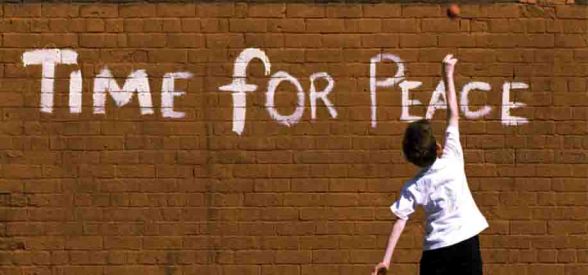
International day of peace

Peace. It’s an elusive concept to many countries, tribes, and populations. The idea that there will ever be a time without war is a dream. It is one that everyone claims to hope for but in reality, hundreds of thousands of politicians, economists, religious leaders, generals, neighbors, soldiers, and contractors work against the concept every day. A world without war is a type of idealism that can sum up the beliefs of bleeding heart liberals, traumatized veterans, moderate conservatives, and true libertarians alike…but it has no place in this world that we live in today, outside of philosophy and imagination. As Robert Heinlein said, “You can have peace. Or you can have freedom. Don’t ever count on having both at once.

Continue reading

Memories of Belfast

My body is rebelling against being thrown back into the States and I caught a vicious cold on the flight back from Ireland. This cold, on top of the jet lag, culture shock, and come down after such a mind-blowing holiday has left me quite speechless. I have a lot of catching up to do for sure and a lot of processing to do as well.

Continue reading

Mairead Maguire

And now for a modern day Irish woman.  Mairead Maguire was born in Belfast, 71 years ago today. Her entry into the world of political protest did not come without a price. A family tragedy in 1976 fueled her desire to bring change to her war torn community. Her nephews and niece were hit by a car when the driver (a (P)IRA paramilitary) lost control of it after being shot by the authorities. Betty Williams, a witness to the accident, capitalized on the tragedy using it to gather women in the community to march in protest of the ongoing violence and paramilitary activity in their neighborhoods. Mairead joined her. It was a surprising success and “Women for Peace” was spontaneously born. The second march that went to the graves of the children took place only a few days later and it included over 10,000 women—both Catholic and Protestant—an unusual feat in such a polarized place and time. It was attacked by the paramilitaries which only brought the women more press and support for the next march and the movement continued to grow. Mairead and Betty changed the name of their group to the gender-neutral “Peace People” and they continued to parade for peace between Republican and Loyalist factions.

Continue reading

July 12th Parades

Everyone likes a parade. I get it. They’re all pomp and circumstance – people showing off their heritage, their music, their flags. There are parades worldwide for what seems like every single little excuse that anyone can find. Some are big, some are small, some are downright silly, and some threaten a fragile balance.

The marching season in the North of Ireland falls into the last category. July 12th is a day that roughly half of the population celebrates the victory of William of Orange (a Dutch King, by the way) over the English King James II. It’s a huge holiday which is steeped in irony, when you think about it. This is a bunch of people who violently insist on being considered British that take to the streets to celebrate a Dutch victory over their own historical ruler. Label that one for storage in the “Things that make you go hmmmm” file.

The truth is, they are really celebrating the defeat of Catholicism. James II was a Catholic and when the Dutch king defeated him, Protestants were granted great wealth and positions of power. It opened the door for instant change – one that Protestants in the area have enjoyed for centuries.
Continue reading