“A rebel is one who opposes lawfully constituted authority and that I have never done.” So said one of the most devoted Republican women in Irish history, Mary MacSwiney. I’m sure she believed in that statement with all of her heart—as she did a free Ireland—but it’s guaranteed the English did not feel the same way. To them, Mary MacSwiney was the one of the worst and biggest female rebels, not only in Cork but in all of Ireland.
Tag Archives: female prisoners
Grace Gifford Plunkett is born
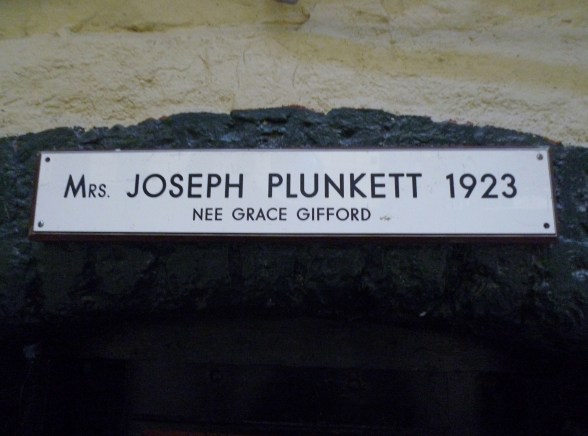
Perhaps the biggest tragedy and the best known story in modern Irish history is that of Joseph Plunkett and Grace Gifford’s doomed love affair and hasty prison wedding. The tragic romance sits right next to Romeo and Juliet in the great sagas of impossible love, and their story may be one of the largest reasons that popular opinion swung in favor of the rebels after the 1916 Easter Rising. The day the British executed Joseph Mary Plunkett, they guaranteed that the story of the rebellion would no longer be remembered without the emotional inclusion of Ireland’s favorite tragic widow – Grace Gifford Plunkett. But before there was a widow, there was a headstrong, artistic woman – one who was born on this day in 1888.
Continue reading
Top ten Favorite Facts about Constance de Markievicz
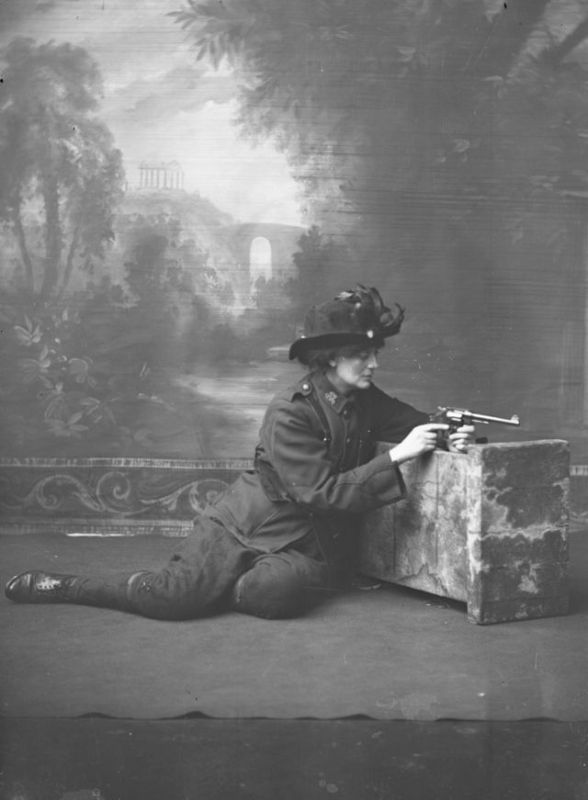
On this date in 1868, one of Irish history’s most famous women was born…in London. Constance Gore-Booth was an aristocratic socialite who fell in love with Irish politics and went on to be one of the most beloved and recognized names in Nationalist history. She fought for women’s rights in Ireland and was a devoted Republican fighter who would have been executed for her role in the Easter Rising, had she not been a woman. Her most famous advice to women was to “Dress suitably in short skirts and strong boots, leave your jewels in the bank and buy a revolver.” In honor of her birthday today, here are my top ten favorite facts you may or may not already know about her life.
The great Maud Gonne
Edith Maud Gonne has been hailed as one of the greatest activists and fighters of her time. Her beauty has been recorded and immortalized by one of Ireland’s greatest poets. History has compared her to Joan of Arc and she’s one of the best known women in the books, in no small part due to her own inflated memoirs and creative storytelling. She is largely considered to be an Irish hero—which is a great feat for a woman—particularly one who wasn’t Irish born and who grew up as a member of a wealthy, loyal, British family. So was she a true revolutionary, or a fraud in it for the fame and her own idea of who she wanted to be? Either way, she did enough to leave her mark on Irish history and one thing is undisputed – Maud Gonne chose the green and was most certainly not born to it.
Remembering Máire Drumm
And now for a different Máire. Máire Drumm was born into a staunchly Republican family. She was lucky enough to have had a mother who was active in the War for Independence and the Irish Civil War, so the concept of strong women who could fight and lead was instilled in her from birth. Perhaps it was also the reason she knew she could grow up to be a commander in Cumann Na mBan and the Vice President of Sinn Fein. She settled in Belfast in 1942 and began fighting on behalf of Republican prisoners, which she did for many years to come. It was in this role that she met Jimmy Drumm, a Republican prisoner who would later become her husband.
Hunger by Choice – Hunger Strike Commemoration
The Hunger Strike is an ancient custom that has been used for solving serious personal and social conflicts for centuries. The concept was originally an option for fighting injustice and it remains so to this day. August 3rd, 2014, is the day Hunger Strike Commemorations in Ireland wind up for the year, which is a perfect time to learn about the tradition and some of the people who have carried it on.
The Hunger Strike was codified in the early Brehon Laws of Ireland and known as a Troscad. It was often employed against a chieftain or tribal leader by someone of lower standing and was carried out publicly on the abuser’s doorstep. Advance notice was given before commencing this type of strike and the defendant was supposed to fast along with the person who had the complaint. If the originator of the strike died of starvation their opponent had to pay relatives a fee and would be subjected to societal penalties and supernatural consequences. Few people allowed themselves to be shamed in such a situation for long and most conflicts were resolved quickly and without death. It turns out that forcing the other party to go hungry right along with you made a difference, as did the peering eyes of the public.
Continue reading
Remembering Margaret Buckley, Irishwoman Extraordinaire
52 years ago today, Ireland lost an incredible feminist voice. Few women have ever managed to juggle being an activist, a rebel, a suffragist, a wife, a prisoner, a judge, a volunteer, a commanding officer, a hunger striker, an author, and the President of a political party, especially during a time when most women were dismissed and ignored. In fact, only one comes to mind.
Margaret Buckley (née Goulding) was an unrepentant suffragist and Republican woman who began her long and lustrous career of activism and politics as the president of the Cork chapter of Inghinidhe na hEireann, before the organization merged with Cumann Na mBan. Later as a married woman, she became a prominent organizer of the Irish Women’s Workers Union and eventually returned to her role as President, but the next time she did it as the head of a newly revamped Sinn Fein. Continue reading
 Choosing the Green