The Women of 1916

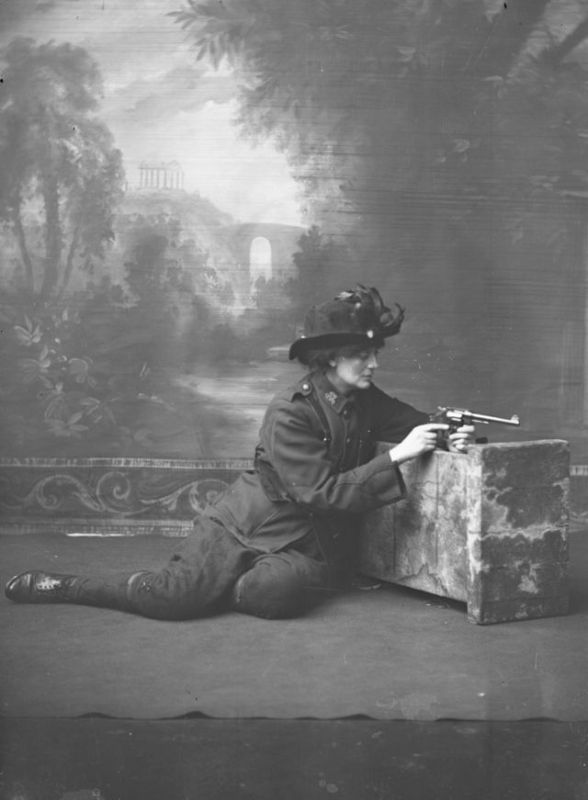
It is estimated that at least 200 women were involved in the Easter Rising of 1916, many more than previously thought. Their roles varied as widely as the women themselves – and ranged from the traditional fundraisers, cooks, and nurses, to the more unexpected roles of sharpshooters, spies, smugglers, and experts on explosives.  A decent effort has been made over the last few years to give them credit for the part they played in the fight for Irish freedom, but sadly, they are still largely absent from many of the narratives.

Worse still is when a historian refers to the women as “great supporters” or “brilliant fundraisers” or “backbones”. These statements are true, but they still have an air of dismissal even amidst the recognition. They still show women in supportive or secondary roles and ignore the fact that many of them saw themselves as rebels, fighters, and soldiers in their own right – regardless of whether or not there were any men around. Until more historians can acknowledge that, many of the women who continuously risked their lives during Easter Week and in the years that followed, will not get the respect and honor that they are due.

Continue reading

On this day in 1916…

99 years ago today Patrick Pearse stood on the steps of the General Post Office in Dublin to recite the following Proclamation. It was a masterpiece and the only declaration of  its time to include women equally. By then he probably had it memorized but as he read it, there were about 1,000 copies being passed out to the passersby and the curious. It was the first notion many had about the chaotic uprising that was about to take over Dublin for the next few days. It read:

Poblacht Na H Eireann

The Provisional Government

of the

Irish Republic

To the People of Ireland

Irishmen and Irishwomen, In the name of God and of the dead generations from which she receives her old tradition of nationhood, Ireland, through us, summons her children to her flag, and strikes for her freedom.

Having organised and trained her manhood, through her secret revolutionary organisation, the Irish Republican Brotherhood, and through her open military organisations, the Irish Volunteers and  the Irish Citizen Army, having patiently perfected her discipline, having resolutely waited for the right moment to reveal itself, she now seizes that moment, and, supported by her exiled children in America and by gallant allies in Europe, but relying in the first on her own strength, she strikes in full confidence of victory.

We declare the right of the people of Ireland to the ownership of Ireland, and to the unfettered control of Irish destinies, to be sovereign and indefeasible. The long usurpation of that right by a foreign people and government has not extinguished the right, nor can it ever  be extinguished, except by the destruction of the Irish people. In every generation the Irish people have asserted their right to national freedom and sovereignty; six times during the last three hundred years they have asserted it to arms.Standing on that fundamental right and again asserting it in arms in the face of the world, we hereby proclaim the Irish Republic as a Sovereign Independent State, and we pledge our lives and the lives of our comrades-in-arms to the cause of its freedom, of its welfare, and of its exaltation among the nations.

The Irish Republic is entitled to, and hereby claims, the allegiance of every Irishman and Irishwoman. The Republic guarantees religious and civil liberty, equal rights and equal opportunities to all its citizens, and declares its resolve to pursue the happiness and prosperity of a whole nation and all of its parts, cherishing all of the children of the nation equally and oblivious of the differences carefully fostered by an alien government, which have divided a minority from the majority in the past.

Until our arms have brought the opportune moment for the establishment of a permanent National, representative of the whole people of Ireland, and elected by the suffrages of all her men and women, the Provisional government, hereby constituted, will administer the civil and military affairs of the Republic in trust for the people.

We place the cause of the Irish Republic under the protection of the Most High God. Whose blessing we invoke upon our arms, and we pray that no one who serves that cause will dishonour it by cowardice, in humanity or rapine. In this supreme hour, the Irish nation must, by its valour and discipline and by the readiness of its children to sacrifice themselves for the common good, prove itself worthy of the august destiny to which it is called.

Signed on behalf of the Provisional Government,

Thomas J. Clarke,

Sean Mac Diarmada, Thomas Mac Donagh,

P.H. Pearse, Eamonn Ceannt,

James Connolly, Joseph Plunkett

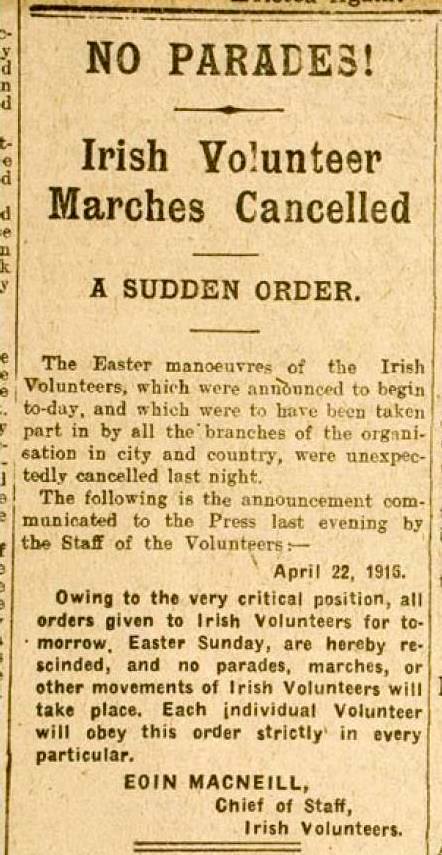
Within a week, the rising was over and all the signatories were awaiting their executions. Nine more men would join them in their deaths and countless men and women languished in prisons all over the region. But on this day in 1916, the reading of the Proclamation signaled a beginning – an idealistic and hopeful moment – before reality and half of Dublin rained down upon them in the days to come.

(Interesting little aside: Patrick Pearse was not the first to read the Proclamation aloud on the streets. It is said that Constance Markievicz beat him to the punch when she started excitedly reading it to her friends and waving it around a few minutes after it had finished printing.)

99 years ago exactly

paper

Easter Monday

Since it is Easter Monday and National Poetry month here in the US, today belongs to Padraig Pearse and his heartbreaking poem, The Mother.

The Mother 
I do not grudge them: Lord, I do not grudge 
My two strong sons that I have seen go out 
To break their strength and die, they and a few,
In bloody protest for a glorious thing,
They  shall be spoken of among their people,
The generations shall remember them,
And call them blessed;
But I will speak their names to my own heart
In the long nights;
The little names that were familiar once
Round my dead hearth.
Lord, thou art hard on mothers:
We suffer in their coming and their going;
And tho I grudge them not, I weary, weary
Of the long sorrow-And yet I have my joy:
My sons were faithful, and they fought.

image

Arthur Griffith’s Birthday

Today in 1872, Arthur Griffith was born in Dublin. He was passionate about Irish history, which drove him to become a member of the Gaelic League where he rubbed shoulders with other Irish activists and cultural leaders. He was a bit of an anomaly. His devotion to the Gaelic League led to Griffith joining the Irish Republican Brotherhood where he was surrounded by many ideological opposites. He was inspired by Charles Parnell and wrote for many radical papers while he was growing up, but he was also ultra-conservative and widely reported to be an anti-Semite. While his IRB friends were planning a complete revolution, he was more in favor of a dual monarchy system, a sort of co-partnership with England. He was against any form of communism or socialism and was largely anti-union, but was in a room talking policies with James Connolly—the driving force behind Irish socialism at the time—on many occasions.
Continue reading

Tom Clarke

On this day in 1857 Thomas James Clarke was born to Irish parents at Hurst Castle in Hampshire, England. It’s more than a little ironic that one of the biggest strategists behind Ireland’s future revolution was born on English soil. In fact, his father was in the British Army and the family did not return to Ireland until Tom was seven years old. They settled in Dungannon, a Fenian stronghold that had suffered terribly during An Gorta Mor – Ireland’s Great Famine. The scars of that disaster were still all around him and from his earliest years, Tom hated the English establishment. He was determined to fight against it however he could.

Continue reading

Grace Gifford Plunkett is born

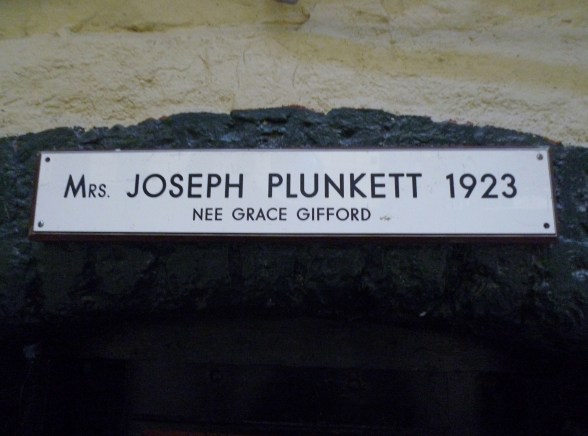
Perhaps the biggest tragedy and the best known story in modern Irish history is that of Joseph Plunkett and Grace Gifford’s doomed love affair and hasty prison wedding. The tragic romance sits right next to Romeo and Juliet in the great sagas of impossible love, and their story may be one of the largest reasons that popular opinion swung in favor of the rebels after the 1916 Easter Rising. The day the British executed Joseph Mary Plunkett, they guaranteed that the story of the rebellion would no longer be remembered without the emotional inclusion of Ireland’s favorite tragic widow – Grace Gifford Plunkett. But before there was a widow, there was a headstrong, artistic woman – one who was born on this day in 1888.
Continue reading

Edward “Ned” Daly

Edward “Ned” Daly was born into a large and proud Fenian family on this day in 1891. Although he was named after his father, he never met the man. His dad passed away just before Ned was born, leaving his uncle, John Daly, and the rest of his family to raise the young boy. They instilled in him the same rebel nature and Irish Republicanism that his father had once fought for.  When he was a small child, all he wanted to do was to be a soldier, like his father before him. Since his family would never allow him to take a post in the English Army, Ned thought his dream would never be achieved. However, when the march toward yet one more rebellion began, suddenly there was another option. Under the influence of his sister (who happened to be Kathleen Clarke), and her husband Tom, Ned’s interest in fighting and soldiering was brought to fruition. It was his destiny to be a rebel but unfortunately, that destiny would also lead to an early grave.

Continue reading

Top ten Favorite Facts about Constance de Markievicz

On this date in 1868, one of Irish history’s most famous women was born…in London. Constance Gore-Booth was an aristocratic socialite who fell in love with Irish politics and went on to be one of the most beloved and recognized names in Nationalist history. She fought for women’s rights in Ireland and was a devoted Republican fighter who would have been executed for her role in the Easter Rising, had she not been a woman. Her most famous advice to women was to “Dress suitably in short skirts and strong boots, leave your jewels in the bank and buy a revolver.” In honor of her birthday today, here are my top ten favorite facts you may or may not already know about her life.

Continue reading

A Son is Born

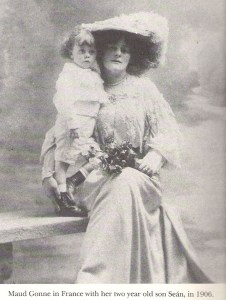
On this day, January 26th, in 1904, Sean MacBride was born to Maud Gonne and John MacBride in France.  He went on to follow in his parents’ Irish Republican footsteps becoming a soldier, politician and the Chief of Staff of the IRA, fulfilling their wishes to have an important and capable son. They agreed on almost nothing else, but they did want their son to believe in and work toward a free Ireland just like they had for most of their lives.

Sean was the apple of his mother’s eye and today would be his 111th birthday, which is hard to imagine when you see this picture, taken when he was 2.

maudegonne2Breithlá Sona