Hunger by Choice – Hunger Strike Commemoration

The Hunger Strike is an ancient custom that has been used for solving serious personal and social conflicts for centuries. The concept was originally an option for fighting injustice and it remains so to this day. August 3rd, 2014, is the day Hunger Strike Commemorations in Ireland wind up for the year, which is a perfect time to learn about the tradition and some of the people who have carried it on.

The Hunger Strike was codified in the early Brehon Laws of Ireland and known as a Troscad. It was often employed against a chieftain or tribal leader by someone of lower standing and was carried out publicly on the abuser’s doorstep. Advance notice was given before commencing this type of strike and the defendant was supposed to fast along with the person who had the complaint. If the originator of the strike died of starvation their opponent had to pay relatives a fee and would be subjected to societal penalties and supernatural consequences. Few people allowed themselves to be shamed in such a situation for long and most conflicts were resolved quickly and without death. It turns out that forcing the other party to go hungry right along with you made a difference, as did the peering eyes of the public.
Continue reading

Miami Showband Massacre

Throughout history there are not many instances that one can absolutely prove that a horrible crime was just a part of a scheme that would have led to something much, much worse. The Miami Showband killings in Ireland is one of those times and it is an appalling lesson of just how brutal and insane the Troubles could get. It  is also a clear cut example of how involved the authorities were in some of the most heinous crimes of the era.

Showbands were quite a popular phenomenon in Ireland. The uniqueness of the showband was documented in the film “The Commitments” which was popular throughout the world. These bands usually had five to ten members and were loved for playing showtunes, pop music, jazz and down home rock n roll greats.  Many played the favorite traditional tunes of the area as well and they were extremely popular from the 50s right up until the mid-seventies. It’s amazing how quickly attendance and participation waned when one was targeted so ruthlessly by the paramilitaries of the UVF. Continue reading

Remembering Margaret Buckley, Irishwoman Extraordinaire

52 years ago today, Ireland lost an incredible feminist voice. Few women have ever managed to juggle being an activist, a rebel, a suffragist, a wife, a prisoner, a judge, a volunteer, a commanding officer, a hunger striker, an author, and the President of a political party, especially during a time when most women were dismissed and ignored. In fact, only one comes to mind.

Margaret Buckley (née Goulding) was an unrepentant suffragist and Republican woman who began her long and lustrous career of activism and politics as the president of the Cork chapter of Inghinidhe na hEireann, before the organization merged with Cumann Na mBan. Later as a married woman, she became a prominent organizer of the Irish Women’s Workers Union and eventually returned to her role as President, but the next time she did it as the head of a newly revamped Sinn Fein. Continue reading

The Death of the Countess

Her cell at Kilmainham, following the Easter Rising. I should mention the tour guide let me go back to take this picture, despite not usually allowing it, because I begged

“I do wish you lot had the decency to shoot me.” -Constance Markievicz, 1916.

Constance Markievicz may have wanted to die like her compatriots for her role in the Easter Rising but the English wouldn’t execute a woman. In the end, they may have wished they had, for the Countess had another 11 years to continue being a thorn in their side. She went straight into an even more political role, creating a world where women were more equal to the men, remaining staunchly Republican and inspiring thousands of people, including myself, throughout the years since. She is one of my favorite heroes.
Continue reading

July 2nd belongs to The Irish Brigade

Today I give you a story of the Irish in America during the Civil War. Throughout American history the Irish have always had a connection to discrimination – first being discriminated against  (No Catholics, No Irish) and then gaining a generalized reputation for discriminating against others. Part of this stems from their own persecution that developed into a deep distrust of anyone outside of their own communities. Some of it is just the age old misconceptions of the Irish in general – that they’re all devoted to shenanigans, violence and little else.

If you buy into those generalizations, you may assume that the Irish Brigade fought for the Confederacy in the Civil War. Thankfully, you’d be totally wrong. They were a highly effective tool for the North, though many were conflicted and unsure of their allegiance. The Union promised them more freedoms and rights, even if they had to fight for them – but many also worried that emancipation would involve more people who would challenge them in their struggles to find even the lowliest of jobs. But in the end, the Fighting Irish committed to the North and when they did, the North gained a company of men that were brilliant fighters who seemingly would never give up.

The Irish Brigade was nearly decimated more than once but they continued to fight even when they lost more than half their numbers. In the battle of Fredericksburg, their numbers fell from 1600 to a measly 256. It was during that battle that General Robert E. Lee allegedly referred to the Irish company as the “Fighting 69th”. They bled through some of the biggest battles of the Civil War and were disillusioned, tired, and only about 500 strong on July 2nd, in 1863, when they fought in the battle of Gettysburg.

As they prayed near Cemetery Hill before they went into battle, the soldiers knew that they were grossly outnumbered and likely to die. They made their stand in a place that would henceforth be known as the Wheatfield, where they were part of an attack designed to stall the Confederate forces that were advancing. The Brigade initially forced them back, fighting dirty with all they had – hands, knives, bayonets, clubs, and muskets. It was such a fierce melee that one of their opponents was quoted as saying that it was “the hottest and sternest struggle of the war.” Ultimately, after losing over one third of their already skeletal numbers they were pushed back, but their ferocity had slowed the South enough that the Union line held until reinforcements arrived.

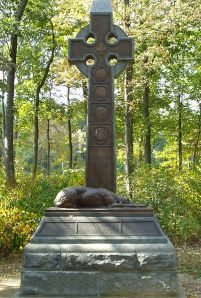
In the end, during the entire Civil War, only 2 other Union brigades lost more people than the Irish. There is a beautiful statue of a Celtic cross with a mourning Irish Wolfhound that’s been raised on the battlefield in Gettysburg to commemorate their sacrifice. Gettysburg is hallowed ground to many but near the cross you can almost hear the battle cry of the Brigade – Fág an Bealach, which means Clear the Way. And the nickname that General Lee had given the unit, has stuck around for more than a century, living on even now. The Wolfe Tones wrote a song about them that the Dropkick Murphys have resurrected and covered. Also, since 1907, the Fighting 69th has been a unit in the National Guard Of New York. They have fought in both World Wars and served with distinction in almost every conflict to this day.

  Gentlemen, thank you for your service.


In Memorium, Irish Brigade

In Memorium, Irish Brigade


Tom Barry’s Birthday

On this day in 1897 Thomas Bernadine Barry was born in Killorglin, Co. Kerry, one of a whopping 14 children. Eighteen years later or so he joined the British Army – an unlikely move that would aid in his future as one of the most respected and strategic IRA commanders in history. While serving in the British army he received news of the 1916 Rising but was unable to return to Ireland until the war he was fighting for Britain had come to an end in 1919.

Upon his return, he got involved in the Volunteer movement. One year later became the commander of the Flying Column 3rd West Cork brigade. He had asked for total autonomy in decision-making and it was given, with a warning that any success or failure would be his responsibility alone. (No pressure!) He then began planning the Kilmichael ambush, a significant political and strategic move that became a touchstone in the War of Independence.

The ambush occurred one week after the first Bloody Sunday. (Yes, I said the first –  there have been multiple, unfortunately) It boosted IRA morale and garnered even more respect for Tom Barry and his tactics. It also brought him to the attention of Michael Collins, who was suddenly aware that he had both a strong ally and some fierce competition.

Michael Collins called for Barry to come to both Dublin and London during the Treaty negotiations. It is said that one of the first things the British wanted was Tom Barry himself. Michael Collins refused, though he later claimed that he had been tempted to give Barry to them. When the treaty was ratified – over Barry’s objections due to the partitioning of the Island – he continued to fight on the behalf of the Anti-Treaty IRA until he was imprisoned by Collins’ Irish Free State Army.  He escaped and continued to command in various locations until the Anti-Treaty IRA was defeated and he was captured once again.

Upon his release, he spent a term as the IRA Chief-of-Staff and served as general superintendent of the Cork Harbor Commission for nearly 40 years. Still an unrepentant Republican, at the age 62 he traveled to the United States in the hopes of gaining funds and support for a united Ireland. His one wish and lifetime goal was to end the partition of Ireland. He died in 1980 and was buried at St. Finbarr’s Cemetery in Cork. Though St. Finbarr’s cemetery has one of the largest Republican plots in the area, Tom Barry is not interned in it but instead is buried nearby.

‘In the end Gerry Conlon won’

Yesterday the funeral of Gerry Conlon was held in Belfast. He was a great inspiration to me as I have said before here: https://lightandthunder.wordpress.com/2014/06/21/gerry-conlon-r-i-p/

A fantastic article on the service and his life was posted in the Irish Times. Once again, I am reminded of how far away from Ireland I am – and of where I’d be if I were not.   Suaimhneas síoraí

‘In the end Gerry Conlon won – the victory was his’.

Roger Casement

On this day in 1916, Roger Casement (once Sir Roger Casement) was convicted by the British crown for high treason. Roger Casement was an anomaly. He was a foreign office diplomat who could never quite get what he was after. He was knighted for his humanitarianism but was trying to broker arms deals. He believed in Irish Republicanism but some of his comrades believed he was too moderate while others believed he was too extreme. He was a rumored sex tourist who traveled to hide and indulge in his homosexuality. And despite having no foreknowledge of the upcoming Easter Rising – being that he was NOT a member of the IRB and they did not fully trust him – he was still convicted of high treason and some of the charges that led to his death were that he helped to plan the rebellion.

It was surprising that he heard of it at all. Casement had been out of the country and then was in the north and kept in the dark by the Republican Brotherhood. He was arrested 3 days before the Rising began – after failing to get Germany to agree to send reinforcements into Ireland to fight the British – and after a whole shipment of German arms heading into Ireland was intercepted. His case was difficult because he was in Germany when such ‘crimes’ happened, but they were relentless in his prosecution.

His supporters at trial were the likes of Sir Arthur Conan Doyle, W.B.Yeats and George Bernard Shaw. Perhaps the revolutionaries weren’t sure about him, but the popular writers of the day sure seemed to be. On June 29th, 1916, he was stripped of knighthood upon his conviction and sentenced to a death by hanging.

His appeals failed. By the time he was hanged, he had converted from Protestant to Catholic and his priest thought he should be considered a saint. He was buried in quicklime at the prison after his death. In 1965, he was repatriated to Ireland and laid to rest with full honors and a state funeral in the Republican Plot at Glasnevin Cemetery. However, Casement’s last wish was to be buried at Murlough Bay on the North Antrim coast and it has yet to be fulfilled. The government released his remains only on condition that they not be brought into Northern Ireland. Oddly enough, the 1965 British Cabinet record of the decision still refers to him as Sir Roger Casement.

Perhaps someday he will get his wish.


Paul Hill remembers Gerry Conlon…

Here, Paul Hill, a fellow Guildford Four member and a leading human rights campaigner based in the US, remembers his friend Gerry Conlon.

I was awoken this grey morning (rather fitting) by the constant ringing of my phone to be informed of the death of Gerry Conlon my fellow member of the Guildford Four.

Doors I had hoped would remain closed began to open in my memory.

It’s incredibly difficult to try to explain to someone exactly what the loss of 15 years of one’s life is like.

Or indeed to ask someone to comprehend having to endure those years as an innocent person, in the hostile environment that was the English prison system.

The simplest way is to think of everything one has achieved in the years between 20 and 35. A career, a home, a marriage, children. We had none of those.

Gerry was a young man who loved life ,music, football. He would have been the first to tell you he had no interest whatsoever in politics.

The background of what he went to prison for is well documented, as is the injustice he suffered,

But the baggage he carried from that is often overlooked, baggage that one can never check.

The mental scars, not visible, remained unhealed. They eat away at one’s being and reopen constantly.

Gerry fought the demons that an injustice unleashes, but I know that he mostly fought those alone and in the dead of night.

People have expressed the opinion that Gerry must have been an incredible man. No, he was not. He was an ordinary man who suffered an incredible injustice.

No doubt we shall have those who (just like after his release) will extol his virtues, whilst having done nothing themselves whilst he was incarcerated,

If I could be so bold, and on behalf of Gerry, I would like to thank all those very ordinary people who believed in him when (unlike today) it was not politically hip to do so. Irish America always stood with us — thank you. Irish governments and Irish embassies did not.

I want to thank the folks who stood in the rain outside the British Embassy, who were accused of being the fellow travelers of terrorists,

The ordinary folk in Ireland who were harassed and photographed by the special branch for having the courage to attempt to right a grievous injustice.

We have come a long way along a harsh, painful road.

Gerry helped us all along that journey.

He was a man of immense humor and a big football fan, no doubt glued to the World Cup.

I know he would give a wry smile knowing England went out before him.

Here is his family’s statement. It captures far more eloquently that I can what Gerry represented.

“He brought life, love, intelligence, wit and strength to our family through its darkest hours. He helped us to survive what we were not meant to survive. We recognise that what he achieved by fighting for justice for us had a far, far greater importance – it forced the world’s closed eyes to be opened to injustice; it forced unimaginable wickedness to be acknowledged; we believe it changed the course of history.

-Paul Hill

http://www.irishcentral.com
Gerry Conlon R.I.P.

Gerry Conlon may be the single most influential person when it comes to who got me into studying Irish politics. The Guildford Four case was riveting for me and it showed just how cruel and scared absolutely everyone was in the heart of the conflict known colloquially as the Troubles. His case was a close second to the Easter Rising of 1916 in my favorite stories of tragic Irish triumph.

On June 21st, 2014 at 4AM California time, I found out that Gerry Conlon had passed away and I actually shed a tear. This marked the first time I  cried over a celebrity passing away since Johnny Cash, and I am pretty sure that it only happened those two times. I was heartbroken and I almost got up then to write about it but I wasn’t awake enough  to articulate the utter sadness of this news.

For those that may not know his story, early in 1975, Gerry Conlon and three other young adults were arrested in connection to the IRA bombing of the Guildford Pub. Despite having nothing to do with the IRA or the bombings, they were convicted and sentenced to life in prison…thankfully, since if they’d been sentenced to death, they all would have been dead before their convictions were quashed. Before they were eventually released, another seven innocent people were convicted of aiding them in this incident – including many of Conlon’s family members and his father, Giuseppe Conlon. Guiseppe never strayed from proclaiming his innocence and he remained hopeful that the miscarriage of justice would be overturned, but Gerry did not. Gerry did not have the fortitude of belief of his father.

Guiseppe Conlon died in prison an innocent man. Years and years later, his son – who found the fighter in himself shortly after the tragic death of his dad, eventually walked out of the courthouse through the front door over fifteen years later when his conviction was quashed, proving to the world that the Guildford Four and the Maguire Seven had been wrongly convicted. The blockbuster movie “In the Name of the Father” was based on these real life events and is an amazing film. If you haven’t seen it, go find it now. Seriously. It took over fifteen years for the police to admit they had made mistakes and purposefully suppressed evidence in order to convict these men and women…none of whom fit any profile or had any paramilitary or political ties.

I was sixteen when they released Gerry and I remember seeing the footage of him leaving the courthouse. It was one of my first forays into Irish politics – and it was a story that led to another, to another, and to another. More than twenty-five years later, I can point to Gerry Conlon as one of the reasons that I fell in love with Irish history. His story had a profound effect on my psyche. Unfortunately his story does not have the Hollywood ending that he so deserved. He struggled with depression, suicide, and addiction since the day he was finally released – and really, who wouldn’t? I cannot find fault in the need to try to erase what has happened to you and your family in whatever way you can. Still, Conlon made it to sixty years of age and was a published author and an activist in other cases that he felt were rigged or unfair. He died on this day in 2014 in Belfast and even now I am still a little teary as I write those words. I wish I had met him – it actually was a thing I had hoped to do someday – just to tell him what a profound impact his story had on shaping who I am and what my interests are. Sixty is too young for many but for Gerry Conlon it was a pretty amazing feat, given that he spent over 15 of them wrongly convicted in the harshest prisons.

His family says it better than anyone else could. In a statement issued through his lawyer Gareth Peirce, they said: “He brought life, love, intelligence, wit and strength to our family through its darkest hours. He helped us to survive what we were not meant to survive. We thank him for his life and we thank all his many friends for their love.”

Rest in Peace Mr. Conlon. Your story and your fight will forever be inspiring and triumphant. I am sorry you lived it and I am thankful for the impact it had on me.  I hope you see your father again.