64 Women

womenmay22

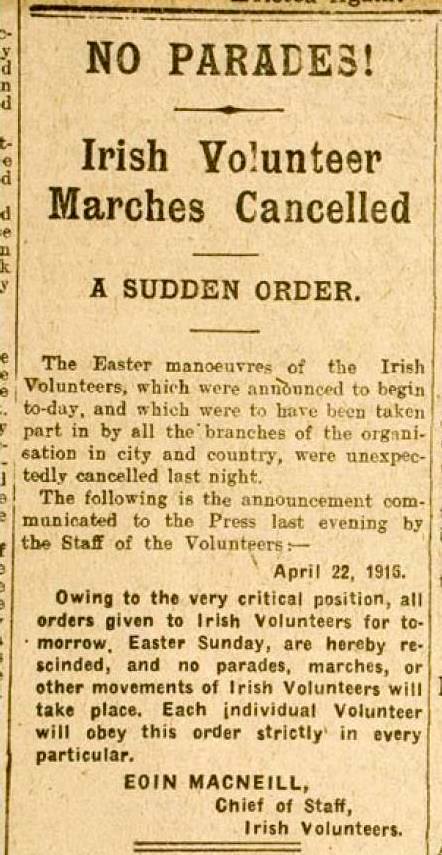
The number of women arrested and questioned in 1916 for their roles in the Easter Rising up until today, 99 years ago, was 64. The paper published their names a week later on the 29th of May, and many believed this number to be the total number of women involved. They could not have been more wrong.

In all, over 200 women are known to have been involved in the Dublin Uprising. More than half are not included on this list – and many more have been lost in time – leaving some to believe that even the higher estimates are lower than they should be. Since many of the documented women are often ignored anyway, we may never have an accurate number altogether but at least there are a few pieces of hard evidence of their involvement, including this tiny clipped article.

In the years leading up to the Centenary celebration, many books and documentaries have made a decent effort to include and acknowledge the female fighters of 1916. I hope they will continue to highlight the women’s fight both for Ireland and for the recognition they deserve in the aftermath. Cheers ladies.

Learn Something!!

Irish Lives in War and Revolution: Exploring Ireland’s History 1912-1923‘ was the name of the online class that I just completed thanks to the partnership between Trinity College and Futurelearn. It certainly lived up to its title, but not in the way I expected. Gone were the heroic tales of Patrick Pearse, Constance Markievicz, or Michael Collins. In their places were the voices, letters, and stories of the average person, struggling to get through his or her life in Ireland during periods of protracted conflict. It featured soldiers and volunteers pretty equally and it was really well constructed. I had a fascinating six weeks and I can’t even begin to tell you how much inspiration it gave me or how many historical events have a new twist (or ten) to think about after taking the course. Thousands of people worldwide took this class online, so I guess the first thing that must be said is way to go Ireland – people like you! And the next is a huge thank you to the teachers, mentors and researchers because this class was really enjoyable and educational.

Continue reading

The executions begin

On this day, 99 years ago, the fateful decision to execute the leaders of the 1916 Easter Rising in Ireland came to fruition. The men were taken from their cells and killed for their role in the uprising during Easter week. The signatories of the new Irish Proclamation had anticipated their deaths since before the Rising began – and while it’s probably not accurate to say they longed for them, they did know that their executions would galvanize many people in Ireland.

The executions began on May 3rd and the last was three months later. By August 3rd when Roger Casement was hanged outside of Ireland’s borders, 16 men had been executed for their roles in the uprising.

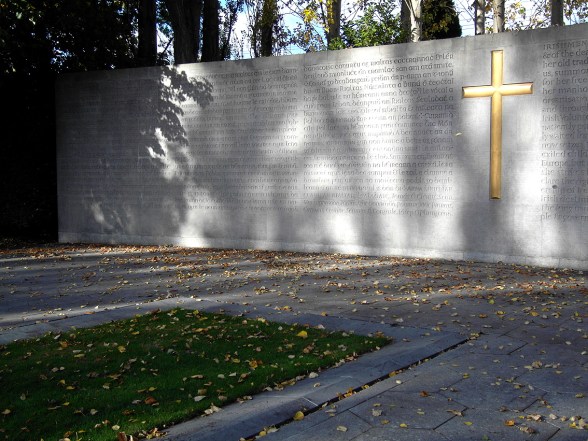
he signatories were shot in the yard at Kilmainham Gaol in Dublin. Today a cross marks the spot where they were killed and ironically, the Gaol now houses a museum dedicated to many Irish Nationalists and Republicans who were once killed or jailed there. It is a booming tourist destination.

Kilmainhamexecution3

The Cost of the Rising

As my commemoration of the 1916 Easter Rising closes out for the year, I feel that it is important to acknowledge that this conflict, like any other, had a downside. Many Irish people suffered unimaginable pain and loss because of the death and destruction that rained down on Dublin during that fateful week. There’s no real way to discern how many lives were touched by the dark side of revolution nor is it possible to gauge how long that devastation lasts. We can look at statistics and see numbers of injuries, buildings lost, and fatalities – but they do not tell us how many left Dublin or Ireland altogether because of those things, or how many families are still touched by the loss, pain, or injuries of their ancestors.

What we do know is that over 425 people died in the rising (not including the executions of the leaders) and 38 of them were children. Another thousand more were injured. More than half off these injuries and deaths were innocent bystanders and civilians. 179 buildings were damaged beyond repair or utterly razed. One hundred thousand people – roughly a third of the entire population – were given assistance in the aftermath of the conflict.

Continue reading

The Foreign Fighters of 1916

Now that some of the Women of 1916 have been highlighted, it’s time to move on to another group that has been largely  left out of the history books when it comes to The Easter Rising. Many brave rebels are celebrated throughout the world every year at this time…but what is ignored by most is that the fighters were not exclusively Irish. There were more than a hundred foreign soldiers who assisted in the Rising and while some were 2nd or 3rd generation Irish there were others who had no Irish blood whatsoever. They came from all over Europe and the rest of the world to join forces against the English and were some of the fiercest warriors in the conflict.

Continue reading

The Women of 1916

It is estimated that at least 200 women were involved in the Easter Rising of 1916, many more than previously thought. Their roles varied as widely as the women themselves – and ranged from the traditional fundraisers, cooks, and nurses, to the more unexpected roles of sharpshooters, spies, smugglers, and experts on explosives.  A decent effort has been made over the last few years to give them credit for the part they played in the fight for Irish freedom, but sadly, they are still largely absent from many of the narratives.

Worse still is when a historian refers to the women as “great supporters” or “brilliant fundraisers” or “backbones”. These statements are true, but they still have an air of dismissal even amidst the recognition. They still show women in supportive or secondary roles and ignore the fact that many of them saw themselves as rebels, fighters, and soldiers in their own right – regardless of whether or not there were any men around. Until more historians can acknowledge that, many of the women who continuously risked their lives during Easter Week and in the years that followed, will not get the respect and honor that they are due.

Continue reading

99 years ago exactly

paper

Easter Monday

Since it is Easter Monday and National Poetry month here in the US, today belongs to Padraig Pearse and his heartbreaking poem, The Mother.

The Mother 
I do not grudge them: Lord, I do not grudge 
My two strong sons that I have seen go out 
To break their strength and die, they and a few,
In bloody protest for a glorious thing,
They  shall be spoken of among their people,
The generations shall remember them,
And call them blessed;
But I will speak their names to my own heart
In the long nights;
The little names that were familiar once
Round my dead hearth.
Lord, thou art hard on mothers:
We suffer in their coming and their going;
And tho I grudge them not, I weary, weary
Of the long sorrow-And yet I have my joy:
My sons were faithful, and they fought.

image

Tom Clarke

On this day in 1857 Thomas James Clarke was born to Irish parents at Hurst Castle in Hampshire, England. It’s more than a little ironic that one of the biggest strategists behind Ireland’s future revolution was born on English soil. In fact, his father was in the British Army and the family did not return to Ireland until Tom was seven years old. They settled in Dungannon, a Fenian stronghold that had suffered terribly during An Gorta Mor – Ireland’s Great Famine. The scars of that disaster were still all around him and from his earliest years, Tom hated the English establishment. He was determined to fight against it however he could.

Continue reading

Grace Gifford Plunkett is born

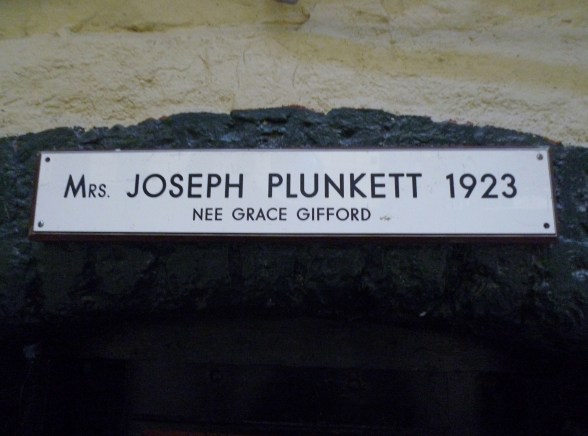
Perhaps the biggest tragedy and the best known story in modern Irish history is that of Joseph Plunkett and Grace Gifford’s doomed love affair and hasty prison wedding. The tragic romance sits right next to Romeo and Juliet in the great sagas of impossible love, and their story may be one of the largest reasons that popular opinion swung in favor of the rebels after the 1916 Easter Rising. The day the British executed Joseph Mary Plunkett, they guaranteed that the story of the rebellion would no longer be remembered without the emotional inclusion of Ireland’s favorite tragic widow – Grace Gifford Plunkett. But before there was a widow, there was a headstrong, artistic woman – one who was born on this day in 1888.
Continue reading