If ever there was a man who stuck to his principles from birth to death, no matter what the cost, it was Ruairí Ó Brádaigh. He was born and raised as a hard-line Republican and he died a hard-line Republican as well, a little over eighty years later.
Tag Archives: Irish Prisoners
Grace Gifford Plunkett is born
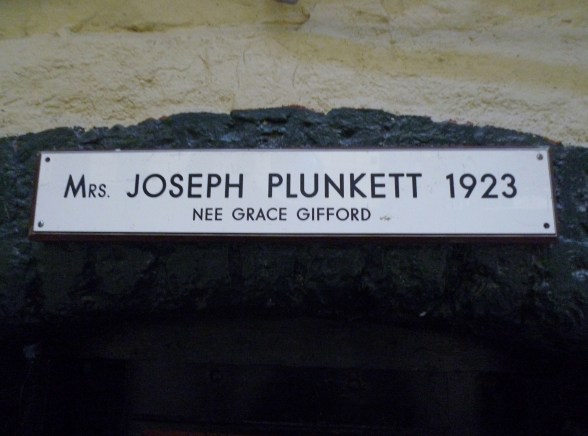
Perhaps the biggest tragedy and the best known story in modern Irish history is that of Joseph Plunkett and Grace Gifford’s doomed love affair and hasty prison wedding. The tragic romance sits right next to Romeo and Juliet in the great sagas of impossible love, and their story may be one of the largest reasons that popular opinion swung in favor of the rebels after the 1916 Easter Rising. The day the British executed Joseph Mary Plunkett, they guaranteed that the story of the rebellion would no longer be remembered without the emotional inclusion of Ireland’s favorite tragic widow – Grace Gifford Plunkett. But before there was a widow, there was a headstrong, artistic woman – one who was born on this day in 1888.
Continue reading
Who Was Mr. Leonard?
41 years ago on Halloween a mysterious American man named “Mr. Leonard” pulled off a serious trick. He hired a helicopter for an ‘Aerial Photo shoot’ in Ireland. It was thought to be a scouting mission for a movie or a book of photography – at least that is what Mr. Leonard told Captain Thompson Boyes, the pilot. Captain Boyes was instructed to fly to a field in Stradbelly in order to grab the photography equipment but when he landed, he was met with armed gunmen instead. “Mr. Leonard” vanished from the scene while Captain Boyes got to know his new masked passengers, much to his own distress. He was informed that he would not be hurt as long as he followed instructions and he wasn’t but he wasn’t given a choice about being involved in a daring prison break either. If he wanted to live, he was going to aid in the escape of Irish Republican prisoners Seamus Twomey, JB O’Hagan, and Kevin Mallon from Mountjoy Prison.
Guildford
On October 5th in 1974, two bombs rocked Guildford, an area south of London. The Provisional Irish Republican Army’s bombing campaign had begun in England and it was brutal and effective. The Guildford pubs were targeted because they were popular with the British Army and the explosions injured about 75 people and killed a handful more. This highly publicized incident aided in the passage of the far-reaching Prevention of Terrorism Act in the United Kingdom shortly thereafter.
Some of the most widely abused provisions under this act were that anyone could be stopped and searched and those arrested could be detained for up to 7 days, rather than the original limit of 48 hours. During that detention, many rights were misplaced and extensive and brutal methods of interrogation were used in an attempt to get confessions from prisoners. As the bombing campaign continued, it led to suspicion, violence and racism within the communities, whether the authorities were involved or not. It was not a good or safe time to be Irish in Britain.
Jailbreak
In honor of the MASSIVE escape from the Maze (Long Kesh) that happened on this day in 1983, I give you this song – played very loudly. 38 IRA prisoners left that day and half that succeeded in escaping. Good on ya boys
The Ghosts of Kilmainham


It has been said that tourists – and mostly American tourists – are the only reason that Kilmainham Gaol is still open because most Irish couldn’t be bothered with it these days. My new friend who is now happily married here in the U.S. agrees with the travel books that say things like that because he and his generation seem to be sick to death of the glorious dead mentality and couldn’t care less about the history and the Troubles that have haunted the country since even before the Rising of 1916. In fact, he was shocked that we were still asked questions about our religion and last names on our travels to Ireland at the end of last year, both in the Republic and the North because he thought those kinds of things were finished.
However, when I did tour Kilmainham Gaol, I was in a group mostly made up of Irish people and all seemed just as profoundly affected by it as I was. Perhaps it was because of the off season which meant my group was thankfully smaller when we went through the infamous prison, or perhaps it was an anomaly altogether but I was glad for it. It made for a decidedly more intimate and more personal experience.
Operation Demetrius
It sounds like a mysterious and enticing thing, Operation Demetrius, so grand…like a top secret cocktail party or a James Bond tryst. It wasn’t – it was just a pretty name for a terrible thing that caused all kinds of problems. It’s better known as Internment and the British introduced it to Northern Ireland on this day in 1971.
The arrests began around 4AM. Witnesses report brutality, abuse, and unnecessary destruction by the police while they searched for their suspects. Other than damage to their homes, the police brought damage to their bodies as well, strapping some to armored vehicles as human shields and wielding batons and other weapons even when they were not resisting. Those arrested were subjected to sleep deprivation, starvation, forced nudity, burns and other forms of torture, all of which were sanctioned by the British government.
Continue reading
The Death of the Countess
“I do wish you lot had the decency to shoot me.” -Constance Markievicz, 1916.
Constance Markievicz may have wanted to die like her compatriots for her role in the Easter Rising but the English wouldn’t execute a woman. In the end, they may have wished they had, for the Countess had another 11 years to continue being a thorn in their side. She went straight into an even more political role, creating a world where women were more equal to the men, remaining staunchly Republican and inspiring thousands of people, including myself, throughout the years since. She is one of my favorite heroes.
Continue reading
Tom Barry’s Birthday
On this day in 1897 Thomas Bernadine Barry was born in Killorglin, Co. Kerry, one of a whopping 14 children. Eighteen years later or so he joined the British Army – an unlikely move that would aid in his future as one of the most respected and strategic IRA commanders in history. While serving in the British army he received news of the 1916 Rising but was unable to return to Ireland until the war he was fighting for Britain had come to an end in 1919.
Upon his return, he got involved in the Volunteer movement. One year later became the commander of the Flying Column 3rd West Cork brigade. He had asked for total autonomy in decision-making and it was given, with a warning that any success or failure would be his responsibility alone. (No pressure!) He then began planning the Kilmichael ambush, a significant political and strategic move that became a touchstone in the War of Independence.
The ambush occurred one week after the first Bloody Sunday. (Yes, I said the first – there have been multiple, unfortunately) It boosted IRA morale and garnered even more respect for Tom Barry and his tactics. It also brought him to the attention of Michael Collins, who was suddenly aware that he had both a strong ally and some fierce competition.
Michael Collins called for Barry to come to both Dublin and London during the Treaty negotiations. It is said that one of the first things the British wanted was Tom Barry himself. Michael Collins refused, though he later claimed that he had been tempted to give Barry to them. When the treaty was ratified – over Barry’s objections due to the partitioning of the Island – he continued to fight on the behalf of the Anti-Treaty IRA until he was imprisoned by Collins’ Irish Free State Army. He escaped and continued to command in various locations until the Anti-Treaty IRA was defeated and he was captured once again.
Upon his release, he spent a term as the IRA Chief-of-Staff and served as general superintendent of the Cork Harbor Commission for nearly 40 years. Still an unrepentant Republican, at the age 62 he traveled to the United States in the hopes of gaining funds and support for a united Ireland. His one wish and lifetime goal was to end the partition of Ireland. He died in 1980 and was buried at St. Finbarr’s Cemetery in Cork. Though St. Finbarr’s cemetery has one of the largest Republican plots in the area, Tom Barry is not interned in it but instead is buried nearby.
Roger Casement
On this day in 1916, Roger Casement (once Sir Roger Casement) was convicted by the British crown for high treason. Roger Casement was an anomaly. He was a foreign office diplomat who could never quite get what he was after. He was knighted for his humanitarianism but was trying to broker arms deals. He believed in Irish Republicanism but some of his comrades believed he was too moderate while others believed he was too extreme. He was a rumored sex tourist who traveled to hide and indulge in his homosexuality. And despite having no foreknowledge of the upcoming Easter Rising – being that he was NOT a member of the IRB and they did not fully trust him – he was still convicted of high treason and some of the charges that led to his death were that he helped to plan the rebellion.
It was surprising that he heard of it at all. Casement had been out of the country and then was in the north and kept in the dark by the Republican Brotherhood. He was arrested 3 days before the Rising began – after failing to get Germany to agree to send reinforcements into Ireland to fight the British – and after a whole shipment of German arms heading into Ireland was intercepted. His case was difficult because he was in Germany when such ‘crimes’ happened, but they were relentless in his prosecution.
His supporters at trial were the likes of Sir Arthur Conan Doyle, W.B.Yeats and George Bernard Shaw. Perhaps the revolutionaries weren’t sure about him, but the popular writers of the day sure seemed to be. On June 29th, 1916, he was stripped of knighthood upon his conviction and sentenced to a death by hanging.
His appeals failed. By the time he was hanged, he had converted from Protestant to Catholic and his priest thought he should be considered a saint. He was buried in quicklime at the prison after his death. In 1965, he was repatriated to Ireland and laid to rest with full honors and a state funeral in the Republican Plot at Glasnevin Cemetery. However, Casement’s last wish was to be buried at Murlough Bay on the North Antrim coast and it has yet to be fulfilled. The government released his remains only on condition that they not be brought into Northern Ireland. Oddly enough, the 1965 British Cabinet record of the decision still refers to him as Sir Roger Casement.
Perhaps someday he will get his wish.
 Choosing the Green
You must be logged in to post a comment.