Martin McGuinness

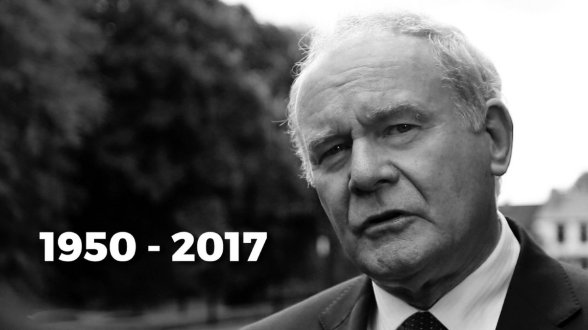
The world lost a giant a few moments ago. Former Deputy First Minister Martin McGuinness was a warrior, a peacemaker, and so much more. It’s not shocking news, but it is devastating. It is safe to say that without Martin McGuinness, the IRA ceasefire(s) and the Good Friday Agreement would probably have never happened. He is remembered by some as a modern Michael Collins and any Irish historian would probably agree that there’s a good deal of truth in that comparison.

McGuinness shaped politics in the North for decades and this evening the region lost much more than a single man. My thoughts and condolences go out to his friends and family and I hope that they can find the comfort they need in the days to come. My candles are lit and there is nothing else I can say at the moment as I try to form my own thoughts into words and to process the passing of such a vital and important person in modern Irish history.

Ar dheis Dé go raibh a anam

https://www.rte.ie/news/2017/0321/861287-martin-mcguinness-death/

The Bay Goes Green

San Francisco has its faults – many of them in fact. The sky-high living expenses, lack of good public transportation, and rising eviction rates make living anywhere in the Bay Area a tricky, anxiety-inducing endeavor. Sometimes it is really hard to remember that it has its perks too – and one of those is the city’s annual St. Patrick’s Day Parade. Continue reading

Elections

Our lives are full of choices. Every day we face them – some small and trivial and others that change lives. If we’re lucky (or unlucky as the case may be) some even change the course of history – and it is important to acknowledge those choices with the gravitas they deserve. The North of Ireland is about to have one of those game-changing elections and it needs to be carefully considered because the next few decades and any remaining scraps of the Good Friday agreement are just the beginning of what’s at stake.

Continue reading

Sheena Fagan Campbell

Sheena Campbell was an enthusiastic and dedicated woman, who was born on this day in 1962. She was a young Irish Republican whose groundbreaking ideas energized and won an important election for Sinn Fein in 1990. Those same ideas, called the torrent strategy, have shaped the foundations of every Sinn Fein campaign since. Ms. Campbell would probably be very proud of this achievement had she not been killed in 1992, just two years after reorganizing the way Sinn Fein prepared for elections.

Continue reading

The Party’s Over

Reading headlines from Ireland over the last few weeks was strange because I could have sworn I’d read them before…and I have. Hunger Strike commemorations, anger over parades, riot police protecting interlopers over residents, arson fires at community centers, the birth of new political parties, and spies in the IRA have dominated the media of late. The anger, frustration, and general sense of “what the fxck” that came with it all was a bit stronger in the last couple of weeks than it has been in much of the last few decades. The pictures, headlines, and videos gave me a sense of foreboding and a lingering confusion which kind of felt like I was having a bad flashback. Unfortunately, that was not the case.

Continue reading

Arrest the Shinners

The English government could never really figure out how to deal with Sinn Fein or its increasing popularity after the Easter Rising of 1916. They blamed the insurrection on the “Shinners” even though the burgeoning political party had little to do with the battle and they were surprised when much of the Irish population flocked to the organization after the government executed all the leaders of the Rising. They tried to downplay Sinn Fein’s popularity and remove its influence on many occasions, but most of the time whatever they tried had the opposite result. The same was true when the government decided to arrest nearly every leading ‘Shinner’ in Ireland ninety-eight years ago today.

Continue reading

Hell No, We Won’t Go

In 1918 it was nearly impossible to get the Catholic church, politicians, working class citizens, labor unions, suffragettes, Unionists, and Irish Nationalists to join together for anything. Ireland was still reeling and recovering from the Easter Rising of 1916, which most of these groups were still arguing over (as they are still doing today), but there was one proposal that unified them all – the Home Rule/Conscription law. Continue reading

The Dark One

On this day in 1948, Brendan “The Dark” Hughes was born. He came from a long line of Republican fighters, and as he grew up, he knew that his own entry into the IRA was inevitable. He was right and he was an effective soldier. Later in life he often talked about peace, reconciliation, tearing down the peace walls, and improving relations in the North of Ireland – but he knew he was being idealistic. That peaceful existence may have been what he ultimately wanted, but his life was filled with violence, prison, hunger, and retribution.

Continue reading

Gerry Adams

He’s been called a murderer, a terrorist, and an evil ringleader. He’s been banned from travel and speech, and he’s been flown around the world to give speeches. He’s been reviled and celebrated, and has been protected by many even as he is threatened by his own people, in addition to the threats from his enemies. He’s divisive and unifying, a liar and a speaker of truth, a politician and a probable paramilitary leader, although he denies that second part. He’s been labeled as Machiavellian and diabolical, or a man of peace and kindness, depending on who you ask. He’s been a prisoner and now rules as a politician – one who some have compared to Nelson Mandela. Many thought he should have shared the glory of Hume’s Nobel Peace Prize, even as others accuse him (then and now) of atrocities and war crimes. Gerry Adams has been many things to many people and it’s hard to know whose impressions are right, but one thing is apparent to everyone. He is not going away.

Continue reading

Ruairí Ó Brádaigh

If ever there was a man who stuck to his principles from birth to death, no matter what the cost, it was Ruairí Ó Brádaigh. He was born and raised as a hard-line Republican and he died a hard-line Republican as well, a little over eighty years later.

Continue reading