The face of sectarianism

I already posted a pretty lengthy opinion on the Orange Order parades so I won’t rehash it now. However, the planned “graduated protests” and the threats of real violence from Protestant leaders prove again that these people have failed to lead at all. If you ‘cannot guarantee’ that your own parades will be peaceful and you are in fact promising that they won’t, what right to you have to call yourself a leader? A sane party host would take responsibility for their guests and cancel the party themselves if things were sure to get out of hand. They would not be falsely ringing their hands, shrugging their shoulders and standing by while their home got destroyed. Leaders who cannot lead should be fired from their jobs no matter which side they adhere to.

And then there’s this.

Vandalized Mary

And this.

Effigy of Gerry Adams

These disgusting crimes put the question of “heritage and tradition” to rest, unless tradition has always been hate-filled supremacy and heritage has always been power over and at the extent of someone else. It is time to put an end to these truly vile events. It’s time to call it what it is – which in these cases, is a celebration of sectarianism, hatred and entitlement.

And please, if you are reading this from the North, do the right thing. Put pressure on the authorities to charge these things as the hate crimes that they are but for the next 48 hours, try to take the high road. Whether you are marching, protesting, or protecting yourselves, try to stay peaceful no matter what and keep each other safe. Respect should be granted to all humans, regardless of which side of the divide you stand on. I hope everyone and everything (except the hateful bonfires) are still standing on the 13th, as unlikely as that seems to be. My thoughts are with you from across the puddle.

A Love story

Today I give you a love story – one that I hope will become a fairy tale ending. When I begrudgingly came home from Ireland at the start of the year, I had a coffee date with a good friend who was enthralled with the stories I was sharing with her. She promptly went home and started researching Ireland on many sites – including a dating one that she had a profile on.

She changed her location search to Ireland and browsed a few profiles there. Within a couple of weeks, she was in constant conversation with a man from Dublin. Each stayed up all night to continue talking despite the time difference and when she flew to Dublin six months later for her first “real” date, I was thrilled for her, particularly when they hit it off even better in person. By the time she left, she had met the parents and friends, and they were planning for him to move here to the U.S.

This is where I think the story goes a little backwards, at least in my head. I want to leave the U.S. and live in Ireland, and eventually, so does she. While I was traveling there, the first question most people asked me once they learned I was an American was “Well, what the hell are you doing here?”. I understand the economy is terrible in Ireland – it is here too – but I was surprised and saddened when the people I spoke to were desperate to get out of Ireland – particularly when all I wanted to do was stay. It is thought that more Irish live outside Ireland than within it, which is a terrible statistic.

But I digress. He was to move here. When he was laid off in Ireland, he joined thousands who had been unable to find a job, and she has one here that could support them both temporarily. So despite her desire to eventually move there, he just landed here in the United States and they are off to a good, if lightning quick, start.

Here is where the tricky business of visas comes into play. He can only stay for a few months unless they get married – which is their plan – to the bewilderment, trepidation, and fascination of everyone that hears their tale. They are a love match but are still getting to know each other outside of the internet. In addition, he has to acquaint himself with a whole new country in a short amount of time, one in which he likely will be unable to work at least for a few months. They have been forced through geography and government to make drastic decisions in an incredibly short amount of time.

They’re choosing each other, consequences be damned. Whether it works out in the end or not, I have to salute their willingness to change everything for each other and try to make it work. It’s rare to find a person who matches you – especially one who will grab the hand and jump – no matter where that leads. Their story gives me a goofy grin and can only hope that it works for them…despite my belief that she’s doing it backwards.

Slainte to you both

Walking tour – Revolutionary Women

The good folk at the Sinn Fein shop in Dublin have an amazing walking tour that they offer, that they call the Rebel Tour. I highly recommend it for people who are interested in Irish history – and even people who know a lot about it already are guaranteed to learn something new on the walk. ( The Rebel Tour )

That being said, I would do almost anything to be able to fly over the puddle and meet Dr. Mary McAuliffe this weekend for her own walking tour. Her tour is based on the revolutionary women who helped shape Ireland’s history – but who are often times reduced to a footnote in it. This is an insult that must be addressed in all the history books of all nations, but this year Ireland is doing a lot to remedy it. Perhaps it is due to the hundred year anniversary of Cumann Na mBan and the renewed interested in the female rebels, or maybe it is just because it’s time to acknowledge the women warriors. Either way, things like this walking tour make me very happy and I hope both men and women get involved in it. I am very sad that I am too far away to experience it.

If you aren’t, please join this tour on Sunday – and report back to the rest of us who cannot.

Rebel Women Walking Tour

Learning Irish

English not preferred or spoken here

English not preferred or spoken here

I beg the pardon of everyone who is a fluent speaker of Irish when I say that your language is damn near impossible and really, really HARD. Seriously. It’s enough to sometimes make me want to throw my lessons across the room and sometimes I just want to rock back and forth and cry.

I’m wondering if there’s anyone out there who has ever participated in the San Francisco Irish Immersion weekend to help with the learning. It seems pretty awesome but it is expensive, so if there’s anyone who has done it or may be interested in going and learning one of the most frustrating (sorry) languages ever, let me know or register here:

http://www.onesourcegraphics.com/Gaeilge/
CinnLine_nios-mo

July 2nd belongs to The Irish Brigade

Today I give you a story of the Irish in America during the Civil War. Throughout American history the Irish have always had a connection to discrimination – first being discriminated against  (No Catholics, No Irish) and then gaining a generalized reputation for discriminating against others. Part of this stems from their own persecution that developed into a deep distrust of anyone outside of their own communities. Some of it is just the age old misconceptions of the Irish in general – that they’re all devoted to shenanigans, violence and little else.

If you buy into those generalizations, you may assume that the Irish Brigade fought for the Confederacy in the Civil War. Thankfully, you’d be totally wrong. They were a highly effective tool for the North, though many were conflicted and unsure of their allegiance. The Union promised them more freedoms and rights, even if they had to fight for them – but many also worried that emancipation would involve more people who would challenge them in their struggles to find even the lowliest of jobs. But in the end, the Fighting Irish committed to the North and when they did, the North gained a company of men that were brilliant fighters who seemingly would never give up.

The Irish Brigade was nearly decimated more than once but they continued to fight even when they lost more than half their numbers. In the battle of Fredericksburg, their numbers fell from 1600 to a measly 256. It was during that battle that General Robert E. Lee allegedly referred to the Irish company as the “Fighting 69th”. They bled through some of the biggest battles of the Civil War and were disillusioned, tired, and only about 500 strong on July 2nd, in 1863, when they fought in the battle of Gettysburg.

As they prayed near Cemetery Hill before they went into battle, the soldiers knew that they were grossly outnumbered and likely to die. They made their stand in a place that would henceforth be known as the Wheatfield, where they were part of an attack designed to stall the Confederate forces that were advancing. The Brigade initially forced them back, fighting dirty with all they had – hands, knives, bayonets, clubs, and muskets. It was such a fierce melee that one of their opponents was quoted as saying that it was “the hottest and sternest struggle of the war.” Ultimately, after losing over one third of their already skeletal numbers they were pushed back, but their ferocity had slowed the South enough that the Union line held until reinforcements arrived.

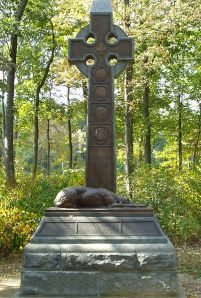
In the end, during the entire Civil War, only 2 other Union brigades lost more people than the Irish. There is a beautiful statue of a Celtic cross with a mourning Irish Wolfhound that’s been raised on the battlefield in Gettysburg to commemorate their sacrifice. Gettysburg is hallowed ground to many but near the cross you can almost hear the battle cry of the Brigade – Fág an Bealach, which means Clear the Way. And the nickname that General Lee had given the unit, has stuck around for more than a century, living on even now. The Wolfe Tones wrote a song about them that the Dropkick Murphys have resurrected and covered. Also, since 1907, the Fighting 69th has been a unit in the National Guard Of New York. They have fought in both World Wars and served with distinction in almost every conflict to this day.

  Gentlemen, thank you for your service.


In Memorium, Irish Brigade

In Memorium, Irish Brigade


Tom Barry’s Birthday

On this day in 1897 Thomas Bernadine Barry was born in Killorglin, Co. Kerry, one of a whopping 14 children. Eighteen years later or so he joined the British Army – an unlikely move that would aid in his future as one of the most respected and strategic IRA commanders in history. While serving in the British army he received news of the 1916 Rising but was unable to return to Ireland until the war he was fighting for Britain had come to an end in 1919.

Upon his return, he got involved in the Volunteer movement. One year later became the commander of the Flying Column 3rd West Cork brigade. He had asked for total autonomy in decision-making and it was given, with a warning that any success or failure would be his responsibility alone. (No pressure!) He then began planning the Kilmichael ambush, a significant political and strategic move that became a touchstone in the War of Independence.

The ambush occurred one week after the first Bloody Sunday. (Yes, I said the first –  there have been multiple, unfortunately) It boosted IRA morale and garnered even more respect for Tom Barry and his tactics. It also brought him to the attention of Michael Collins, who was suddenly aware that he had both a strong ally and some fierce competition.

Michael Collins called for Barry to come to both Dublin and London during the Treaty negotiations. It is said that one of the first things the British wanted was Tom Barry himself. Michael Collins refused, though he later claimed that he had been tempted to give Barry to them. When the treaty was ratified – over Barry’s objections due to the partitioning of the Island – he continued to fight on the behalf of the Anti-Treaty IRA until he was imprisoned by Collins’ Irish Free State Army.  He escaped and continued to command in various locations until the Anti-Treaty IRA was defeated and he was captured once again.

Upon his release, he spent a term as the IRA Chief-of-Staff and served as general superintendent of the Cork Harbor Commission for nearly 40 years. Still an unrepentant Republican, at the age 62 he traveled to the United States in the hopes of gaining funds and support for a united Ireland. His one wish and lifetime goal was to end the partition of Ireland. He died in 1980 and was buried at St. Finbarr’s Cemetery in Cork. Though St. Finbarr’s cemetery has one of the largest Republican plots in the area, Tom Barry is not interned in it but instead is buried nearby.

‘In the end Gerry Conlon won’

Yesterday the funeral of Gerry Conlon was held in Belfast. He was a great inspiration to me as I have said before here: https://lightandthunder.wordpress.com/2014/06/21/gerry-conlon-r-i-p/

A fantastic article on the service and his life was posted in the Irish Times. Once again, I am reminded of how far away from Ireland I am – and of where I’d be if I were not.   Suaimhneas síoraí

‘In the end Gerry Conlon won – the victory was his’.

Irish Studies Programs – Updated

Yesterday’s post about the best schools to get your Irish Studies programs needs an update. I went straight for the online program – the only in the world – based in Galway because I’m a non-traditional student who can’t quit any of her 3 jobs for class time. The list I posted yesterday shows a partnership for that program with a U.S. school in Colorado but the links didn’t work when I tried them. I contacted the school in Ireland and while there used to be a partnership, it no longer exists, and you have to sign up for the program through Galway directly.

No problem – I’m still totally excited. Except for one thing – a whopping 12,750.00 per year international student fee….which applies since the partnership isn’t valid anymore. That is on top of the class fees and things that are needed to complete the course – which I thought was definitely update worthy, since U.S. students can’t get federal aid for those courses either. Alas.

It makes me sad, as the idea of an online program really opened some doors in my brain – but I will have to just table that again. I will continue to study as I have for the last 20+ years and be satisfied without a paper that tells other people that I’ve done so. For those of you that can take traditional classes – or afford nearly 13,000 euros, still check out that list since there are options. The Galway link was so enticing – and if you could manage that – the class looks as if it’s extensive and lovely.

On the off chance

that there are any  of you in the USA looking to further your Irish studies as I am, here’s a great resource. I find it incomprehensible that there are no studies programs here in San Francisco and unfortunately, you must be far richer than I to go to Berkeley or any of the other main schools that this lists, but it’s still a great chance to explore the options. Thanks Irish Central!

http://www.irishcentral.com/news/education/The-definitive-list-of-Irish-Studies-programs–United-States-and-Canada-.html

Paul Hill remembers Gerry Conlon…

Here, Paul Hill, a fellow Guildford Four member and a leading human rights campaigner based in the US, remembers his friend Gerry Conlon.

I was awoken this grey morning (rather fitting) by the constant ringing of my phone to be informed of the death of Gerry Conlon my fellow member of the Guildford Four.

Doors I had hoped would remain closed began to open in my memory.

It’s incredibly difficult to try to explain to someone exactly what the loss of 15 years of one’s life is like.

Or indeed to ask someone to comprehend having to endure those years as an innocent person, in the hostile environment that was the English prison system.

The simplest way is to think of everything one has achieved in the years between 20 and 35. A career, a home, a marriage, children. We had none of those.

Gerry was a young man who loved life ,music, football. He would have been the first to tell you he had no interest whatsoever in politics.

The background of what he went to prison for is well documented, as is the injustice he suffered,

But the baggage he carried from that is often overlooked, baggage that one can never check.

The mental scars, not visible, remained unhealed. They eat away at one’s being and reopen constantly.

Gerry fought the demons that an injustice unleashes, but I know that he mostly fought those alone and in the dead of night.

People have expressed the opinion that Gerry must have been an incredible man. No, he was not. He was an ordinary man who suffered an incredible injustice.

No doubt we shall have those who (just like after his release) will extol his virtues, whilst having done nothing themselves whilst he was incarcerated,

If I could be so bold, and on behalf of Gerry, I would like to thank all those very ordinary people who believed in him when (unlike today) it was not politically hip to do so. Irish America always stood with us — thank you. Irish governments and Irish embassies did not.

I want to thank the folks who stood in the rain outside the British Embassy, who were accused of being the fellow travelers of terrorists,

The ordinary folk in Ireland who were harassed and photographed by the special branch for having the courage to attempt to right a grievous injustice.

We have come a long way along a harsh, painful road.

Gerry helped us all along that journey.

He was a man of immense humor and a big football fan, no doubt glued to the World Cup.

I know he would give a wry smile knowing England went out before him.

Here is his family’s statement. It captures far more eloquently that I can what Gerry represented.

“He brought life, love, intelligence, wit and strength to our family through its darkest hours. He helped us to survive what we were not meant to survive. We recognise that what he achieved by fighting for justice for us had a far, far greater importance – it forced the world’s closed eyes to be opened to injustice; it forced unimaginable wickedness to be acknowledged; we believe it changed the course of history.

-Paul Hill

http://www.irishcentral.com