Sláinte, Mr. Guinness

Today we raise a pint of the good old black stuff to the man himself–Arthur Guinness–whose full life came to a close on this day in 1803.

Arthur Guinness is the founder and creator of Guinness brewery, and though he did not create the dark stout that the company is now famous for, he was responsible for signing a 9,000 year lease, guaranteeing that the brewery would always have a place to operate in Dublin. This permanence allowed for funds to be allocated for experimentation and distribution and he made sure to do both. He was already a master brewer and his creations resulted in a decent porter coming to the city and a load of devoted ale drinkers. They called him Uncle Arthur for much of his life. He and his (poor) wife Olivia had 21 children, half of whom lived, but none of his descendants are directly involved in the brewery business at this time.  Still, his signature flourishes can be seen on every can or bottle that the company produces and his legacy is honored in Ireland and around the world to this day.

A recent offering, the 1759, is a 750ml bottle of Guinness Ale–not Stout–that is based on recipes from that time. It is likely the closest we’ll get to Arthur’s own creations in this day and age. The brewery has been transformed into the number one tourist attraction in Dublin, and though visitors don’t get to see the inky stout being made, they do get the history of the brewery, a look at the longest lease ever, and one of the greatest views in Dublin. Today I’d like to personally thank Uncle Arthur for one of my favorite adult beverages on the planet, because even though it will never taste the same outside of Ireland, without him, it may never have reached our far shores at all.

Sláinte

guinness

Anne Devlin, Ireland’s Almost Entirely Ignored Hero

Today is not the day Anne Devlin died but September 18th is. Given that the Scottish vote will be the news of that day this year, I thought I would step back for a minute into my favorite subjects. I started this blog because I am incredibly passionate about history in general – and Irish history in specific. I make an effort to highlight Irish women – the rebels, suffragists, and strong women who fought for Ireland just as much as their male counterparts but who rarely get the same credit. The Scottish referendum on Independence is HUGE news but their vote falls on an all too forgotten date in Irish history as well – and to ignore that would be yet another travesty inflicted upon Anne Devlin. Given that she suffered more brutality in her life than most would ever survive, the least I can do is mark the anniversary of her passing and give her the recognition that she deserves – even if I tell my tale of her life and death a day early.

Continue reading

The Mysterious Death of Michael Collins

Few political and military leaders span the spectrum like Michael Collins did. He was a brilliant strategist, and went from an IRA guerrilla leader who could pretty much do anything to a reluctant politician and a commander in the National Army.

Mick was used as a pawn and a scapegoat by Eamon De Valera in the Anglo-Irish Treaty negotiations that resulted in the partition of Ireland in 1921. He wanted no part in the political process but was sent anyway despite his fervent objections. He knew this agreement would bring chaos and anger to the Isle and was personally against it. Still, his name was signed and when another signatory mentioned that by signing it, he may have ended his own political career, Collins replied with “I may have signed my actual death warrant.” He was right. Continue reading

The Ghosts of Kilmainham

Kilmainhamlock

It has been said that tourists – and mostly American tourists – are the only reason that Kilmainham Gaol is still open because most Irish couldn’t be bothered with it these days. My new friend who is now happily married here in the U.S. agrees with the travel books that say things like that because he and his generation seem to be sick to death of the glorious dead mentality and couldn’t care less about the history and the Troubles that have haunted the country since even before the Rising of 1916. In fact, he was shocked that we were still asked questions about our religion and last names on our travels to Ireland at the end of last year, both in the Republic and the North because he thought those kinds of things were finished.

However, when I did tour Kilmainham Gaol, I was in a group mostly made up of Irish people and all seemed just as profoundly affected by it as I was. Perhaps it was because of the off season which meant my group was thankfully smaller when we went through the infamous prison, or perhaps it was an anomaly altogether but I was glad for it. It made for a decidedly more intimate and more personal experience.

Continue reading

Oh Captain, My Captain

This last weekend in Merrion Square, hundreds of Dubliners saw an outdoor viewing of one of my favorite movies in the world – Dead Poet’s Society. The proceeds went to various suicide prevention and mental health programs in Ireland which is incredibly encouraging. Here in the U.S., our entire health care system is broken and the worst victims of this are those who suffer from mental health afflictions. Whenever something that is this tragic and heartbreaking happens, we always hope that it will change the dialogue and the system, but it rarely does anything to truly help, except at a grass roots level. Our politicians can’t admit that the reality of how poorly we treat our citizens is appalling because then they would actually have to come up with a way to change it – and that involves a complete revamp of mental and physical healthcare. Continue reading

July 2nd belongs to The Irish Brigade

Today I give you a story of the Irish in America during the Civil War. Throughout American history the Irish have always had a connection to discrimination – first being discriminated against  (No Catholics, No Irish) and then gaining a generalized reputation for discriminating against others. Part of this stems from their own persecution that developed into a deep distrust of anyone outside of their own communities. Some of it is just the age old misconceptions of the Irish in general – that they’re all devoted to shenanigans, violence and little else.

If you buy into those generalizations, you may assume that the Irish Brigade fought for the Confederacy in the Civil War. Thankfully, you’d be totally wrong. They were a highly effective tool for the North, though many were conflicted and unsure of their allegiance. The Union promised them more freedoms and rights, even if they had to fight for them – but many also worried that emancipation would involve more people who would challenge them in their struggles to find even the lowliest of jobs. But in the end, the Fighting Irish committed to the North and when they did, the North gained a company of men that were brilliant fighters who seemingly would never give up.

The Irish Brigade was nearly decimated more than once but they continued to fight even when they lost more than half their numbers. In the battle of Fredericksburg, their numbers fell from 1600 to a measly 256. It was during that battle that General Robert E. Lee allegedly referred to the Irish company as the “Fighting 69th”. They bled through some of the biggest battles of the Civil War and were disillusioned, tired, and only about 500 strong on July 2nd, in 1863, when they fought in the battle of Gettysburg.

As they prayed near Cemetery Hill before they went into battle, the soldiers knew that they were grossly outnumbered and likely to die. They made their stand in a place that would henceforth be known as the Wheatfield, where they were part of an attack designed to stall the Confederate forces that were advancing. The Brigade initially forced them back, fighting dirty with all they had – hands, knives, bayonets, clubs, and muskets. It was such a fierce melee that one of their opponents was quoted as saying that it was “the hottest and sternest struggle of the war.” Ultimately, after losing over one third of their already skeletal numbers they were pushed back, but their ferocity had slowed the South enough that the Union line held until reinforcements arrived.

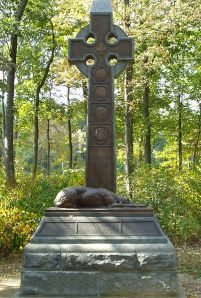
In the end, during the entire Civil War, only 2 other Union brigades lost more people than the Irish. There is a beautiful statue of a Celtic cross with a mourning Irish Wolfhound that’s been raised on the battlefield in Gettysburg to commemorate their sacrifice. Gettysburg is hallowed ground to many but near the cross you can almost hear the battle cry of the Brigade – Fág an Bealach, which means Clear the Way. And the nickname that General Lee had given the unit, has stuck around for more than a century, living on even now. The Wolfe Tones wrote a song about them that the Dropkick Murphys have resurrected and covered. Also, since 1907, the Fighting 69th has been a unit in the National Guard Of New York. They have fought in both World Wars and served with distinction in almost every conflict to this day.

  Gentlemen, thank you for your service.


In Memorium, Irish Brigade

In Memorium, Irish Brigade


John Sands, father of Bobby Sands

On this Father’s Day I am very saddened to hear the news that John Sands, the father of famed hunger striker and Irish martyr Bobby Sands, has passed away. I cannot imagine the pain of a father losing a child and I hope that how Bobby has been remembered and the love of the rest  of his family made his life easier after the loss of his son.  I also hope that son’s beautiful smile was the first he saw in his afterlife for that would be a happy Father’s day indeed.

Rest in Peace sir.

His memorial service will be held  Tuesday, 17th June, at St Agnes’ Chapel, Andersonstown Road, in Belfast.