Ireland has always had more than its fair share of feisty women. By 1908 there were already numerous Suffragist groups in Ireland, full of women who wanted equality, the ability to vote, and more freedoms. Many of these groups focused on petitions, publicity, and spreading their message through polite channels and discourse, and they attracted many prominent socialites who used their influence to further the cause. This was not good enough for Hanna Sheehy Skeffington, her husband Francis, and their radical friends. 108 years ago today, they founded the Irish Women’s Franchise League, a group dedicated to equal rights that used agitation and action to spread their message.
Tag Archives: Irish history
The struggle for equality

Women have been fighting for equality and recognition for centuries. In Irish history, women have always been seen as supporting cast members, fundraisers, nurses, etc. and safely put in the appropriate roles for their gender, whether they could do more or not. This has been the case for years and years and only now is that idea starting to be debunked by historians…but the historians devoting themselves to elevating the roles of women are mostly female. Myself included. Continue reading
Josie McGowan
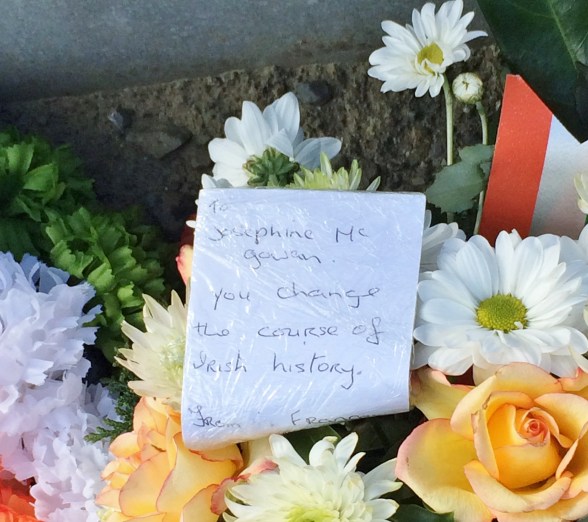
Josephine McGowan was one of the many women who participated in Ireland’s struggle for freedom. She was a member of the Inghinidhe na hEireann branch of Cumann na mBan and was stationed at the Marrowbone Lane garrison during the 1916 Easter Rising. She was one of twenty-five women who reported for duty and according to one witness statement, Marrowbone seemed to have more women than men at the beginning of the fight. Some of the women vanished throughout the week but Josephine stayed until the very end.
San Francisco’s temporary Gaeltacht
Learning Irish is a struggle for me. I’ve tried many programs, and dutifully play with my Irish Rosetta Stone weekly but it is somewhat joyless and difficult without another Irish speaker to practice with. So when the advertisement for the 18th annual Irish Immersion weekend at the United Irish Cultural Center in San Francisco, California came across my radar, I planned on trying to find a way to attend.
This was not my first attempt but the Immersion’s price tag is a bit steep so I’ve never made it before….and probably wouldn’t have made it this time either except that my registration fee was a birthday gift from a dear friend I always go to Ireland with. Kathleen’s theory is that one of us needs to learn Irish in preparation for the inevitable day that we move to Ireland – and I thought I was pretty up to the task. I felt pretty confident about what I already knew when I walked in but I quickly learned that it is one thing to know some phrases or a lot of vocabulary and another altogether to be able to carry on a coherent conversation. I was even more intimidated when I realized that some of ár múinteoirí were prominent and well-known Irish speakers in Ireland, who bring the language to life every day.
Sidney Czira
There was more than one amazing Gifford girl. Grace has been immortalized in the annals of Irish History and song, but her sisters were just as political, in fact more so, than the tragic bride of 1916. Sidney was one of the first Gifford sisters to get involved in politics, even though she did it quietly and under the assumed name of John Brennan. In a world where women weren’t listened to, Sidney made her voice and her opinions heard.
The Death of Innocence
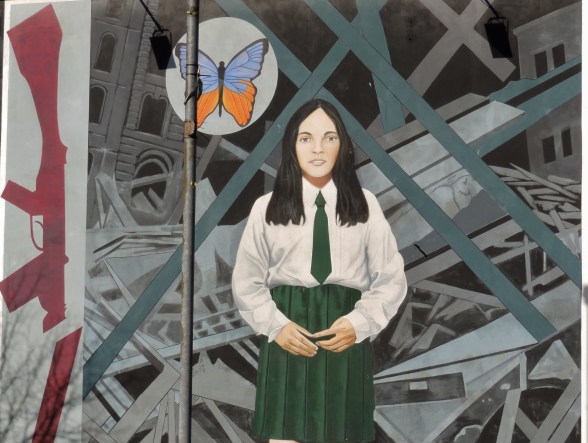
Annette McGavigan was only eleven years old when the Troubles erupted in the North of Ireland. Her home was in Derry, one of the major flashpoints of the Troubles and a stronghold of the Provisional Irish Republican Army. She and the other children of the area witnessed more conflict than any child should within those first few years. She would have seen the British Army rolling into her city, bringing CS gas, rubber bullets, violence and protest with them. Riot after riot broke out and civil rights marches, anti-internment protests, and anti-police incidents were frequent and violent. These things probably became rather commonplace over the next few years for Annette and the other children who were growing up in areas like Creggan, Little Diamond, and the Bogside.
On Sept. 6th, 1971, when Annette was only fourteen, Catholic schools were closed in Derry. Teachers were taking part in a week-long anti-internment program. This left the schoolchildren with free time. Some joined the protests and riots and others stayed in. Once a small riot had ended on the edge of the Bogside, Annette and her friends went out to collect the leftovers of the violence. Children regularly gathered rubber bullets, gas canisters and more after each riot in Derry and this day off from school gave Annette the perfect opportunity to hunt for these dangerous souvenirs. As the young girl in a school uniform picked up an empty cartridge, a shot rang out. She likely never knew what hit her.
John Donaldson, the Baron of Lymington
“Who will you believe, the police or the suspects?” Justice John Donaldson is not the first judge to undermine defense lawyers with a question like that but he made this biased statement and others while he was presiding over the trial of Paul Hill, Paddy Armstrong, Carole Richardson, and Gerry Conlon – a group of Irish suspects who were also known as the Guildford Four. The highly publicized case was covered widely and all of the judge’s snide remarks and opinions were too. This pointed question for the jury was the last nail in the coffin for the Guildford Four. When their guilty verdicts came back, Donaldson wished that he could hang the suspects and went on the record saying so during sentencing. The bully judge imposed the longest sentence in the history of English law (at the time) against Paul Hill saying, “Your crime is such that life must mean life, and if the death penalty had not been abolished, you would have been executed.” The other members of the Guildford Four didn’t fare much better when the sentencing came down and in the subsequent case where many of their friends and family members were accused of bomb making (known as the Maguire Seven) similarly harsh and opinionated sentences were handed down. Donaldson had no pity for one suspect’s serious illness and another being only fourteen years of age. He just handed out lengthy sentences and cruel comments to everyone. He never backtracked from his dubious remarks even after he was heavily criticized for them. In fact, the only times he was silent during this entire ordeal were when the IRA claimed responsibility for the bombs years later, when it was proven that the police had suppressed evidence and lied throughout the trials, and when those he had so gravely threatened were declared innocent fifteen and sixteen years later, respectively. Continue reading
The death of De Valera
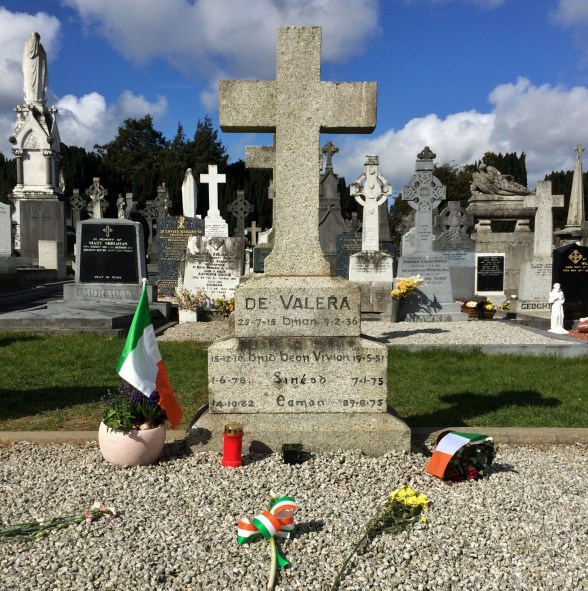
Love him or hate him, Eamon De Valera was perhaps the most influential man in Irish History, despite the fact that he was born in the United States. He helped create the political machine of modern Ireland and his influence is still being felt (and untangled) today, forty-one years after his death.
Ballymurphy

Forty-five years ago today the Parachute Regimen of the British Army was sent to Belfast to take part in Operation Demetrius, the fancy codename the government used for internment. They were to detain and arrest anyone who they thought was either involved in or supporting the Provisional IRA, but sending the Paras in to do this was rather like setting off a grenade to stop a fist fight. Over the next few days in the Ballymurphy area alone, eleven civilians were killed. Many who were killed were just trying to get away from the trouble and some were shot while helping others.
Honoring Roger Casement

One hundred years ago today, Roger Casement was executed at Pentonville Prison in London. In record time, Casement had gone from being a world-renowned humanitarian and a Knight in high standing to a treasonous pervert who was shunned by many of those he once called friends. He was hanged on August 3rd, 1916, for his failed attempt to bring German support and weaponry to Ireland for the Easter Rising and for other “crimes” he committed in his pursuit for Irish freedom.
Casement’s knightly betrayal embarrassed the English government and they were not content to simply kill him.They stripped him of his knighthood and thoroughly destroyed his reputation before making him face the noose. He was the only man associated with the Rising who was killed in this fashion and the only one who died on foreign soil. This was an added insult to someone who had devoted many years of his life to Ireland and its fight for independence.
 Choosing the Green
You must be logged in to post a comment.