So I probably just did the scariest thing I have ever done ever. I published a book. One that people can buy, and that has my name on it. It’s terrifying and wonderful and I kind of feel like an impostor.
Petticoats, Patriots, and Partition (take 1)

So I probably just did the scariest thing I have ever done ever. I published a book. One that people can buy, and that has my name on it. It’s terrifying and wonderful and I kind of feel like an impostor.
It’s so very close to being finished and I just can’t keep it to myself anymore. I hope you’ll forgive the teasing since it is not available yet, but by December 1st, it will be.
It’s written. It exists. It’s a collection of short histories, and mini-biographies – many that started as blog posts here. In fact, there are only a few that I’ve held back for the book only, but in this form the entries are expanded, edited, and written slightly differently. It’s taken forever and I’m super excited about it – or I would be if I could just stop editing. But now there’s a single, real-life, (albeit marked up) copy in the world and the rest are so very close.
Now you know the title. And my real name for that matter. Hopefully some of you will love this book – and will be OK with me promoting you in it too. I can’t believe it. Coming so very, very soon!
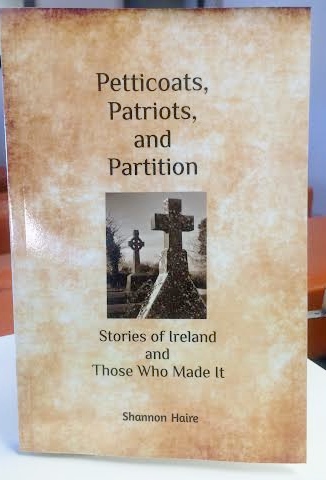
#holycrapIwroteabook
If ever there was a man who stuck to his principles from birth to death, no matter what the cost, it was Ruairí Ó Brádaigh. He was born and raised as a hard-line Republican and he died a hard-line Republican as well, a little over eighty years later.

Congo Casement. Comma Casement. Sir Casement. These names and more applied to Roger Casement, over the course of his life. He was born on this day in 1864, and by the time he was executed, he had gone from being a world-renowned humanitarian, a British Consul, and a favored knight to a social pariah, an arms dealer, and a dastardly rebel. If the road to hell is paved with good intentions, there are many – and Roger Casement traveled more than a few.
Roger Casement was born outside of Dublin and had a strict, Protestant father. When he was three, his mother secretly had him baptized as a Catholic and by the age of thirteen, both of his parents were dead. He and his brother were sent to relatives in the North, County Antrim, and he considered that his home, even though he spent much of his life away from it.
Casement left Ireland at sixteen to find work. He took a job at a shipping company, and spent a great deal of time in Africa. He learned more than one language there and he began trying to improve the treatment and the communication between the native population and the foreign traders. He then went to work for the English Government, first by clerking in the Foreign Office and then as an appointed British consul. He was tasked with reporting about any human rights violations that he was witnessing first hand. He traveled all over Africa talking to residents and viewing destroyed villages before writing a blistering account of imperialism and its impact on the native population. It was controversial and rejected outright by the traders, his former boss included, but it provided other humanitarian groups with enough information to mount an international campaign against King Leopold of Belgium, the man who claimed to rule the area. The campaign was effective and eventually led to the king relinquishing his hold on the area. It was one instance where his idealism worked out.
When he returned to England, he continued his humanitarian efforts by founding the Anti-Slavery Society.After that, he was sent back to Africa to make sure that improvements had been made, and he was disheartened to discover that the horrific abuse continued. He continued to chronicle the plight of the natives and was eventually knighted for his work and his activism on their behalf.
During a break from Africa, he visited Ireland and joined the Gaelic League. He idealistically tried to learn Irish, but despite a gift for languages, he never got a grasp on it. He met with leaders to petition them for their support in Africa, but Ireland had its own problems and the meetings weren’t fruitful. However, in the process he developed an infatuation with Sinn Fein and their commitment to a Free Ireland. As his fascination with the idea grew, he retired from his position in the English government and devoted himself full time to the cause of Irish Freedom. He co-founded the Irish Volunteers and used his formidable writing skills to help pen their manifesto. He then traveled to America to raise funds among the exiled Irish. He was naive and he imagined himself a sort of ambassador for Irish Nationalism. He did not realize that the Irish Republican Brotherhood had already quietly taken over the Volunteers and were excluding him from their plans. He was also too wrapped up in his travels to notice that his activities were no longer as covert as he thought. The IRB were watching him to make sure he stayed out of the way, and the English government was keeping tabs on his travels and his contacts as well.
Despite the prying eyes, he donned a disguise and traveled to Germany in order to secure funds and arms for Irish freedom fighters. He spun it as a mutually beneficial agreement between countries, trying to convince the Germans that if they supplied arms to Ireland, the Irish would divert England’s attention away from them and their war. The request was not as well-received as he hoped, but he secured a promise from German authorities that said, “The Imperial Government formally declares that under no circumstances would Germany invade Ireland with a view to its conquest or the overthrow of any native institutions in that country. Should the fortune of this Great War, that was not of Germany’s seeking, ever bring in its course German troops to the shores of Ireland, they would land there not as an army of invaders to pillage and destroy but as the forces of a Government that is inspired by goodwill towards a country and people for whom Germany desires only national prosperity and national freedom“.
He spent the rest of his time there trying to raise an Irish Brigade out of the prisoners of war that Germany held. He had been sure that many Irish soldiers would jump at the chance to fight for Ireland, but he was sadly mistaken. After months of pitching the idea, he finally admitted defeat and accepted the much smaller arms deal that the Germans offered. It didn’t include any support beyond the weapons and was nowhere close to the agreement he had been hoping for. Meanwhile, he learned of the planned uprising and he hoped to get them to cancel it, because of the inadequate aid from Germany. Because he had been kept in the dark the entire time, he had no way of knowing that it would go ahead with or without the weapons…and with or without him.
Casement made it to Ireland in a submarine, but the arms that came by boat did not. They were intercepted by the English, who immediately arrested Roger for treason, sabotage, and espionage. He missed the Rising altogether and heard of it while languishing in the Tower of London. If he thought that his life of service would keep him from prison, he was wrong. He was stripped of his knighthood and left to his own devices – neither the English or the Irish would help him and no rescue attempts were made. His important friends were vocal but only until the English shared his “Black diaries” publicly. They allegedly chronicled his homosexual adventures throughout the world. They made him look more like a predatory sex tourist than an idealistic humanitarian and they destroyed any hopes for support or leniency. Homosexuality was nearly enough to get someone killed already in that day and age, and when they added a charge of treason to it, well – it was only a matter of time before death came calling. He was hanged on August 3rd, 1916 – making him the only man connected to the Rising who was executed in that fashion, and the only one who was killed on foreign soil. His remains were repatriated to Ireland fifty years after he was killed, but they were not allowed to be brought North, so he lies in Glasnevin Cemetery in Dublin….not too far from where his life began.
There are a lot of what ifs to his tale. What if the arms had landed? What if he had been involved in the planning of the Rising? What if he had been able to bring reinforcements that were culled from the P.O.W.s in Germany? What if the diaries were fiction? There are many who still believe that they were fabricated, or at least exaggerated by the English in order to allow his execution. What if homosexuality had not been such a grave charge at that time? If his powerful friends and activists had been supportive throughout the trial and imprisonment, maybe he would have lived.
Roger Casement would have been one of the most important men in Irish history, regardless of his sexual orientation, if any one of his idealistic plans had come to fruition. He still has a large place in it, despite the fact that they didn’t. His goals were always intertwined with helping people achieve a better life and teaching them to fight the over-reaching powers that be. He was an idealist and was always rooting for the underdog – even when he was one. His short life was full of naivete and the best intentions – and if anyone had truly trusted and followed him, Irish history may be very different today. Even with the stain of the diaries hanging over him, his story has persevered and as we all move toward a more open society, maybe some day he will be remembered on equal footing with the rest of the leaders of that time.
A little over 60 years ago, the Irish Republican Army (IRA) managed one of the cleanest military heists in history. It took about six months to plan, along with an IRA volunteer who actually enlisted in the British Army, and a whole lot of luck, but the raid was incredibly successful and they pulled it off without firing a shot or spilling a single drop of blood. Continue reading

On this day, 99 years ago, James Connolly was executed by the English for his role in the Easter Rising of 1916 and his death caused anger to explode all over Ireland. This is not to say that the death of Sean MacDiarmada who was executed on this day as well for the same reasons, was any lesser of a sore point to be mad or upset about, or that any executions before them were either. In fact, the decision to kill the leaders after secret trials still haunts the British to this day. It is only the fact that James Connolly was driven to his death in Kalmainham Gaol by ambulance and shot after being tied to a chair that makes his execution any different from the other leaders.
This blog, Choosing the Green – Roghnú Glas is officially one year old today. My, how the time flies…
When I began this little project, the intention was to have a little place to put all of my Irish heroes, stories, news and photos in one place—and that is exactly what I’ve done—but I did not expect, support from other larger blogs, a Facebook page or any readers at all, for that matter. I just needed a proverbial tree to carve my love into and I didn’t really expect it to grow like it has over the last year. I am humbled by your interest, your comments and your support and I thank you from the bottom of my heart.

“They have nothing in the whole imperial arsenal that can break the spirit of one Irishman who doesn’t want to be broken”
– Bobby Sands.
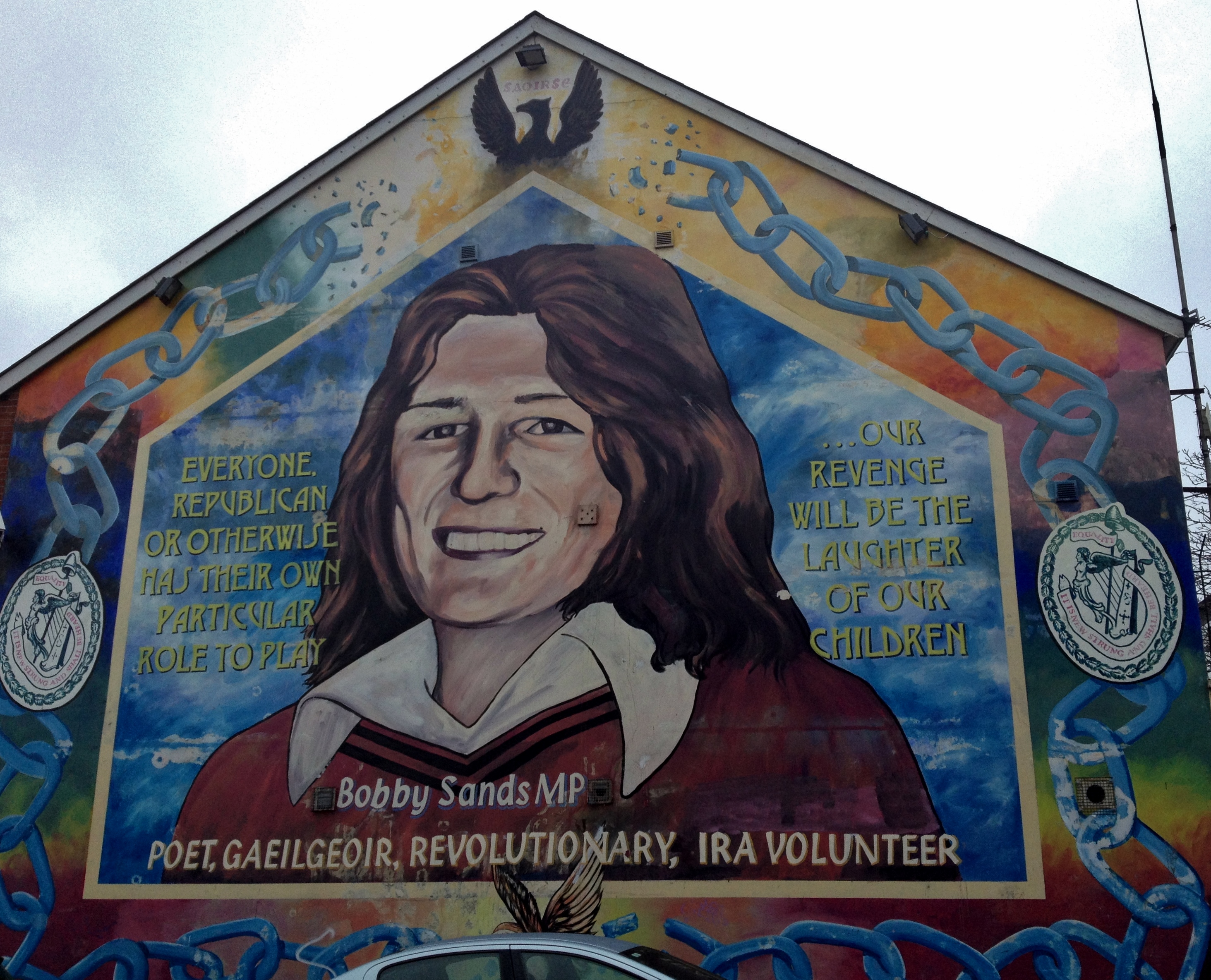
Bobby’s smile. Belfast, 12/12/13
Bobby Sands was elected MP while languishing in prison on hunger strike. His newly elected position did not save him from death. He died 34 years ago today on the H blocks in the Maze. His funeral was attended by over 100,000 people and was seen worldwide, sparking international protests against the British government in other countries as well as Ireland. Countless stories, movies, and songs have been inspired by his life, and he remains an icon of Ireland to this day. Here’s a wonderful example of the music inspired by him from the great Black 47. Rest in peace, Bobby.
As my commemoration of the 1916 Easter Rising closes out for the year, I feel that it is important to acknowledge that this conflict, like any other, had a downside. Many Irish people suffered unimaginable pain and loss because of the death and destruction that rained down on Dublin during that fateful week. There’s no real way to discern how many lives were touched by the dark side of revolution nor is it possible to gauge how long that devastation lasts. We can look at statistics and see numbers of injuries, buildings lost, and fatalities – but they do not tell us how many left Dublin or Ireland altogether because of those things, or how many families are still touched by the loss, pain, or injuries of their ancestors.
What we do know is that over 425 people died in the rising (not including the executions of the leaders) and 38 of them were children. Another thousand more were injured. More than half off these injuries and deaths were innocent bystanders and civilians. 179 buildings were damaged beyond repair or utterly razed. One hundred thousand people – roughly a third of the entire population – were given assistance in the aftermath of the conflict.
Now that some of the Women of 1916 have been highlighted, it’s time to move on to another group that has been largely left out of the history books when it comes to The Easter Rising. Many brave rebels are celebrated throughout the world every year at this time…but what is ignored by most is that the fighters were not exclusively Irish. There were more than a hundred foreign soldiers who assisted in the Rising and while some were 2nd or 3rd generation Irish there were others who had no Irish blood whatsoever. They came from all over Europe and the rest of the world to join forces against the English and were some of the fiercest warriors in the conflict.
 Choosing the Green
You must be logged in to post a comment.