No Surrender

April 29th looms ever closer and the Centenary celebration truly comes to a close…at least until May when the executed leaders will be remembered a hundred years after they were killed. The surrender was originally offered on behalf of the revolution by Elizabeth O’Farrell, but the English would not accept it from a woman. She returned with Patrick Pearse and stood at his side when he offered it himself to “prevent the further slaughter of the civilian population and in the hope of saving our followers, now hopelessly surrounded and outnumbered”. Some argue that it was no surrender at all, but rather a pause to prevent the loss of innocent life because the leaders knew the fight for Irish freedom would continue, with or without them. Others couldn’t bear the thought of standing down for anything, even if their leaders were asking them to. The end to the Easter Rising is a fact, but were the rebels defeated?

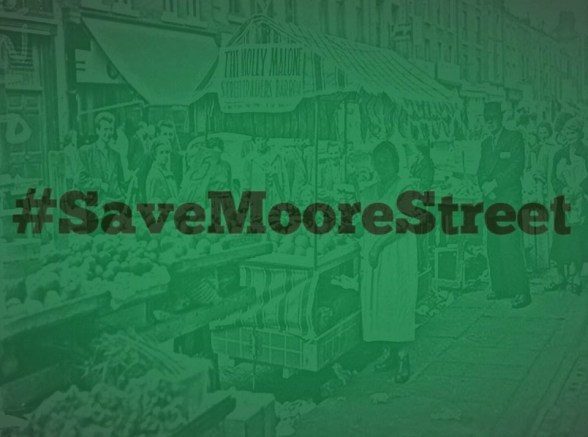
That’s a question I’ve been studying for a long, long time and my answer is still yes and no. It’s also for a different post, because this one is about what you can do in Dublin on April 29th to commemorate the close of the battle and to lend your support to those who are still fighting to save one of the most important areas of the city.
Continue reading

Mother of the Revolution

In honor of Margaret Pearse who died 84 years ago today I thought I’d share the bit I wrote about her in my book, Petticoats, Patriots, and Partition. Many women suffered incredible loss during Ireland’s revolutionary period, but Margaret had a special kind of pain, losing both of her only sons. We are days away from their commemoration times and remembrances, so I thought Margaret should have hers too.

Continue reading

An Unrepentant Pagan

On this day inn 1946 Ireland lost a powerful voice when Ms. Hanna Sheehy Skeffington passed away.  She was one of the country’s most independent and fierce women who always fought for equal rights, for peace, and for Ireland, even when those beliefs cost her dearly. Hanna was indomitable and as she reminded her son before her death, she was an unrepentant pagan. Continue reading

The 1916 Societies Parade

Yesterday’s plan was to observe and walk behind the 1916 Societies’ Easter Commemoration parade, being a proper journalist and chronicling the march. Instead, upon arrival at the GPO, my traveling companion and I were handed the Cumann na mBan flag to hold while the two ladies it belonged to got to know us and socialized with other parade organizers. When the flag was taken up to join the others of the parade, the women invited us to join them in carrying the Constance Markievicz banner, and we were given pride of place near the very front of the march. It was an amazing experience and beyond my wildest imagination of what yesterday could be.

Continue reading

Derry

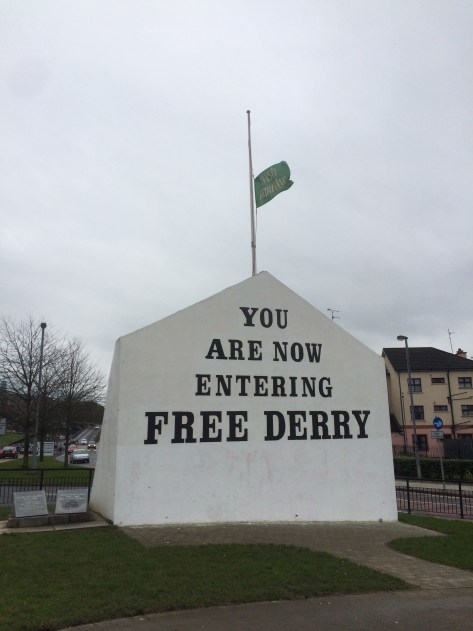
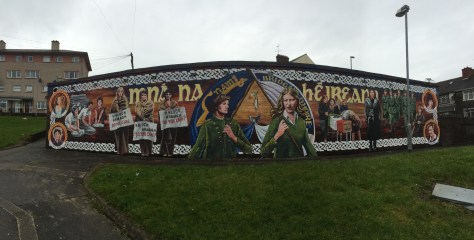
This city is like nowhere else I’ve ever been. It’s powerful, amazing, and heartbreaking. As a student of Irish history, to stand on Free Derry Corner during a brief break from the rain was potent and awesome.

IMG_1718
Yesterday I took a long ride with Paul Doherty whose father was murdered on Bloody Sunday. It was an intense afternoon full of laughter and a few silent tears. I have never written about that massacre specifically and I’m still not sure I ever will. His voice and the voices of the other families and survivors are loud enough and more important. But it has been mentioned here because you can’t have an Irish blog with no mention of Bloody Sunday; just like you can’t walk or drive through Derry without seeing those scars and the strength and anger that still remain so many years later. I can’t recommend Paul’s taxi ride highly enough. We went everywhere and he took me to many of the murals off the beaten path. When he found out I write an Irish blog that’s somewhat focused on women, he took me to a couple that honor women specifically.

IMG_1710

My only complaint thus far is how shoddy the wi-fi is my hotel. Other than that, I may be in love with this region. I have a giant oak tattooed on my body, so I guess it’s no surprise that I’d love Derry considering that its name means Oak Grove. I have a day or so left, so if there’s something I absolutely must do or see here, let me know.

Doctor Sophie Bryant

Sophie Bryant was born on this day in 1850, into a time when women did not receive much education or have too many professional options. She was lucky enough to be largely home-schooled by her father who was a math professor at the University of London, and by private governesses that he hired. She became fluent in many languages and fell in love with math and science. She was an exceptionally strong student.

Continue reading

No, Nay, Never; Cumann na mBan rejects treaty

The ladies of Cumann na mBan have always had very strong opinions about the state of Ireland and its politics. Since its inception, the majority of CnamB members have fought for a united Ireland. During the lead up to the Easter Rising of 1916, these women supported the Republican cause in many different ways. They raised funds for the uprising, trained in first aid in order to help wounded Volunteers, smuggled various weapons and explosives throughout Ireland, spread important news, and many learned to shoot and fight themselves. They became a force to be reckoned with.

In the aftermath of the Rising, CnamB was flooded with new members and big ideas. They were prominent in the Dáil Éireann, the Republican legislature set up to counter England’s rule. Many of the widows of the leaders of the Rising were some of the loudest voices and strongest supporters of a free Ireland, and almost all were members of the female Republican organization. Eamon De Valera called them the “most unmanageable revolutionaries.” Many others accused the organization of making decisions based on vengeance and emotion without thought or consequence, especially when they voted against the Anglo-Irish Treaty ninety-four years ago today.

Continue reading

The Countess; Petticoats, Patriots, and Partition

I write a lot about Constance Markievicz, just like anyone else who writes Irish history should. However, she was not the only woman involved in the planning or the execution of the Easter Rising in 1916…and many others never get the credit they are due. That’s not to say that she doesn’t deserve a bit of her own though. After all, one of her more famous quotes is highlighted proudly on my business cards, and she does have her own few pages in my book. Today in honor of her birthday, I give you some of her story from Petticoats, Patriots, and Partition – the book that has stolen most of my time for the last six months or so. Happy birthday Countess.

Continue reading

Dr. Ada English

Dr. Ada English was a strong woman, a fervent Nationalist, a prominent member of Cumann na mBan, and one of the first female psychiatrists in Ireland. Like her peer Dr. Kathleen Lynn, Dr. English devoted her spare time to politics and to healing and aiding the Irish Volunteers who were fighting for a free Ireland. Her story is not as well known as Dr Lynn’s however, since Ada was not in Dublin during the Easter Rising. Many political women of Ireland’s revolutionary periods have slowly vanished throughout the years, and Dr. Ada English has not been an exception to that unfortunate trend, though she should be.

Continue reading

Helena Molony

Today in honor of Ms. Helena Molony’s birthday, I give you the bit I wrote about her in my new book; Petticoats, Patriots, and Partition.  She was a pretty awesome lady, and one of many that I celebrate in the first section of the book. I hope it tempts your curiosity about the rest of them too. If it does, the book is available worldwide through Amazon and nationally through Barnes and Noble, other bookstores, Amazon, and Blurb. Enjoy!!

Continue reading