Finally, the Dublin City Council decided to actually vote on the Moore Street dilemma. They have been putting it off as the contention grew to palpable levels and more and more people got involved in the process. At issue was an opaque “Land Swap” which was an idea that involved a lot of special interests, veiled corruption and back room deals – but in the end, the deal was finally defeated yesterday.
Category Archives: activism
Remembering Máire Drumm
And now for a different Máire. Máire Drumm was born into a staunchly Republican family. She was lucky enough to have had a mother who was active in the War for Independence and the Irish Civil War, so the concept of strong women who could fight and lead was instilled in her from birth. Perhaps it was also the reason she knew she could grow up to be a commander in Cumann Na mBan and the Vice President of Sinn Fein. She settled in Belfast in 1942 and began fighting on behalf of Republican prisoners, which she did for many years to come. It was in this role that she met Jimmy Drumm, a Republican prisoner who would later become her husband.
Fighting for Moore (Street)
There have been a lot of ups and downs, questions, and contentious debates in Dublin regarding just what to do with Moore Street. It is home to one of the only outdoor produce and farmer’s markets left in the city, it is a magnet for black market cigarette sales and it is an historical gem that should never be lost. All around the area, you can find shopping centers, malls, restaurants, and hotels rising into the sky, dwarfing the historically significant buildings and edging out the market, little by little. There’s been talk of development and yet another mall, hotel or shopping center, despite how many are already there.
Historically it needs to be preserved. This is where the soldiers trapped in the burning GPO made their escape in 1916. The alley they ran through is a shady spot – some people have witnessed drug sales and shakedowns of various degrees. It’s not the best area – but what back alley is? The buildings above the market, where the escapees busted through walls for at least half a city block are ramshackle and almost entirely empty. Everyone knows something has to be done about them, but no one can agree what that thing is.
Guildford
On October 5th in 1974, two bombs rocked Guildford, an area south of London. The Provisional Irish Republican Army’s bombing campaign had begun in England and it was brutal and effective. The Guildford pubs were targeted because they were popular with the British Army and the explosions injured about 75 people and killed a handful more. This highly publicized incident aided in the passage of the far-reaching Prevention of Terrorism Act in the United Kingdom shortly thereafter.
Some of the most widely abused provisions under this act were that anyone could be stopped and searched and those arrested could be detained for up to 7 days, rather than the original limit of 48 hours. During that detention, many rights were misplaced and extensive and brutal methods of interrogation were used in an attempt to get confessions from prisoners. As the bombing campaign continued, it led to suspicion, violence and racism within the communities, whether the authorities were involved or not. It was not a good or safe time to be Irish in Britain.
Mrs. Tom Clarke
On this day in 1972 Ireland lost a valiant soldier in its continued quest for freedom. Mrs. Tom Clarke was how she preferred to be addressed in spite of being a staunch suffragist. She gave up her fight on September 29th at the ripe old age of 94, after living a life that would have sent anyone else to the grave much sooner.
Oh Captain, My Captain
This last weekend in Merrion Square, hundreds of Dubliners saw an outdoor viewing of one of my favorite movies in the world – Dead Poet’s Society. The proceeds went to various suicide prevention and mental health programs in Ireland which is incredibly encouraging. Here in the U.S., our entire health care system is broken and the worst victims of this are those who suffer from mental health afflictions. Whenever something that is this tragic and heartbreaking happens, we always hope that it will change the dialogue and the system, but it rarely does anything to truly help, except at a grass roots level. Our politicians can’t admit that the reality of how poorly we treat our citizens is appalling because then they would actually have to come up with a way to change it – and that involves a complete revamp of mental and physical healthcare. Continue reading
Operation Demetrius
It sounds like a mysterious and enticing thing, Operation Demetrius, so grand…like a top secret cocktail party or a James Bond tryst. It wasn’t – it was just a pretty name for a terrible thing that caused all kinds of problems. It’s better known as Internment and the British introduced it to Northern Ireland on this day in 1971.
The arrests began around 4AM. Witnesses report brutality, abuse, and unnecessary destruction by the police while they searched for their suspects. Other than damage to their homes, the police brought damage to their bodies as well, strapping some to armored vehicles as human shields and wielding batons and other weapons even when they were not resisting. Those arrested were subjected to sleep deprivation, starvation, forced nudity, burns and other forms of torture, all of which were sanctioned by the British government.
Continue reading
Hunger by Choice – Hunger Strike Commemoration
The Hunger Strike is an ancient custom that has been used for solving serious personal and social conflicts for centuries. The concept was originally an option for fighting injustice and it remains so to this day. August 3rd, 2014, is the day Hunger Strike Commemorations in Ireland wind up for the year, which is a perfect time to learn about the tradition and some of the people who have carried it on.
The Hunger Strike was codified in the early Brehon Laws of Ireland and known as a Troscad. It was often employed against a chieftain or tribal leader by someone of lower standing and was carried out publicly on the abuser’s doorstep. Advance notice was given before commencing this type of strike and the defendant was supposed to fast along with the person who had the complaint. If the originator of the strike died of starvation their opponent had to pay relatives a fee and would be subjected to societal penalties and supernatural consequences. Few people allowed themselves to be shamed in such a situation for long and most conflicts were resolved quickly and without death. It turns out that forcing the other party to go hungry right along with you made a difference, as did the peering eyes of the public.
Continue reading
Blessed are the Peacemakers
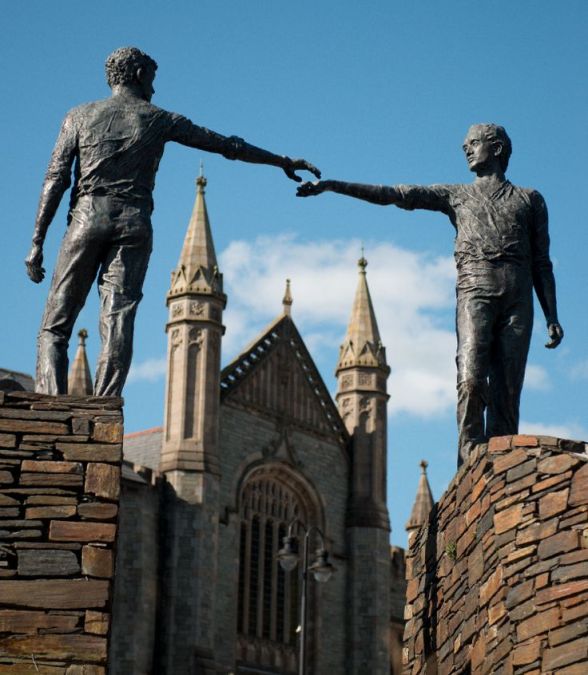
Here’s one that on the face of it, might not normally fit in my blog. I usually rail against the PUP and many loyalist factions and traditions but I always try to give credit where credit is due. David Ervine is one person who deserves that credit and I write that without hesitation, if only to show how similar both sides of the divide in the North of Ireland may be. At the end of the day, I am a firm believer in peace, empathy, and understanding. I also believe that while fundamental change is incredibly difficult, some people can accomplish it. I may be naive, hippy-ish, or simply too far removed from the first-hand experience but I believe David Ervine managed to pull it off.
The Death of the Countess
“I do wish you lot had the decency to shoot me.” -Constance Markievicz, 1916.
Constance Markievicz may have wanted to die like her compatriots for her role in the Easter Rising but the English wouldn’t execute a woman. In the end, they may have wished they had, for the Countess had another 11 years to continue being a thorn in their side. She went straight into an even more political role, creating a world where women were more equal to the men, remaining staunchly Republican and inspiring thousands of people, including myself, throughout the years since. She is one of my favorite heroes.
Continue reading


You must be logged in to post a comment.