Margaret Skinnider was a woman who should have died long before she did, but like a cat with nine lives she nearly always landed on her feet. She did not die while learning to shoot weapons and build bombs in her home town of Glasgow. She did not have a fatal accident while smuggling explosives under her hat and detonators under her dress from Scotland to Ireland in 1915. She did not blow herself up while spending many afternoons testing dynamite in the hills around Dublin and she was not killed while acting as a courier between rebel outposts during the Easter Rising of 1916. On the contrary, between delivery missions on her bicycle, she joined the men on a roof over Stephen’s Green with a rifle and took her own deadly aim. She was proud of her sniper abilities and famously said, “More than once I saw the man I aimed at fall.”
Continue reading
Category Archives: Ireland
Fighting for Moore (Street)
There have been a lot of ups and downs, questions, and contentious debates in Dublin regarding just what to do with Moore Street. It is home to one of the only outdoor produce and farmer’s markets left in the city, it is a magnet for black market cigarette sales and it is an historical gem that should never be lost. All around the area, you can find shopping centers, malls, restaurants, and hotels rising into the sky, dwarfing the historically significant buildings and edging out the market, little by little. There’s been talk of development and yet another mall, hotel or shopping center, despite how many are already there.
Historically it needs to be preserved. This is where the soldiers trapped in the burning GPO made their escape in 1916. The alley they ran through is a shady spot – some people have witnessed drug sales and shakedowns of various degrees. It’s not the best area – but what back alley is? The buildings above the market, where the escapees busted through walls for at least half a city block are ramshackle and almost entirely empty. Everyone knows something has to be done about them, but no one can agree what that thing is.
Guildford
On October 5th in 1974, two bombs rocked Guildford, an area south of London. The Provisional Irish Republican Army’s bombing campaign had begun in England and it was brutal and effective. The Guildford pubs were targeted because they were popular with the British Army and the explosions injured about 75 people and killed a handful more. This highly publicized incident aided in the passage of the far-reaching Prevention of Terrorism Act in the United Kingdom shortly thereafter.
Some of the most widely abused provisions under this act were that anyone could be stopped and searched and those arrested could be detained for up to 7 days, rather than the original limit of 48 hours. During that detention, many rights were misplaced and extensive and brutal methods of interrogation were used in an attempt to get confessions from prisoners. As the bombing campaign continued, it led to suspicion, violence and racism within the communities, whether the authorities were involved or not. It was not a good or safe time to be Irish in Britain.
Mrs. Tom Clarke
On this day in 1972 Ireland lost a valiant soldier in its continued quest for freedom. Mrs. Tom Clarke was how she preferred to be addressed in spite of being a staunch suffragist. She gave up her fight on September 29th at the ripe old age of 94, after living a life that would have sent anyone else to the grave much sooner.
Gratitude
I just want to take a moment to thank everyone who reads my little ramblings and stories here. When I began it was just a place to put the things I was so passionate about and now it has blossomed into a tiny sparkling gem that makes me so very happy. Today I was given a gift that let me know I had moved someone enough to find and leave flowers on a grave and it damn near made me cry in a wonderful way.
Two things happened last week. I got to write the story of a woman who has been in my head and heart for years and then Scotland took over everything. Between writing about Anne Devlin, one of my passions and heroes, and the heartbreak of Scotland’s no vote, I have felt a little spent. I am still trying to find the words for a Scotland post – which is still coming to be sure – and have been focused on that quest. The radio has been silent for a bit as I puzzle out just what I want to say.
However, today I got a notification from a stranger named Annie (ha!) who had read my story of Anne Devlin on a recommendation from a friend and who is currently visiting Ireland. She let me know that she had gone hunting for Anne’s grave in Glasnevin and then sent a picture of the bright red flowers she had left there for Anne – and for me – because she had been touched by my telling of her tale. It brought tears to my eyes and a giddy smile to my face that has yet to go away. To know someone reads an entry and is inspired by it is amazing. It is motivating me to quit my stumbling and get back into the writing patterns I had started before hitting the roadblock in my brain and heart that is the Scottish Referendum.
So thank you Annie, and everyone else, for occasionally stopping by and reading this silly little dream of a journal. It was just a place for me to ramble on about Ireland and history without driving all of my friends batty and now it is a thing that sometimes brings other people joy and inspiration. For that, I am eternally humbled and grateful.
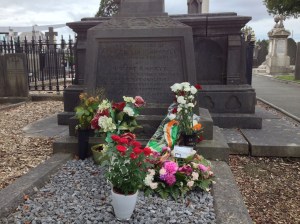
Annie left the red flowers for Anne today
Anne Devlin, Ireland’s Almost Entirely Ignored Hero
Today is not the day Anne Devlin died but September 18th is. Given that the Scottish vote will be the news of that day this year, I thought I would step back for a minute into my favorite subjects. I started this blog because I am incredibly passionate about history in general – and Irish history in specific. I make an effort to highlight Irish women – the rebels, suffragists, and strong women who fought for Ireland just as much as their male counterparts but who rarely get the same credit. The Scottish referendum on Independence is HUGE news but their vote falls on an all too forgotten date in Irish history as well – and to ignore that would be yet another travesty inflicted upon Anne Devlin. Given that she suffered more brutality in her life than most would ever survive, the least I can do is mark the anniversary of her passing and give her the recognition that she deserves – even if I tell my tale of her life and death a day early.
Ian Paisley, dead
When I was much younger and more of a punk kid, I always said I’d dance a jig on the day that Ian Paisley passed away. I even had a red dress. Now that I am older, less reactionary and more educated, when I heard that he had died this morning I sprang out of bed, got a cup of coffee and started looking for the news. I may have skipped just a little to get the coffee but there was no real jig. In my opinion, Ian Paisley was a bigot, one of the leading voices of Sectarianism and a figurehead of those who would preach hate and call it faith. There are way too many people in the world like him. The most diplomatic thing I can say about him is that he was divisive and powerful…but he was also a human being with a family and no one should ever cheer or crow about another person’s death.
His pulpits were often protected by masked men with clubs or worse. His fiery language was cruel and divisive throughout the Troubles. Moderate Protestants have gone on record saying that Paisley was likely responsible for more IRA volunteers than any other person – and many agree. The byproducts of his hate were an international sympathy toward the Catholics, high recruitment in the IRA and other paramilitary groups, and support for the civil rights movement. It was quite the opposite reaction from what he was hoping for but he continued his sectarian sermons nonetheless.
That said, without him the Peace Accord and Good Friday agreement may not have come to pass. “Dr. NO” as he was called, said yes – far later than he should have – but he finally did. Watching him stand next to Gerry Adams and Martin McGuinness was a surreal and bizarre milestone, but it was one that was necessary to calm the strife in the North. I’m not sure there’s a tale of redemption in my heart for the man – but without him, things could have been much worse for much longer.
Ian Paisley passed away this morning in Belfast at age 88. Many are mourning his death, including Martin McGuinness who says they had a mutually respectful friendship even though at Paisley’s insistence, they never shook hands. In life Ian Paisley was a man who reveled in leading angry mobs, guiding immense crowds, and hogging media attention but before he died he requested a private funeral, attended only by close family. His family intends to honor that request, but has also spoken of a public memorial in the future.
Red Hugh
It is thought that on this day in 1602, at a dinner in Spain far away from his beloved Ireland, Red Hugh O’Donnell took a sip of his wine. That last indulgence ended the life of one of the most famous and admired chieftains in Irish history.
Continue reading
St. Enda’s School
On this day in 1908, Padraig (Patrick) Pearse opened St. Enda’s (or Scoil Éanna) school for boys. Pearse was concerned with education in Ireland and felt that students were just “learning how to be British”, rather than being encouraged to study their own language and rich history. He felt that was unacceptable and decided that his school would be different. Pearse was a poet and a dreamer, a devoted headmaster and an Irish language enthusiast who infected his students with the same passions. Continue reading
The Ghosts of Kilmainham


It has been said that tourists – and mostly American tourists – are the only reason that Kilmainham Gaol is still open because most Irish couldn’t be bothered with it these days. My new friend who is now happily married here in the U.S. agrees with the travel books that say things like that because he and his generation seem to be sick to death of the glorious dead mentality and couldn’t care less about the history and the Troubles that have haunted the country since even before the Rising of 1916. In fact, he was shocked that we were still asked questions about our religion and last names on our travels to Ireland at the end of last year, both in the Republic and the North because he thought those kinds of things were finished.
However, when I did tour Kilmainham Gaol, I was in a group mostly made up of Irish people and all seemed just as profoundly affected by it as I was. Perhaps it was because of the off season which meant my group was thankfully smaller when we went through the infamous prison, or perhaps it was an anomaly altogether but I was glad for it. It made for a decidedly more intimate and more personal experience.
 Choosing the Green
You must be logged in to post a comment.