Thomas Ashe was a teacher, a piper, an Irish language enthusiast, a soldier, a devout man of faith and one of the pioneers of the modern Republican Hunger Strike. His life began on this day in 1885.

Thomas Ashe, 1917
Thomas Ashe was a teacher, a piper, an Irish language enthusiast, a soldier, a devout man of faith and one of the pioneers of the modern Republican Hunger Strike. His life began on this day in 1885.
Thomas Ashe, 1917
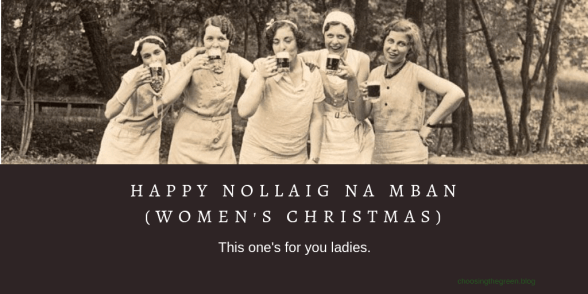
Gather the women!!
Jan. 6th marks Nollaig na mBan, also known as little Christmas or Women’s Christmas in Ireland. It’s an old Irish tradition that evolved from celebrating the Epiphany but these days it’s become less about religion and more about fun and frivolity. Traditionally, Irish women were not only responsible for the Christmas time entertaining and feasts but they also had to deal with all the holiday clean up, and every day chores and household duties too for that matter. Except on January 6th, that is. That’s the day they finally got a break. On Women’s Christmas, (12th Night, little Christmas or whatever you want to call January 6th) the men took over the chores and the households so that the women could gather and drink, tell stories, kick off their shoes and relax for a moment.
It was a real treat back in the day – so much so that it continues now, even though women’s roles have changed all around the world. In modern times, it’s a day for women to gather and treat themselves to a night out at a bar with friends, a trip to the favorite day spa or salon, or head out for a fancy meal. Nollaig na mBan is the day to play hooky from work (or from the house and kids) to enjoy a day with your ladies, create your own little henhouse, tell stories, catch up, or have a cocktail and relax. No matter what women normally work too hard on, Jan. 6th is the time to take a day off, even if it’s only a mental one. It’s well deserved.

It’s rare that a woman can juggle an immense amount of political power, a restaurant of her own and a family of four children. But Jennie Wyse Power did all this and more, at a time when most women weren’t even getting an education. She was an Irish superwoman and an unapologetic suffragist who passed away on this day in 1941.
Edith Maud Gonne has been hailed as one of the greatest activists and fighters of her time. Her beauty has been recorded and immortalized by one of Ireland’s greatest poets. History has compared her to Joan of Arc and she’s one of the best known women in the books, in no small part due to her own inflated memoirs and creative storytelling. She is largely considered to be an Irish hero—which is a great feat for a woman—particularly one who wasn’t Irish born and who grew up as a member of a wealthy, loyal, British family. So was she a true revolutionary, or a fraud in it for the fame and her own idea of who she wanted to be? Either way, she did enough to leave her mark on Irish history and one thing is undisputed – Maud Gonne chose the green and was most certainly not born to it.
One year ago today I returned to the U.S. from a trip to Ireland. When we went there, we had no itinerary, no lodging lined up, and no plan at all. We had our luggage and a rental car and we just went wherever whimsy sent us…and that was mostly the west, Dublin, and the coast. It was a scary and amazing way to travel and we found many things we would have missed if we had scheduled things or tried to plan. Because it was December, I had a heavy coat. I also had a simple raincoat, with down lining and a hood. It came in very handy on the top of the Cliffs of Moher and when we decided to go to Achill in winter. (Here’s a tip: nothing is open in winter on Achill. Seriously.)
Here in the US, I don’t really use a heavy raincoat because I live in Oakland, CA. While it is not entirely the sunshine state, most of the time I can get away with a regular coat and an umbrella. I kept the raincoat as a reminder of my trip and whenever I saw it hanging in the closet it made me smile with nostalgia and long for another visit.
now here’s a proper ad for the 2016 centenary. At least this one has the actual thing that is supposed to be celebrated in it.
On this day in Irish history a mighty warrior poet was born. Joseph Mary Plunkett was born in one of the wealthiest parts of Dublin with the proverbial silver spoon in his mouth. He should have had a wonderful childhood, surrounded by wealth and adventure—and in some ways he did—but a terrible case of Tuberculosis threw a wrench into many roads he may have otherwise wandered. The disease was something that affected him for his whole life, leaving him weak and infirm in many ways but it also gave him focus and determination. Joseph became a journalist and a prolific poet. Later in life his study of languages, the written word, and a love for theater brought him into a close friendship with Thomas MacDonagh, another poet and politically charged man. Thomas was married to a woman named Muriel, who had a charming sister named Grace. She would become the love of Plunkett’s life. Aside from their mutual infatuation with the Gifford girls, the men were also active in the Gaelic League, the Irish Volunteers, and the secretive Irish Republican Brotherhood. In addition, they co-founded the Irish Theatre, bringing their love of drama to the stage.
Continue reading
I have been waiting impatiently for news of the centennial celebration in Ireland for months now. I was even more impatient in the days leading up to the release of the schedule of planned events because I have been planning my trip to Dublin for the anniversary for well over a decade and was eager to see what was going to be happening officially. That said, the only thing running through my head after following all the links is What the f%ck did I just watch?
Finally, the Dublin City Council decided to actually vote on the Moore Street dilemma. They have been putting it off as the contention grew to palpable levels and more and more people got involved in the process. At issue was an opaque “Land Swap” which was an idea that involved a lot of special interests, veiled corruption and back room deals – but in the end, the deal was finally defeated yesterday.
41 years ago on Halloween a mysterious American man named “Mr. Leonard” pulled off a serious trick. He hired a helicopter for an ‘Aerial Photo shoot’ in Ireland. It was thought to be a scouting mission for a movie or a book of photography – at least that is what Mr. Leonard told Captain Thompson Boyes, the pilot. Captain Boyes was instructed to fly to a field in Stradbelly in order to grab the photography equipment but when he landed, he was met with armed gunmen instead. “Mr. Leonard” vanished from the scene while Captain Boyes got to know his new masked passengers, much to his own distress. He was informed that he would not be hurt as long as he followed instructions and he wasn’t but he wasn’t given a choice about being involved in a daring prison break either. If he wanted to live, he was going to aid in the escape of Irish Republican prisoners Seamus Twomey, JB O’Hagan, and Kevin Mallon from Mountjoy Prison.


You must be logged in to post a comment.