The face of sectarianism

I already posted a pretty lengthy opinion on the Orange Order parades so I won’t rehash it now. However, the planned “graduated protests” and the threats of real violence from Protestant leaders prove again that these people have failed to lead at all. If you ‘cannot guarantee’ that your own parades will be peaceful and you are in fact promising that they won’t, what right to you have to call yourself a leader? A sane party host would take responsibility for their guests and cancel the party themselves if things were sure to get out of hand. They would not be falsely ringing their hands, shrugging their shoulders and standing by while their home got destroyed. Leaders who cannot lead should be fired from their jobs no matter which side they adhere to.

And then there’s this.

Vandalized Mary

And this.

Effigy of Gerry Adams

These disgusting crimes put the question of “heritage and tradition” to rest, unless tradition has always been hate-filled supremacy and heritage has always been power over and at the extent of someone else. It is time to put an end to these truly vile events. It’s time to call it what it is – which in these cases, is a celebration of sectarianism, hatred and entitlement.

And please, if you are reading this from the North, do the right thing. Put pressure on the authorities to charge these things as the hate crimes that they are but for the next 48 hours, try to take the high road. Whether you are marching, protesting, or protecting yourselves, try to stay peaceful no matter what and keep each other safe. Respect should be granted to all humans, regardless of which side of the divide you stand on. I hope everyone and everything (except the hateful bonfires) are still standing on the 13th, as unlikely as that seems to be. My thoughts are with you from across the puddle.

Walking tour – Revolutionary Women

The good folk at the Sinn Fein shop in Dublin have an amazing walking tour that they offer, that they call the Rebel Tour. I highly recommend it for people who are interested in Irish history – and even people who know a lot about it already are guaranteed to learn something new on the walk. ( The Rebel Tour )

That being said, I would do almost anything to be able to fly over the puddle and meet Dr. Mary McAuliffe this weekend for her own walking tour. Her tour is based on the revolutionary women who helped shape Ireland’s history – but who are often times reduced to a footnote in it. This is an insult that must be addressed in all the history books of all nations, but this year Ireland is doing a lot to remedy it. Perhaps it is due to the hundred year anniversary of Cumann Na mBan and the renewed interested in the female rebels, or maybe it is just because it’s time to acknowledge the women warriors. Either way, things like this walking tour make me very happy and I hope both men and women get involved in it. I am very sad that I am too far away to experience it.

If you aren’t, please join this tour on Sunday – and report back to the rest of us who cannot.

Rebel Women Walking Tour

July 12th Parades

Everyone likes a parade. I get it. They’re all pomp and circumstance – people showing off their heritage, their music, their flags. There are parades worldwide for what seems like every single little excuse that anyone can find. Some are big, some are small, some are downright silly, and some threaten a fragile balance.

The marching season in the North of Ireland falls into the last category. July 12th is a day that roughly half of the population celebrates the victory of William of Orange (a Dutch King, by the way) over the English King James II. It’s a huge holiday which is steeped in irony, when you think about it. This is a bunch of people who violently insist on being considered British that take to the streets to celebrate a Dutch victory over their own historical ruler. Label that one for storage in the “Things that make you go hmmmm” file.

The truth is, they are really celebrating the defeat of Catholicism. James II was a Catholic and when the Dutch king defeated him, Protestants were granted great wealth and positions of power. It opened the door for instant change – one that Protestants in the area have enjoyed for centuries.
Continue reading →

July 2nd belongs to The Irish Brigade

Today I give you a story of the Irish in America during the Civil War. Throughout American history the Irish have always had a connection to discrimination – first being discriminated against  (No Catholics, No Irish) and then gaining a generalized reputation for discriminating against others. Part of this stems from their own persecution that developed into a deep distrust of anyone outside of their own communities. Some of it is just the age old misconceptions of the Irish in general – that they’re all devoted to shenanigans, violence and little else.

If you buy into those generalizations, you may assume that the Irish Brigade fought for the Confederacy in the Civil War. Thankfully, you’d be totally wrong. They were a highly effective tool for the North, though many were conflicted and unsure of their allegiance. The Union promised them more freedoms and rights, even if they had to fight for them – but many also worried that emancipation would involve more people who would challenge them in their struggles to find even the lowliest of jobs. But in the end, the Fighting Irish committed to the North and when they did, the North gained a company of men that were brilliant fighters who seemingly would never give up.

The Irish Brigade was nearly decimated more than once but they continued to fight even when they lost more than half their numbers. In the battle of Fredericksburg, their numbers fell from 1600 to a measly 256. It was during that battle that General Robert E. Lee allegedly referred to the Irish company as the “Fighting 69th”. They bled through some of the biggest battles of the Civil War and were disillusioned, tired, and only about 500 strong on July 2nd, in 1863, when they fought in the battle of Gettysburg.

As they prayed near Cemetery Hill before they went into battle, the soldiers knew that they were grossly outnumbered and likely to die. They made their stand in a place that would henceforth be known as the Wheatfield, where they were part of an attack designed to stall the Confederate forces that were advancing. The Brigade initially forced them back, fighting dirty with all they had – hands, knives, bayonets, clubs, and muskets. It was such a fierce melee that one of their opponents was quoted as saying that it was “the hottest and sternest struggle of the war.” Ultimately, after losing over one third of their already skeletal numbers they were pushed back, but their ferocity had slowed the South enough that the Union line held until reinforcements arrived.

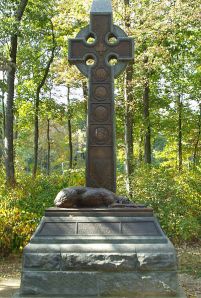
In the end, during the entire Civil War, only 2 other Union brigades lost more people than the Irish. There is a beautiful statue of a Celtic cross with a mourning Irish Wolfhound that’s been raised on the battlefield in Gettysburg to commemorate their sacrifice. Gettysburg is hallowed ground to many but near the cross you can almost hear the battle cry of the Brigade – Fág an Bealach, which means Clear the Way. And the nickname that General Lee had given the unit, has stuck around for more than a century, living on even now. The Wolfe Tones wrote a song about them that the Dropkick Murphys have resurrected and covered. Also, since 1907, the Fighting 69th has been a unit in the National Guard Of New York. They have fought in both World Wars and served with distinction in almost every conflict to this day.

  Gentlemen, thank you for your service.


In Memorium, Irish Brigade

In Memorium, Irish Brigade


Tom Barry’s Birthday

On this day in 1897 Thomas Bernadine Barry was born in Killorglin, Co. Kerry, one of a whopping 14 children. Eighteen years later or so he joined the British Army – an unlikely move that would aid in his future as one of the most respected and strategic IRA commanders in history. While serving in the British army he received news of the 1916 Rising but was unable to return to Ireland until the war he was fighting for Britain had come to an end in 1919.

Upon his return, he got involved in the Volunteer movement. One year later became the commander of the Flying Column 3rd West Cork brigade. He had asked for total autonomy in decision-making and it was given, with a warning that any success or failure would be his responsibility alone. (No pressure!) He then began planning the Kilmichael ambush, a significant political and strategic move that became a touchstone in the War of Independence.

The ambush occurred one week after the first Bloody Sunday. (Yes, I said the first –  there have been multiple, unfortunately) It boosted IRA morale and garnered even more respect for Tom Barry and his tactics. It also brought him to the attention of Michael Collins, who was suddenly aware that he had both a strong ally and some fierce competition.

Michael Collins called for Barry to come to both Dublin and London during the Treaty negotiations. It is said that one of the first things the British wanted was Tom Barry himself. Michael Collins refused, though he later claimed that he had been tempted to give Barry to them. When the treaty was ratified – over Barry’s objections due to the partitioning of the Island – he continued to fight on the behalf of the Anti-Treaty IRA until he was imprisoned by Collins’ Irish Free State Army.  He escaped and continued to command in various locations until the Anti-Treaty IRA was defeated and he was captured once again.

Upon his release, he spent a term as the IRA Chief-of-Staff and served as general superintendent of the Cork Harbor Commission for nearly 40 years. Still an unrepentant Republican, at the age 62 he traveled to the United States in the hopes of gaining funds and support for a united Ireland. His one wish and lifetime goal was to end the partition of Ireland. He died in 1980 and was buried at St. Finbarr’s Cemetery in Cork. Though St. Finbarr’s cemetery has one of the largest Republican plots in the area, Tom Barry is not interned in it but instead is buried nearby.

‘In the end Gerry Conlon won’

Yesterday the funeral of Gerry Conlon was held in Belfast. He was a great inspiration to me as I have said before here: https://lightandthunder.wordpress.com/2014/06/21/gerry-conlon-r-i-p/

A fantastic article on the service and his life was posted in the Irish Times. Once again, I am reminded of how far away from Ireland I am – and of where I’d be if I were not.   Suaimhneas síoraí

‘In the end Gerry Conlon won – the victory was his’.

Roger Casement

On this day in 1916, Roger Casement (once Sir Roger Casement) was convicted by the British crown for high treason. Roger Casement was an anomaly. He was a foreign office diplomat who could never quite get what he was after. He was knighted for his humanitarianism but was trying to broker arms deals. He believed in Irish Republicanism but some of his comrades believed he was too moderate while others believed he was too extreme. He was a rumored sex tourist who traveled to hide and indulge in his homosexuality. And despite having no foreknowledge of the upcoming Easter Rising – being that he was NOT a member of the IRB and they did not fully trust him – he was still convicted of high treason and some of the charges that led to his death were that he helped to plan the rebellion.

It was surprising that he heard of it at all. Casement had been out of the country and then was in the north and kept in the dark by the Republican Brotherhood. He was arrested 3 days before the Rising began – after failing to get Germany to agree to send reinforcements into Ireland to fight the British – and after a whole shipment of German arms heading into Ireland was intercepted. His case was difficult because he was in Germany when such ‘crimes’ happened, but they were relentless in his prosecution.

His supporters at trial were the likes of Sir Arthur Conan Doyle, W.B.Yeats and George Bernard Shaw. Perhaps the revolutionaries weren’t sure about him, but the popular writers of the day sure seemed to be. On June 29th, 1916, he was stripped of knighthood upon his conviction and sentenced to a death by hanging.

His appeals failed. By the time he was hanged, he had converted from Protestant to Catholic and his priest thought he should be considered a saint. He was buried in quicklime at the prison after his death. In 1965, he was repatriated to Ireland and laid to rest with full honors and a state funeral in the Republican Plot at Glasnevin Cemetery. However, Casement’s last wish was to be buried at Murlough Bay on the North Antrim coast and it has yet to be fulfilled. The government released his remains only on condition that they not be brought into Northern Ireland. Oddly enough, the 1965 British Cabinet record of the decision still refers to him as Sir Roger Casement.

Perhaps someday he will get his wish.


Irish Studies Programs – Updated

Yesterday’s post about the best schools to get your Irish Studies programs needs an update. I went straight for the online program – the only in the world – based in Galway because I’m a non-traditional student who can’t quit any of her 3 jobs for class time. The list I posted yesterday shows a partnership for that program with a U.S. school in Colorado but the links didn’t work when I tried them. I contacted the school in Ireland and while there used to be a partnership, it no longer exists, and you have to sign up for the program through Galway directly.

No problem – I’m still totally excited. Except for one thing – a whopping €12,750.00 per year international student fee….which applies since the partnership isn’t valid anymore. That is on top of the class fees and things that are needed to complete the course – which I thought was definitely update worthy, since U.S. students can’t get federal aid for those courses either. Alas.

It makes me sad, as the idea of an online program really opened some doors in my brain – but I will have to just table that again. I will continue to study as I have for the last 20+ years and be satisfied without a paper that tells other people that I’ve done so. For those of you that can take traditional classes – or afford nearly 13,000 euros, still check out that list since there are options. The Galway link was so enticing – and if you could manage that – the class looks as if it’s extensive and lovely.

On the off chance

that there are any  of you in the USA looking to further your Irish studies as I am, here’s a great resource. I find it incomprehensible that there are no studies programs here in San Francisco and unfortunately, you must be far richer than I to go to Berkeley or any of the other main schools that this lists, but it’s still a great chance to explore the options. Thanks Irish Central!

http://www.irishcentral.com/news/education/The-definitive-list-of-Irish-Studies-programs–United-States-and-Canada-.html

Paul Hill remembers Gerry Conlon…

Here, Paul Hill, a fellow Guildford Four member and a leading human rights campaigner based in the US, remembers his friend Gerry Conlon.

I was awoken this grey morning (rather fitting) by the constant ringing of my phone to be informed of the death of Gerry Conlon my fellow member of the Guildford Four.

Doors I had hoped would remain closed began to open in my memory.

It’s incredibly difficult to try to explain to someone exactly what the loss of 15 years of one’s life is like.

Or indeed to ask someone to comprehend having to endure those years as an innocent person, in the hostile environment that was the English prison system.

The simplest way is to think of everything one has achieved in the years between 20 and 35. A career, a home, a marriage, children. We had none of those.

Gerry was a young man who loved life ,music, football. He would have been the first to tell you he had no interest whatsoever in politics.

The background of what he went to prison for is well documented, as is the injustice he suffered,

But the baggage he carried from that is often overlooked, baggage that one can never check.

The mental scars, not visible, remained unhealed. They eat away at one’s being and reopen constantly.

Gerry fought the demons that an injustice unleashes, but I know that he mostly fought those alone and in the dead of night.

People have expressed the opinion that Gerry must have been an incredible man. No, he was not. He was an ordinary man who suffered an incredible injustice.

No doubt we shall have those who (just like after his release) will extol his virtues, whilst having done nothing themselves whilst he was incarcerated,

If I could be so bold, and on behalf of Gerry, I would like to thank all those very ordinary people who believed in him when (unlike today) it was not politically hip to do so. Irish America always stood with us — thank you. Irish governments and Irish embassies did not.

I want to thank the folks who stood in the rain outside the British Embassy, who were accused of being the fellow travelers of terrorists,

The ordinary folk in Ireland who were harassed and photographed by the special branch for having the courage to attempt to right a grievous injustice.

We have come a long way along a harsh, painful road.

Gerry helped us all along that journey.

He was a man of immense humor and a big football fan, no doubt glued to the World Cup.

I know he would give a wry smile knowing England went out before him.

Here is his family’s statement. It captures far more eloquently that I can what Gerry represented.

“He brought life, love, intelligence, wit and strength to our family through its darkest hours. He helped us to survive what we were not meant to survive. We recognise that what he achieved by fighting for justice for us had a far, far greater importance – it forced the world’s closed eyes to be opened to injustice; it forced unimaginable wickedness to be acknowledged; we believe it changed the course of history.

-Paul Hill

http://www.irishcentral.com