Lawyers, Guns, and Collusion

Lawyers are a group of people in an occupation that everyone loves to hate. Endless jokes use them as the punchline, there’s an eternal stream of songs and stories about how evil they are, and it seems that no matter which area of law they practice, they’re always hated by someone. It takes a thick skin, an obsessive attention to detail, endless patience, and a lot of manipulation to succeed in the field. In the North of Ireland, the law not only takes over their lives, but sometimes it ends them. It is not a job for the weak.

Rosemary Nelson lived her life trying to make the world a better place for everyone. She lived in a hotbed of Sectarianism during the Troubles but she represented people on both sides of the religious divide in small matters for years and went to bat for those that other people would ignore. She fought on behalf of the Garvaghy Road residents during the long Drumcree conflict in nearby Portadown, which thrust her firmly into politics and ruined any rapport she had with the Royal Ulster Constabulary (the RUC). That relationship only got worse when she decided to represent Colin Duffy, a man accused of killing their officers. That case would change her life and it ultimately took it as well. In the North, there have been many cases where certain factions of the population are unable to separate the lawyer from the criminal, and the assumption is that they’re one and the same. Even before she got Duffy released on a successful appeal, she was getting death threats from officers and Loyalist paramilitaries alike, just for representing him. There were twenty serious and documented death threats over a two year period, and two of them allegedly came directly from police officers. She dutifully reported each one, but was consistently refused protection by the police and the government, even after the United Nations’ Special Rapporteur stated on television that he felt her life was in danger. He recommended that the British government take action. They chose not to. She eventually testified about the threats before a committee of the United States Congress that was investigating human rights in the North of Ireland. It seems everyone was concerned about Nelson, except the very people whose job it was to take care of her.

The British government, MI5, and the RUC did not investigate any of these threats, nor did they ever give her protection. In case you feel like they didn’t do anything, rest assured that they did – they put Rosemary herself under surveillance for criminal activity. Between 1994-1998 security reports about her life increased until her home was bugged. She was seen as a criminal, rather than an attorney; and a threat, rather than a victim.

Rosemary Nelson was killed when a bomb planted under her car exploded on March 15th, 1999. The Red Hand Defenders, a Loyalist paramilitary group that was mostly made up of members of the LVF and the UDA, took credit for her assassination. Many of the members of the Red Hand Defenders were also RUC officers and British Army soldiers – people who belonged to the same organizations that had ignored her complaints for years, even while they were watching her every move. Strangely though, they didn’t have much in their records to investigate when it came to her death, despite all the surveillance – at least nothing they were willing to share with anyone else. There were a few inquiries into her murder and the final reports stated that all three agencies (the Government, MI5, and the RUC) had failed to protect her and had helped “legitimize” her as a target in the eyes of Loyalist paramilitaries. It also stated that these agencies and their employees had publicly threatened her and that their intelligence information had been “leaked”, making it easier for the murderers to get to her. It noted that numerous requests and warrants for surveillance footage or reports had been ignored completely. The inquiry couldn’t prove definitively that anyone in these departments had directly been involved in her death, but it certainly couldn’t prove otherwise either and their report clearly stated that investigators could not rule out the possibility that officers or soldiers might have aided the murderers.

Nelson was awarded the Train Foundation’s Civil Courage Prize after her death – an award that honors “extraordinary heroes of conscience.” Her humanitarian status was celebrated and mourned world-wide in the aftermath of her murder – and while some Loyalists still see her as a symbol of hate, those who she spent her life trying to help remember her as an incredible and determined woman, who wanted justice for everyone whether they were young, old, Catholic, or Protestant. Today would be her birthday and I humbly suggest doing something wonderful in her honor. Help someone in whatever way you can, large or small, friend or stranger. I’m sure she’d want to be remembered in that way, rather than for the horrific way she was targeted, abandoned, and killed.
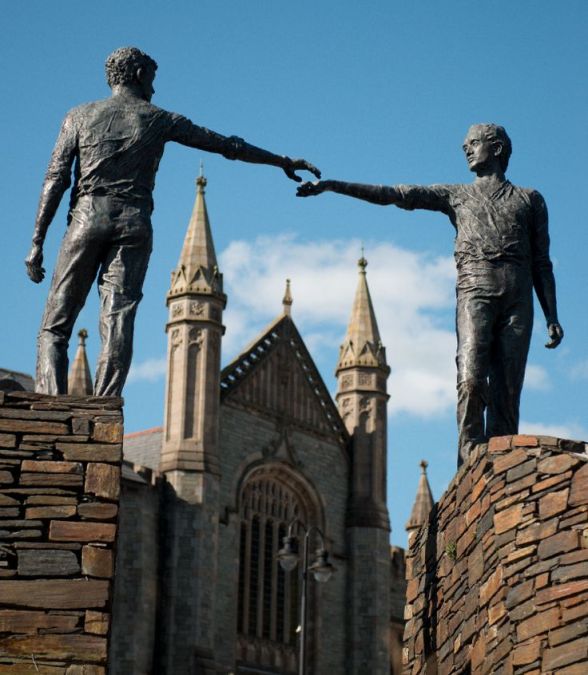
Speaking of Derry…

“We too are concerned that there are currently members of the British army on our streets years after we were told that they no longer have an active role in the north.” ~Danny Morrison, IRSP, Derry Journal.

That quote is not a throwback to the Troubles. It is not left over from Operation Banner – the longest deployment of the Army in British history. Operation Banner lasted for over 38 years. Their presence and poor decision making skills fueled the flames of the Troubles for thirty years, and the mission “failed to defeat the Irish Republican Army on a strategic level or have any long term plan,” according to a Ministry of Defence report. The British Army formally ended their engagement (Operation Banner) in the North of Ireland in July 2007.

Continue reading

The Power of Names

“Londonderry or Derry?,” asked a friend of mine when he was off to the North of Ireland. It’s an age old question and I found myself a little stuck when it came to answering. “That depends” seemed to be the safest bet at the time. However, the next time either of us visit, the question may no longer be an issue since last week Derry city and the Strabane District Council voted in favor of formally losing the London prefix.
Continue reading

Romper Room Murder

For many people a romper room is a play room full of games and toys or a television show that they grew up watching. It evokes a carefree and silly time in childhood that is full of play, puppets, and joy. For others, particularly in the North of Ireland during the Troubles, a romper room is a place of absolute horror, torture, and death – a room that is akin to a slaughterhouse or a snuff film set. These romper rooms were usually derelict homes or businesses where drinking, dancing, torture, and killing could occur without much fear of discovery or interference. One of the more brutal murders of that era took place in a UDA-controlled romper room in the Sandy Row area of Belfast, 41 years ago today. The victim’s name was Ann Ogilby and her killers were all female members of the UDA (Ulster Defence Association). It wasn’t really a political killing even though the murderous women involved were loyalist paramilitaries – it was more of a jealous feud that ended in Ann’s horrific torture and savage beating death. The story was so repulsive and put such a spotlight on the women’s group that it resulted in the total dissolution of their unit.

Continue reading

The ___________ 12th

It’s a fill in the blank title, predominantly because almost any adjective in the world could be used to describe the 12th of July in Ireland, depending on where you come from. That said, my own fill in the blank words would include Ridiculous, Divisive, Uncontrolled, and Tragic, just to start with. There are plenty more but I think those are my choices to sum up a whole lot of inflamed feelings, a huge cultural problem, and the profound lack of leadership witnessed all over the North of Ireland and beyond for the last few days.

Continue reading

Heritage of Hate

It’s rare that American news coincides so neatly with news in Ireland. It’s a real treat to write about it when it does unless it is a story full of bigotry and grandstanding which unfortunately, is true today. Often times whenever a group is called out for their bullying traditions or symbols of hatred, their response is always the same. They claim that the behavior isn’t racist or sectarian, that instead it is tradition and heritage – as if the concepts are mutually exclusive. Guess what? It IS tradition and heritage and it IS racist, sectarian and vile. The time has come to accept that and leave horrible traditions behind.
Continue reading

The Saville Report

It was an investigation that took twelve years and over £200m to complete. The Bloody Sunday inquiry, as it was originally called, produced over ten volumes of analysis and led to a comprehensive and glaring report by Lord Saville that was released five years ago today. It caused shockwaves throughout the North of Ireland and it forced the Prime Minister to make a formal and public apology for the actions of the British Army in Derry on one fateful Sunday in 1972.

Continue reading

The Perfect Heist – Gough Barracks 1954

A little over 60 years ago, the Irish Republican Army (IRA) managed one of the cleanest military heists in history. It took about six months to plan, along with an IRA volunteer who actually enlisted in the British Army, and a whole lot of luck, but the raid was incredibly successful and they pulled it off without firing a shot or spilling a single drop of blood. Continue reading

Crashing into the History Books

On May 21st, 1932, Amelia Earhart became the first woman to fly a plane over the Atlantic ocean by herself. She ended up crashing in a field near Derry, rather than landing safely in France as she had intended, but she earned her title nonetheless and became an important symbol and inspiration to women everywhere. Continue reading

The Paisley Adams Power Sharing Promise

On this day, March 26th, in 2007, a historic meeting was made in the North of Ireland.  Ian Paisley, an avid Protestant firebrand known for his “Never” phrases sat down with the other side of his coin, Gerry Adams, who led (and leads) Sinn Féin. The two men hammered out an agreement at Stormont that promised to form a power-sharing partnership by May 8th of that year. For the first time, the ideological opposites were able to come together and reach an agreement that was mostly fair for most of their constituents . Both Former Taoiseach Bertie Ahern and Former British prime minister Tony Blair hail this  first meeting and agreement as “a reconciliatory and transforming moment in British-Irish history.”

Continue reading