Bring Back the Snakes!!

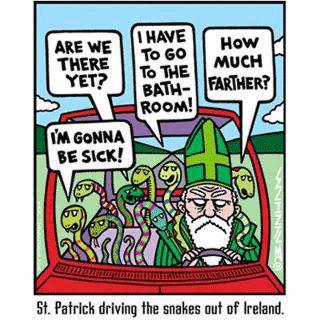
St. Patrick’s Day. Every year people celebrate this day by punishing their livers and making poor wardrobe choices, with stereotypical and sometimes truly awful T-Shirts. The fake accents yelling out over loud music get worse and worse as the pints keep coming and if you’re lucky, you may get a little Irish parade or traditional music in there somewhere too. It is not the solemn celebration one would associate with a Saint, but rather one that is decidedly sacrilegious in the eyes of the church. And you know what? I absolutely support it, (with the exception of the racist and stereotypical garb and the fake accents,) because anything that removes the original intent of this holiday is just fine by me. After all, this is not a celebration that has anything at all to do with snakes, but rather it is one that celebrates the defeat of free thinkers and ancient traditions. St. Patrick (who was NOT Irish, by the way) has the dubious claim to fame of driving all the snakes out of Ireland…but science has confirmed that there were no snakes at the time. Of course, Christianity uses the metaphor of snakes to talk about evil temptations and the devil himself….and following that metaphor, Patrick driving the snakes from Ireland means he drove out what he considered to be the wickedness – he conquered Pagan Ireland.

Continue reading

Haunted and hunted

The New Yorker has just published a surprisingly in-depth article on Jean McConville and Irish history in the North – just in time to take advantage of the 15 minutes that most Americans devote annually to Ireland around St. Patrick’s Day. It’s brilliant timing and the article is very well done, even if it does rehash a lot of old information and it is certainly another strike at Gerry Adams and his past. It is clear yet again that this case will continue to haunt those who may be involved in it. No matter what side of the spectrum politically that you may fall on, this case was undeniably brutal. A single mother of ten, Jean McConville, was dragged out of her home at Divis Flats in front of her children, and wasn’t seen again until her body was discovered decades later. She is one of the “Disappeared” – people who were murdered by the Irish Republican Army whose bodies were never supposed to be discovered. Her story is the albatross around Gerry Adams’ neck and one that will never disappear again.
Continue reading

They’re Coming to America

So you want to move to America? Whatever for?! Unless you are in a “third world” country, chances are your health care is better, your education is better, your work schedule is better, and people are probably kinder where you already are. Considering the weakness of our dollar, our union-busting corporations that are considered people, the current political climate, our abhorrent race and gender issues, and our militarized police force, I would encourage you to think again before coming to the “Land of the Free.” However, since a lot of people are still interested in moving here, I thought I’d go over some of the most common ways to accomplish it and throw my observations into the mix. We are hard on our immigrants—legal or not—and there are several things to consider. Here are some of them, wrapped up in the most frequent ways to get into good ol ‘Merica. Keep in mind, this isn’t even about the path to citizenship. These are just things I’ve witnessed while watching people try to obtain semi-permanent residence and entrance into our work force. Citizenship is even more difficult.
Continue reading

Tom Clarke

On this day in 1857 Thomas James Clarke was born to Irish parents at Hurst Castle in Hampshire, England. It’s more than a little ironic that one of the biggest strategists behind Ireland’s future revolution was born on English soil. In fact, his father was in the British Army and the family did not return to Ireland until Tom was seven years old. They settled in Dungannon, a Fenian stronghold that had suffered terribly during An Gorta Mor – Ireland’s Great Famine. The scars of that disaster were still all around him and from his earliest years, Tom hated the English establishment. He was determined to fight against it however he could.

Continue reading

Love, Marriage, and Immigration

A few months ago, I shared a love story.  My dear friend Jody found the man of her dreams through the magic of technology. Unfortunately for the two of them, Kevin was half a world away in Raheny on the outskirts of Dublin and Jody was here in California. Trips between the United States and Ireland can get pretty expensive relatively quickly. At some point in the future Kevin might have moved away from Raheny but he did not want to come to America at all. That was never in the plan. However, even the best laid plans change and he did end up coming here for Jody. At first, everyone on both sides of the puddle worried a bit but there was no need. Kevin is delightful and Jody has never been happier. I was thrilled for them when they got married a few months after his arrival at San Francisco City Hall and it has been my privilege to watch them grow into an amazing couple.

Continue reading

The Gibraltar Killings

If you somehow knew who Adolph Hitler would become and what he would do, would you murder him before he could do his damage? This rhetorical question is asked by personality tests, psychologists, and Philosophy professors all the time to gauge the morality of their subjects.  Many otherwise peaceful people have quickly answered yes. So then the quandary becomes about where the boundary lies and when we become OK with murder or assassination. When you use someone as horrible as Hitler, the odds are guaranteed to have an emotional and reactionary response. When taken out of the hypothetical realm, odds are that most people would say they are against preemptive murder, no matter what the circumstances are. There are laws against that kind of thing in almost every civilized nation – including Britain – but on this day in 1988, British soldiers ignored them.
Continue reading

Grace Gifford Plunkett is born

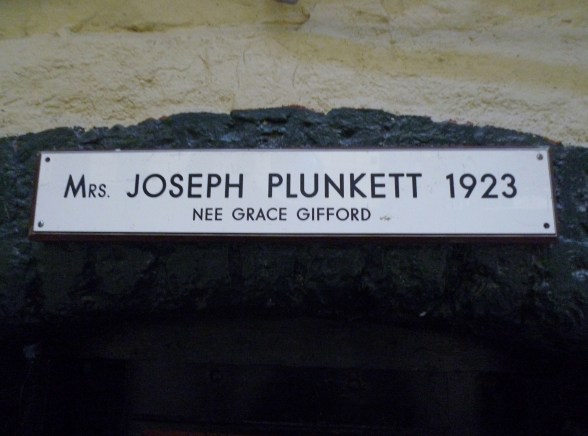
Perhaps the biggest tragedy and the best known story in modern Irish history is that of Joseph Plunkett and Grace Gifford’s doomed love affair and hasty prison wedding. The tragic romance sits right next to Romeo and Juliet in the great sagas of impossible love, and their story may be one of the largest reasons that popular opinion swung in favor of the rebels after the 1916 Easter Rising. The day the British executed Joseph Mary Plunkett, they guaranteed that the story of the rebellion would no longer be remembered without the emotional inclusion of Ireland’s favorite tragic widow – Grace Gifford Plunkett. But before there was a widow, there was a headstrong, artistic woman – one who was born on this day in 1888.
Continue reading

Edward “Ned” Daly

Edward “Ned” Daly was born into a large and proud Fenian family on this day in 1891. Although he was named after his father, he never met the man. His dad passed away just before Ned was born, leaving his uncle, John Daly, and the rest of his family to raise the young boy. They instilled in him the same rebel nature and Irish Republicanism that his father had once fought for.  When he was a small child, all he wanted to do was to be a soldier, like his father before him. Since his family would never allow him to take a post in the English Army, Ned thought his dream would never be achieved. However, when the march toward yet one more rebellion began, suddenly there was another option. Under the influence of his sister (who happened to be Kathleen Clarke), and her husband Tom, Ned’s interest in fighting and soldiering was brought to fruition. It was his destiny to be a rebel but unfortunately, that destiny would also lead to an early grave.

Continue reading

Bombs and Potential Bombshells

Remember the idea that the Good Friday Agreement would end the Troubles and bring peace in the North? It’s a tenuous peace at best, and certainly not as tranquil as most Americans believe. There are still shootings, bombs, and more every day in the region. We don’t hear about it in America most of the time because the Good Friday agreement was the jewel of the Clinton administration but it happens more than anyone would hope. In the last week or so, there were at least four pipe bombs planted under cars resulting in mass evacuations and one explosion. There were also at least two “paramilitary-style” shootings, two large protests, a vandalized memorial, another bomb scare in Derry, and an article on the people who are already amassing tires and pallets for their bonfires in July. A Catholic church was spray painted with Sectarian graffiti that supports the Ulster Volunteer Force (UVF) and in other areas you can see an ever increasing number of tags supporting the IRA. The Union Jack will fly on some government buildings for the first time in nearly a decade. Martin McGuinness has been warned of a serious assassination plot against him where he’d be killed with a rocket – not a gun or a bomb, but a rocket. How peaceful does this sound to you?

Continue reading

Margaret Pearse, mother of Ireland

It must be agonizing for a parent to outlive their child. It goes against the natural order of the universe and has to be absolutely devastating. For many, it usually involves anger and hopelessness. Margaret Pearse knew that suffering better than most, for she didn’t lose one son, but two—at once—both executed at the hands of the British for their roles in the Easter Rising of 1916. Despite this, she steadfastly refused to give in to despair and she spent the rest of her life fighting for the free Ireland that her sons had died for.
Continue reading