It’s rare that a woman can juggle an immense amount of political power, a restaurant of her own and a family of four children. But Jennie Wyse Power did all this and more, at a time when most women weren’t even getting an education. She was an Irish superwoman and an unapologetic suffragist who passed away on this day in 1941.
Tag Archives: 1916
Remembering Agnes O’Farrelly
Agnes O’Farrelly was a mighty woman in the realm of aademia during a time when that was highly unusual. She was a suffragette committed to improving the role of women in society and a staunch supporter of the Irish language. She has the important distinction of being the first woman to publish multiple novels in Irish. She was not a native speaker and did not learn it until she went to university – in fact, she was the reason that language lessons were revived there. Eoin MacNeill was her mentor in the language and eventually he sent her to the Gaeltacht area in the Aran Islands to further her education in Irish. Though she did not speak it from birth, this trip only reinforced her love for it. Eventually, she became a professor in Modern Irish and she continued speaking, teaching, and writing it for the rest of her life.
Ms. O’Farrelly presided over the inaugural meeting of Cumann Na mBan in Dublin, however she did not stay involved for long. While she was in favor of an independent Ireland and a supporter of Irish Nationalism, she felt that the women’s organization should be dedicated to arming and supporting the men of the Irish Volunteers, rather than joining the fight directly. It may seem like a peculiar stance for someone who wanted equal rights for women but she also believed in peace. As Cumann Na mBan became more militant in their own right, she withdrew from her leadership role and returned to academia – still fighting for women and an independent Ireland in her own ways, such as reviving the language and history, becoming an influential member of the Gaelic League and convincing other women to join her.
In 1916, she used her powerful gift of the written word and her scholarly position in an attempt to save her good friend Roger Casement from execution. She started a petition and sent a lot of correspondence but in the end, she was unable to persuade the authorities to spare his life. In 1922, she was part of a group of women who tried to convince the IRA leadership to avoid the upcoming civil war. That too, failed. Despite these setbacks, Agnes O’Farrelly remained influential in Dublin for many years and continued to be one of the most prominent female activists of the time.
Her devotion to the Irish language, to education, and to peace left little room in her life for romantic attachments. She remained an independent woman her whole life and never married. She died on this day, Nov. 5th, in 1951 and was buried in Deans Grange Cemetery. Her funeral was attended by many former colleagues, students, political activists, authors, rebels and the Taoiseach himself. She is remembered for being one of the most profound advocates for the Irish language in recent memory and has been credited for being one of the reasons that the number of women in academia swelled greatly at the time and ever since.
Moore Street Vote
Finally, the Dublin City Council decided to actually vote on the Moore Street dilemma. They have been putting it off as the contention grew to palpable levels and more and more people got involved in the process. At issue was an opaque “Land Swap” which was an idea that involved a lot of special interests, veiled corruption and back room deals – but in the end, the deal was finally defeated yesterday.
1916-2016
As someone who has been a long term student of Irish history, I have been looking forward to the centennial celebration for years and years. At first, I thought I’d have to watch it from afar – and I still may yet have to do that, but the goal is to spend about a month wandering through the whole of the Emerald Isle before culminating in Dublin for the 100 year commemoration of the Easter Rising. I have been devouring any information I can find on the planned celebrations for years and have found it all woefully lacking. I still can’t even get an answer about whether it is going to be planned for Easter, which is incredibly early in 2016, or if it will wait until April 24th.
I started paying attention to what the people in charge were and were not saying. Modern politicians seem to be more concerned with whether or not the British royalty will show up than they are about planning something awesome for their own people. Given that they owe their positions to the rebellious men and women of 1916 (also before and since) you would think that they’d be getting ready to honor them.
Continue reading
Hunger by Choice – Hunger Strike Commemoration
The Hunger Strike is an ancient custom that has been used for solving serious personal and social conflicts for centuries. The concept was originally an option for fighting injustice and it remains so to this day. August 3rd, 2014, is the day Hunger Strike Commemorations in Ireland wind up for the year, which is a perfect time to learn about the tradition and some of the people who have carried it on.
The Hunger Strike was codified in the early Brehon Laws of Ireland and known as a Troscad. It was often employed against a chieftain or tribal leader by someone of lower standing and was carried out publicly on the abuser’s doorstep. Advance notice was given before commencing this type of strike and the defendant was supposed to fast along with the person who had the complaint. If the originator of the strike died of starvation their opponent had to pay relatives a fee and would be subjected to societal penalties and supernatural consequences. Few people allowed themselves to be shamed in such a situation for long and most conflicts were resolved quickly and without death. It turns out that forcing the other party to go hungry right along with you made a difference, as did the peering eyes of the public.
Continue reading
Howth Gunrunning Ladies
100 years ago exactly, a large shipment of arms landed in Ireland. It took the actions of extraordinary women to accomplish the Howth Gun Running scheme of 1914. One, Alice Stopford Green, gave a loan to have the capital for negotiations. Two more, Molly Childers and Mary Spring Rice, raised the rest of the funds to purchase the weapons. They were transported on the Childer’s family yacht – The Asgard – and two of the women sailed proudly with them. This is not to say that they did it alone but without the actions of these women, this large landing of arms destined for the hands of the Irish Volunteers may never have happened. Continue reading
The Death of the Countess
“I do wish you lot had the decency to shoot me.” -Constance Markievicz, 1916.
Constance Markievicz may have wanted to die like her compatriots for her role in the Easter Rising but the English wouldn’t execute a woman. In the end, they may have wished they had, for the Countess had another 11 years to continue being a thorn in their side. She went straight into an even more political role, creating a world where women were more equal to the men, remaining staunchly Republican and inspiring thousands of people, including myself, throughout the years since. She is one of my favorite heroes.
Continue reading
Roger Casement
On this day in 1916, Roger Casement (once Sir Roger Casement) was convicted by the British crown for high treason. Roger Casement was an anomaly. He was a foreign office diplomat who could never quite get what he was after. He was knighted for his humanitarianism but was trying to broker arms deals. He believed in Irish Republicanism but some of his comrades believed he was too moderate while others believed he was too extreme. He was a rumored sex tourist who traveled to hide and indulge in his homosexuality. And despite having no foreknowledge of the upcoming Easter Rising – being that he was NOT a member of the IRB and they did not fully trust him – he was still convicted of high treason and some of the charges that led to his death were that he helped to plan the rebellion.
It was surprising that he heard of it at all. Casement had been out of the country and then was in the north and kept in the dark by the Republican Brotherhood. He was arrested 3 days before the Rising began – after failing to get Germany to agree to send reinforcements into Ireland to fight the British – and after a whole shipment of German arms heading into Ireland was intercepted. His case was difficult because he was in Germany when such ‘crimes’ happened, but they were relentless in his prosecution.
His supporters at trial were the likes of Sir Arthur Conan Doyle, W.B.Yeats and George Bernard Shaw. Perhaps the revolutionaries weren’t sure about him, but the popular writers of the day sure seemed to be. On June 29th, 1916, he was stripped of knighthood upon his conviction and sentenced to a death by hanging.
His appeals failed. By the time he was hanged, he had converted from Protestant to Catholic and his priest thought he should be considered a saint. He was buried in quicklime at the prison after his death. In 1965, he was repatriated to Ireland and laid to rest with full honors and a state funeral in the Republican Plot at Glasnevin Cemetery. However, Casement’s last wish was to be buried at Murlough Bay on the North Antrim coast and it has yet to be fulfilled. The government released his remains only on condition that they not be brought into Northern Ireland. Oddly enough, the 1965 British Cabinet record of the decision still refers to him as Sir Roger Casement.
Perhaps someday he will get his wish.
Stand up For James Connolly
I’m sure that they’ll argue that he was Scottish born. I’m sure they’ll denigrate his socialist beliefs. Neither dispute the fact that he stood for Ireland when others didn’t – and included rich, poor, male and female equally in all of his philosophies. Write. Call. Stop this ridiculousness.
At 6pm on Sunday, 18th of May 2014, RTÉ1 Radio’s History Programme is asking the question: “Is James Connolly a false 1916 Icon?” Don’t let them degrade the winner of the Public Poll to choose the Greatest Irishman Ever. We need to flood RTÉ’s Inbox with support for James Connolly. Please take time to E-Mail: history@rte.ie saying that you support James Connolly as a National Irish Icon.

Protect Moore Street!
On the off chance you are in Dublin this weekend, or you have the ear of an Irish politician, you should help protect Moore Street. It is home to one of the only outdoor markets left in Dublin, but aside from that it is also where the rebels of 1916 made their last stand and escape from the GPO before surrendering to stop civilian casualties. Developers want to replace all that history and street vending with another mall, though there are more than a few in the area and more hotels. Stand up and link arms for history, street vendors, farmers and locals. You can find more information via these 2 links
http://www.occuworld.org/news/817530
https://www.facebook.com/events/1537009746526361/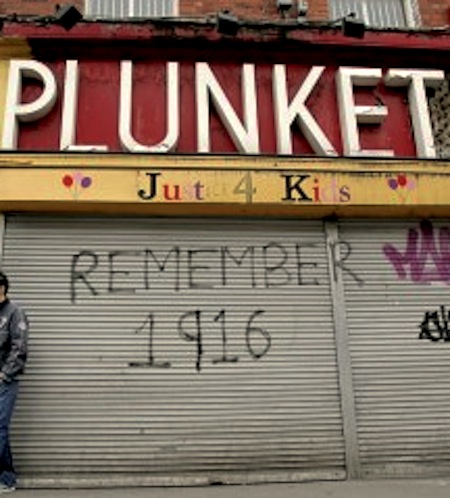

 Choosing the Green
You must be logged in to post a comment.