There was more than one amazing Gifford girl. Grace has been immortalized in the annals of Irish History and song, but her sisters were just as political, in fact more so, than the tragic bride of 1916. Sidney was one of the first Gifford sisters to get involved in politics, even though she did it quietly and under the assumed name of John Brennan. In a world where women weren’t listened to, Sidney made her voice and her opinions heard.
Tag Archives: Women
The Lady of Bachelors Walk

On this day 102 years ago, a large shipment of arms landed in Howth, destined for the Irish Volunteers. Many of these guns were used two years later during the Easter Rising of 1916 and without them, the Rising may never have happened at all. When the Asgard came to shore it was met by the Fianna Éireann and other Volunteers who were quick to unload the weapons and begin carting them off. They hoped to avoid the attention of the police, but their mission did not pass unnoticed. The authorities who were watching did not engage the large crowd but they did call for backup. As the Volunteers left the area they were met by the King’s Own Scottish Borderers, a regiment of the British Army. A tussle ensued but in the end, the soldiers were only able to confiscate a mere nineteen of the nine hundred guns brought into Ireland that day.
News spread quickly of the successful smuggling operation and the military’s failure to seize most of the weapons so by the time the Borderers were marching back into Dublin, crowds had already gathered to celebrate and to mock them. They antagonized the soldiers, taunting them and throwing rubbish and fruit at the column (which magically became stones in the official reports). They shouted insults and openly laughed at the troops and their failed mission. Soldiers and police officers never tolerate this kind of behavior for long (as they continue to prove to this day) and by the time they marched onto Bachelors Walk they had had enough of the hostile crowd. The soldiers turned to face the people and seconds later shots were fired directly into the busy street, hitting those who had been following them and innocent civilians alike. They followed the volley of bullets with a bayonet charge. The collective lack of self control from the army resulted in four casualties and nearly forty others were injured.
Veronica Guerin is born
On July 5th, 1958 a true fighter was born in Artane, Dublin. Veronica “Ronnie” Guerin was one of four children and she was a strong girl from the moment she was born. She excelled in school and played many sports, competing and working with the best athletes. She played for the Women’s National basketball team, and the Women’s National Football league. Her competitive nature and strength gave her the drive she had as an adult to succeed in whatever profession she chose.
Remembering Elizabeth O’Farrell
On this day in Irish history one of the bravest Irish women bid her last farewell to her beloved Ireland. Elizabeth O’Farrell passed away on June 25th, 1957, forty-one years after completing a dangerous mission that many thought would kill her. In 1916, Ms. O’Farrell wore a red cross and carried a white flag through raging battle zones to offer the surrender of the leaders of the Easter Rising. As she left the makeshift rebel headquarters in Moore Street her friend Sheila fell into hysterics, sure that Elizabeth would be killed on this mission.
Free Anna Harvey

I haven’t written much about my month-long journey through Ireland culminating with the Centenary because to be frank, I am left speechless by most of it. I have no words to convey how much it changed me and how blessed I was to connect with so many amazing people. Many of the greatest moments of my life happened on this trip, including being one of the Constance Markievicz 1916 Societies standard bearers near the forefront of the centenary parade(s). I still can’t believe that happened and I owe the honor to a couple of incredible women named Anna Harvey and Emma Radford.
Mother of the Revolution
In honor of Margaret Pearse who died 84 years ago today I thought I’d share the bit I wrote about her in my book, Petticoats, Patriots, and Partition. Many women suffered incredible loss during Ireland’s revolutionary period, but Margaret had a special kind of pain, losing both of her only sons. We are days away from their commemoration times and remembrances, so I thought Margaret should have hers too.
Derry
This city is like nowhere else I’ve ever been. It’s powerful, amazing, and heartbreaking. As a student of Irish history, to stand on Free Derry Corner during a brief break from the rain was potent and awesome.
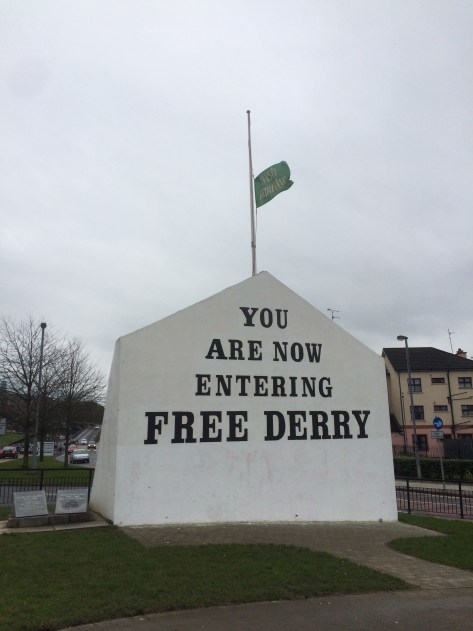
Yesterday I took a long ride with Paul Doherty whose father was murdered on Bloody Sunday. It was an intense afternoon full of laughter and a few silent tears. I have never written about that massacre specifically and I’m still not sure I ever will. His voice and the voices of the other families and survivors are loud enough and more important. But it has been mentioned here because you can’t have an Irish blog with no mention of Bloody Sunday; just like you can’t walk or drive through Derry without seeing those scars and the strength and anger that still remain so many years later. I can’t recommend Paul’s taxi ride highly enough. We went everywhere and he took me to many of the murals off the beaten path. When he found out I write an Irish blog that’s somewhat focused on women, he took me to a couple that honor women specifically.
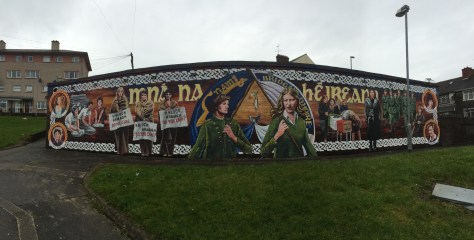
My only complaint thus far is how shoddy the wi-fi is my hotel. Other than that, I may be in love with this region. I have a giant oak tattooed on my body, so I guess it’s no surprise that I’d love Derry considering that its name means Oak Grove. I have a day or so left, so if there’s something I absolutely must do or see here, let me know.
No, Nay, Never; Cumann na mBan rejects treaty
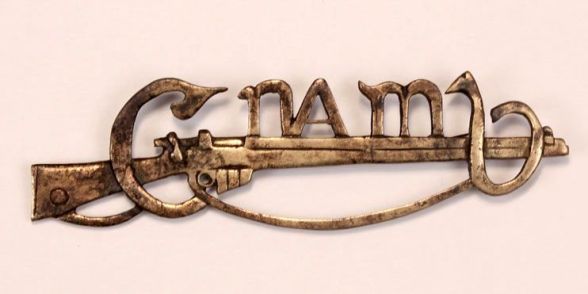
The ladies of Cumann na mBan have always had very strong opinions about the state of Ireland and its politics. Since its inception, the majority of CnamB members have fought for a united Ireland. During the lead up to the Easter Rising of 1916, these women supported the Republican cause in many different ways. They raised funds for the uprising, trained in first aid in order to help wounded Volunteers, smuggled various weapons and explosives throughout Ireland, spread important news, and many learned to shoot and fight themselves. They became a force to be reckoned with.
In the aftermath of the Rising, CnamB was flooded with new members and big ideas. They were prominent in the Dáil Éireann, the Republican legislature set up to counter England’s rule. Many of the widows of the leaders of the Rising were some of the loudest voices and strongest supporters of a free Ireland, and almost all were members of the female Republican organization. Eamon De Valera called them the “most unmanageable revolutionaries.” Many others accused the organization of making decisions based on vengeance and emotion without thought or consequence, especially when they voted against the Anglo-Irish Treaty ninety-four years ago today.
The Countess; Petticoats, Patriots, and Partition

I write a lot about Constance Markievicz, just like anyone else who writes Irish history should. However, she was not the only woman involved in the planning or the execution of the Easter Rising in 1916…and many others never get the credit they are due. That’s not to say that she doesn’t deserve a bit of her own though. After all, one of her more famous quotes is highlighted proudly on my business cards, and she does have her own few pages in my book. Today in honor of her birthday, I give you some of her story from Petticoats, Patriots, and Partition – the book that has stolen most of my time for the last six months or so. Happy birthday Countess.
Dr. Ada English

Dr. Ada English was a strong woman, a fervent Nationalist, a prominent member of Cumann na mBan, and one of the first female psychiatrists in Ireland. Like her peer Dr. Kathleen Lynn, Dr. English devoted her spare time to politics and to healing and aiding the Irish Volunteers who were fighting for a free Ireland. Her story is not as well known as Dr Lynn’s however, since Ada was not in Dublin during the Easter Rising. Many political women of Ireland’s revolutionary periods have slowly vanished throughout the years, and Dr. Ada English has not been an exception to that unfortunate trend, though she should be.
 Choosing the Green
You must be logged in to post a comment.