Sheelagh Murnaghan

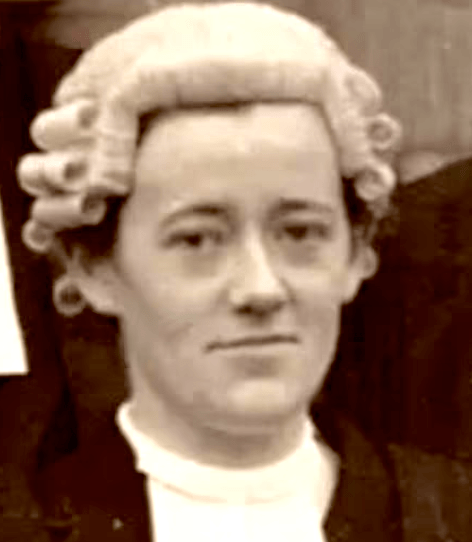
On this day in 1993, the North of Ireland lost a formidable voice. Sheellagh Murnaghan was a tenacious woman who was dedicated to equality in a world that didn’t have much of it. She never let that stop her though and she championed that fight for decades, despite suffering defeats time and time again. Guess it was the hockey player in her that never let her back away from a good fight.

Sheelagh Murnaghan was born in Dublin, but she went to school in Omagh and then studied law at Queen’s University in Belfast. While studying to become a lawyer, she also found the time to join and captain the National Irish Women’s Hockey team. She gave up the sport when she became the region’s first female lawyer and was accepted to the Northern Ireland Bar in 1948. Murnaghan then went into politics. She was one of the first women in Stormont and was the only liberal voice in the chamber at that time. Sheelagh was considered eccentric – she liked cigars and often brought her dog to work. She was a woman, a Catholic, and a liberal in a misogynistic, Sectarian, and conservative climate and she was ferociously dedicated to human rights. Murnaghan introduced legislation to abolish the death penalty and attempted to pass a Northern Bill of Rights at least four times. She also stood for Traveller’s rights, criminalizing discrimination in the workplace, and equal compensation for all, regardless of sex, creed, or political belief. Sheelagh was met with opposition (and probable ridicule) every time she attempted to introduce anything but she did not let that stop her. I’m certain she would have continued her quest if she had been successful in winning another seat once the university’s were abolished in 1969. She stood for election twice more in two different areas, but she lost both times.

Murnaghan was no longer a member of parliament but she still championed equality every day. She sat on several committees, including the Industrial Relations Tribunal, the Belfast Settlement Committee, and the Equal Opportunities Commission. She chaired a tribunal that heard the region’s very first sexual harassment case and her law practice specialized in harassment cases and gender equality from that point on. Murnaghan was not born in the North of Ireland, but it is clear that she devoted her entire career to making it a fairer, more balanced place while others were actively trying to prevent these things. She was absolutely opposed to the violence that erupted in the region and was openly vocal about it, which led to potential peril when her house was bombed by Loyalist paramilitaries in 1970. Luckily, she was not injured or intimidated by this attack and she continued to fight for peace and justice for another twenty-three years.

Sheelagh Murnaghan died on this day in 1993. She did not live to see the North finally adopt many of her ideas, nor did she see the end of the more active conflict in the region, but today, many recognize her as one of the first torchbearers of change and equality in the area. It’s a fitting legacy for a woman who devoted her life to making the world a better place.

Dan Breen

Dan Breen was an integral and powerful man in Ireland’s long fight for independence. He was a husband and father, a gangster, a politician, a speakeasy operator, and an author, but first and foremost he was a self-described soldier who was dedicated to freedom.

Continue reading

Remembering Jennie Wyse Power

Jennie Wyse Power


On this day in Irish history, Jennie Wyse Power passed away in Dublin. Prior to her death was a mother of four, a restaurant owner, a senator, a rebel, a suffragist, the first president of Cumann na mBan, and a founding member of both Cumann na Saoirse and Sinn Fein.

For more about this super capable woman and her full and crazy life, please click here.

The complicated legacy of Martin McGuinness

Humans are animals. It’s not something we like to admit, but it is true. Our animalistic instincts come out when we are hurting and angry, when we need to protect ourselves or our loved ones, or when we are desperate and afraid. Over time we learn to control them, not letting that dark side rear its ugly head just because our toy was taken away at the playground and if we’re lucky that animal fades into the background of our minds, never needing to come out.

When James Martin Pacelli McGuinness was growing up in Derry a lot was wrong in his world. The boy who would come to be known as Martin was partially named after a pope in a society that was violently sectarian and discriminatory against Catholic communities like his. He saw things most of us thankfully never will. War raged in the streets as he grew up. He witnessed friends being mowed down by soldiers without consequence. He saw authorities break the law over and over without punishment. That animal inside him grew and raged, like many others in the region and Martin found his way into the Irish Republican Army at a relatively young age. He stayed for a heavily disputed amount of time. Let’s just call it many years.

Continue reading

Martin McGuinness

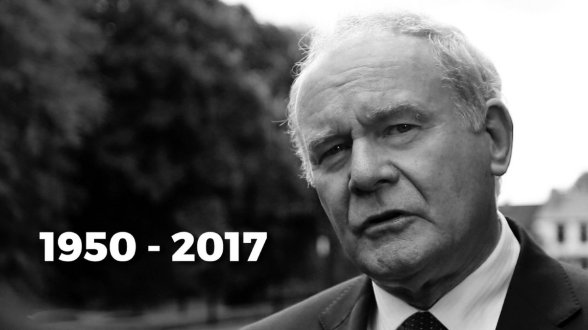
The world lost a giant a few moments ago. Former Deputy First Minister Martin McGuinness was a warrior, a peacemaker, and so much more. It’s not shocking news, but it is devastating. It is safe to say that without Martin McGuinness, the IRA ceasefire(s) and the Good Friday Agreement would probably have never happened. He is remembered by some as a modern Michael Collins and any Irish historian would probably agree that there’s a good deal of truth in that comparison.

McGuinness shaped politics in the North for decades and this evening the region lost much more than a single man. My thoughts and condolences go out to his friends and family and I hope that they can find the comfort they need in the days to come. My candles are lit and there is nothing else I can say at the moment as I try to form my own thoughts into words and to process the passing of such a vital and important person in modern Irish history.

Ar dheis Dé go raibh a anam

https://www.rte.ie/news/2017/0321/861287-martin-mcguinness-death/

Jennie Wyse Power

It’s rare that a woman can juggle an immense amount of political power, a restaurant of her own and a family of four children. But Jennie Wyse Power did all this and more, at a time when most women weren’t even getting an education. She was an Irish superwoman and an unapologetic suffragist who passed away on this day in 1941.

Continue reading