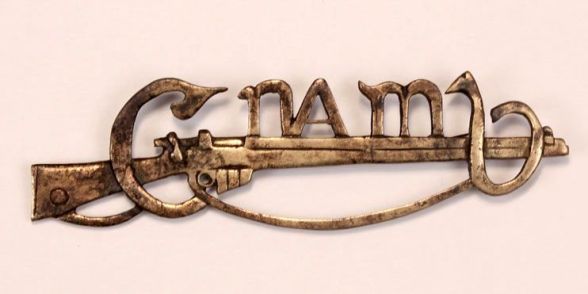
No, Nay, Never; Cumann na mBan rejects treaty

The ladies of Cumann na mBan have always had very strong opinions about the state of Ireland and its politics. Since its inception, the majority of CnamB members have fought for a united Ireland. During the lead up to the Easter Rising of 1916, these women supported the Republican cause in many different ways. They raised funds for the uprising, trained in first aid in order to help wounded Volunteers, smuggled various weapons and explosives throughout Ireland, spread important news, and many learned to shoot and fight themselves. They became a force to be reckoned with.

In the aftermath of the Rising, CnamB was flooded with new members and big ideas. They were prominent in the Dáil Éireann, the Republican legislature set up to counter England’s rule. Many of the widows of the leaders of the Rising were some of the loudest voices and strongest supporters of a free Ireland, and almost all were members of the female Republican organization. Eamon De Valera called them the “most unmanageable revolutionaries.” Many others accused the organization of making decisions based on vengeance and emotion without thought or consequence, especially when they voted against the Anglo-Irish Treaty ninety-four years ago today.

Continue reading

The Countess; Petticoats, Patriots, and Partition

I write a lot about Constance Markievicz, just like anyone else who writes Irish history should. However, she was not the only woman involved in the planning or the execution of the Easter Rising in 1916…and many others never get the credit they are due. That’s not to say that she doesn’t deserve a bit of her own though. After all, one of her more famous quotes is highlighted proudly on my business cards, and she does have her own few pages in my book. Today in honor of her birthday, I give you some of her story from Petticoats, Patriots, and Partition – the book that has stolen most of my time for the last six months or so. Happy birthday Countess.

Continue reading

Moore Street Wars

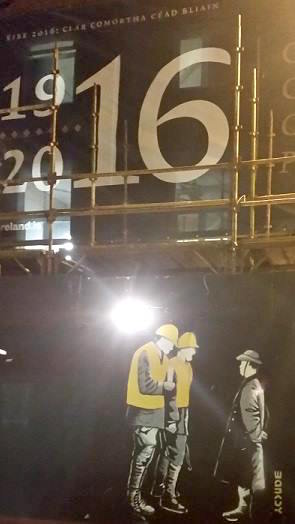
I’m returning to my favorite cause lately again for one more time (this week). Last night the “Banksy” mural appeared – and while it is obviously not Banksy, it is pretty great.

banksy

Well, it’s pretty great except for one thing. As one astute observer on Facebook said, “Just another time Elizabeth O’Farrell was edited out of the picture.” This artist didn’t even add her shoes. Still, the flash of color and the twist on the old surrender picture is still an awesome one.

Continue reading

Petticoats, Patriots, and Partition (take 1)

#nowyouknowmyname

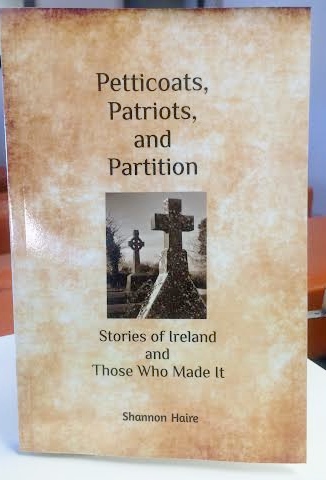
So I probably just did the scariest thing I have ever done ever. I published a book. One that people can buy, and that has my name on it. It’s terrifying and wonderful and I kind of feel like an impostor.

Continue reading

Shameless Self-Promotion

It’s so very close to being finished and I just can’t keep it to myself anymore. I hope you’ll forgive the teasing since it is not available yet, but by December 1st, it will be.

It’s written. It exists. It’s a collection of short histories, and mini-biographies – many that started as blog posts here. In fact, there are only a few that I’ve held back for the book only, but in this form the entries are expanded, edited, and written slightly differently. It’s taken forever and I’m super excited about it – or I would be if I could just stop editing. But now there’s a single, real-life, (albeit marked up) copy in the world and the rest are so very close.

Now you know the title. And my real name for that matter. Hopefully some of you will love this book – and will be OK with me promoting you in it too. I can’t believe it. Coming so very,  very soon!

#nowyouknowmyname

#holycrapIwroteabook

Catalina Bulfin MacBride

The Bulfin family has a very respectable presence in the historic fight for Irish freedom. Many generations of the family fought for Nationalist and Republican causes, both inside and outside of Ireland. One branch ended up in Argentina, which is where Catalina Bulfin and her brother Eamon were born.
Continue reading

Gerry Adams

He’s been called a murderer, a terrorist, and an evil ringleader. He’s been banned from travel and speech, and he’s been flown around the world to give speeches. He’s been reviled and celebrated, and has been protected by many even as he is threatened by his own people, in addition to the threats from his enemies. He’s divisive and unifying, a liar and a speaker of truth, a politician and a probable paramilitary leader, although he denies that second part. He’s been labeled as Machiavellian and diabolical, or a man of peace and kindness, depending on who you ask. He’s been a prisoner and now rules as a politician – one who some have compared to Nelson Mandela. Many thought he should have shared the glory of Hume’s Nobel Peace Prize, even as others accuse him (then and now) of atrocities and war crimes. Gerry Adams has been many things to many people and it’s hard to know whose impressions are right, but one thing is apparent to everyone. He is not going away.

Continue reading

Ruairí Ó Brádaigh

If ever there was a man who stuck to his principles from birth to death, no matter what the cost, it was Ruairí Ó Brádaigh. He was born and raised as a hard-line Republican and he died a hard-line Republican as well, a little over eighty years later.

Continue reading

The Power of Names

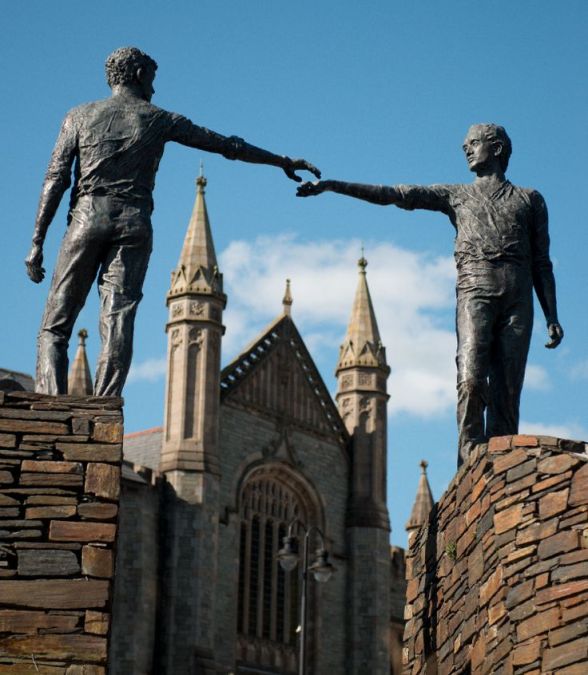
“Londonderry or Derry?,” asked a friend of mine when he was off to the North of Ireland. It’s an age old question and I found myself a little stuck when it came to answering. “That depends” seemed to be the safest bet at the time. However, the next time either of us visit, the question may no longer be an issue since last week Derry city and the Strabane District Council voted in favor of formally losing the London prefix.
Continue reading

Love Will Tear Us Apart

Charles Parnell was the ultimate star of Irish politics in his day. His meteoric rise might have been enough to give Ireland the Home Rule it had longed for. He might have been the man to change the course of Irish history long before the armed militias and secret societies of later years ever had a chance to grow or rise up. He might have done all this and more—or not—but we will never know because his passion for Ireland came second to one other – and that one other was a married woman named Katharine O’Shea.

The two met originally because Katharine’s husband Willie had decided to enter the political arena. Like any smart and supportive wife, Katharine thought to further advance her husband’s career by befriending the most powerful politician at the time and that was Charles Parnell. This plan immediately backfired when the attraction between the two of them grew after their first encounter. Within a matter of months the two were carrying on a passionate and overwhelming affair, to the peril of all else.

It is highly improbable that Willie O’Shea did not know of the affair, given that Katharine had three children with Parnell. He turned a blind eye to his wandering wife for the sake of his political career and all of the Parnell children were given the last name of O’Shea, despite their bloodlines. He used Parnell for his own career advancement and lived comfortably on his wife’s money, staying silent about the affair for years. He held his tongue until it would utterly destroy everything Parnell had been working for. Then and only then did Willie open his mouth, publicly and scandalously.

It was Christmas Eve in 1889 that Willie filed for divorce, and it was motivated by greed since Katharine had just received a large inheritance. She tried to silence him with a large settlement but he would not be satisfied and he continued to petition for divorce. He dubiously claimed that he had known nothing of the near decade-long affair and he named Parnell as a co-respondent in the proceedings, knowing that it would destroy both his wife and the politician. Support for the Home Rule that was Parnell’s dream fell along with him and burned out in scandal. He was accused of bribing Willie in order to sleep with his wife. The Irish Parliamentary Party split down the middle and the only thing they agreed upon was that it was all Katharine’s fault. She was accused of being a manipulative Englishwoman who had designed the affair to take down Parnell. She was called a whore and was told that she was responsible for the defeat of Home Rule. The Irish press took to calling her Kitty – a slang term for a stupid, young, or childish woman and a more subtle, occasional title for prostitutes, or certain parts of the female body. It was an open insult to her and one that stung the lovers deeply.

Parnell fought back, and tried to keep his career from totally imploding. He defended them both and sought to calm the scandal by proving once and for all that their love was real. They were married on this day in 1891 but in spite of his hopes for understanding and respectability, the wedding only made things worse. The press categorically refused to call Katharine by her married name of Mrs. Parnell and they continued to hurl abuse at her, selling paper after paper denouncing the couple. Parnell’s attempts to save them both only put another nail in the coffin and although he tried to resume his work after the wedding, he quickly discovered that the Ireland he had fought for had irrevocably turned against him and the love of his life.

Katharine, or Katie, (but never Kitty,) as she was known to friends and family, was the perfect scapegoat and her notoriety as the woman who harpooned the best chance of Home Rule for Ireland still permeates today, even though many historians feel like Parnell would never have achieved it anyway. She was a woman of scandal, even though her true love had made an honest woman out of her, so to speak. Their marriage only lasted four months before Charles Parnell passed away – and it was fraught with stress and insults all the way through. At least they had the years of joy beforehand, otherwise Katharine Parnell may have lost her mind completely. As it was, she had the first of many breakdowns soon after her husband died but she went on to publish a few books and she lived for another thirty years. Just not in Ireland.