My body is rebelling against being thrown back into the States and I caught a vicious cold on the flight back from Ireland. This cold, on top of the jet lag, culture shock, and come down after such a mind-blowing holiday has left me quite speechless. I have a lot of catching up to do for sure and a lot of processing to do as well.
Tag Archives: Northern Ireland
Derry
This city is like nowhere else I’ve ever been. It’s powerful, amazing, and heartbreaking. As a student of Irish history, to stand on Free Derry Corner during a brief break from the rain was potent and awesome.
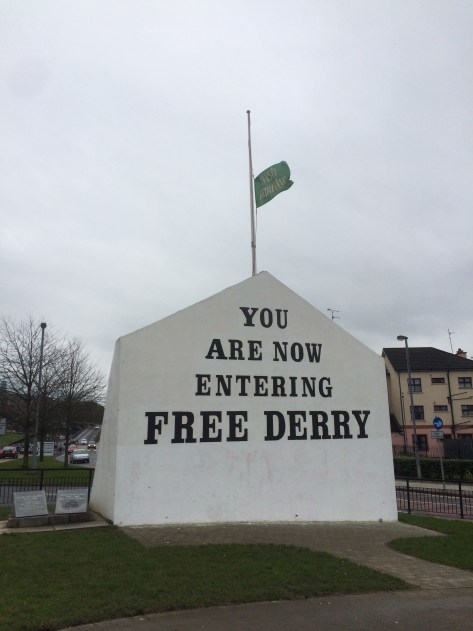
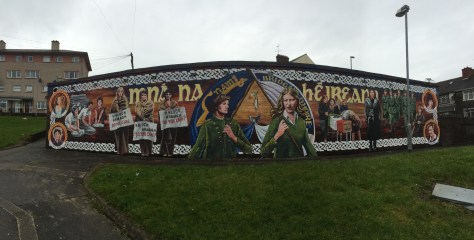
Yesterday I took a long ride with Paul Doherty whose father was murdered on Bloody Sunday. It was an intense afternoon full of laughter and a few silent tears. I have never written about that massacre specifically and I’m still not sure I ever will. His voice and the voices of the other families and survivors are loud enough and more important. But it has been mentioned here because you can’t have an Irish blog with no mention of Bloody Sunday; just like you can’t walk or drive through Derry without seeing those scars and the strength and anger that still remain so many years later. I can’t recommend Paul’s taxi ride highly enough. We went everywhere and he took me to many of the murals off the beaten path. When he found out I write an Irish blog that’s somewhat focused on women, he took me to a couple that honor women specifically.
My only complaint thus far is how shoddy the wi-fi is my hotel. Other than that, I may be in love with this region. I have a giant oak tattooed on my body, so I guess it’s no surprise that I’d love Derry considering that its name means Oak Grove. I have a day or so left, so if there’s something I absolutely must do or see here, let me know.
The Hunger

Last week I wrote a little about Brendan Hughes, and coincidentally, today is the commemoration of the start of his hunger strike. Their troscad – which is the Celtic name for a fast that was employed to draw attention to insult or to fight injustice – began 35 years ago today.
It’s my birthday!

My blogs have had a birthday! I almost missed the notification – but I turn two today…or one of them does. It is hard to believe, considering I didn’t even know I had two years of material in me. This one isn’t quite two yet, but since it is more regular, I’m celebrating it anyway. Earlier this year, I posted my ten favorite Irish posts from my first year of writing. Now I’m publishing a book, looking forward to spending a month in Ireland come March, and already forging ahead. I hope you’ll all join me on these adventures.
The Dark One
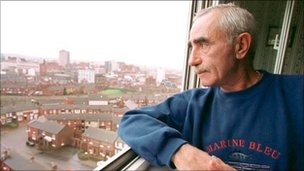
On this day in 1948, Brendan “The Dark” Hughes was born. He came from a long line of Republican fighters, and as he grew up, he knew that his own entry into the IRA was inevitable. He was right and he was an effective soldier. Later in life he often talked about peace, reconciliation, tearing down the peace walls, and improving relations in the North of Ireland – but he knew he was being idealistic. That peaceful existence may have been what he ultimately wanted, but his life was filled with violence, prison, hunger, and retribution.
Gerry Adams

He’s been called a murderer, a terrorist, and an evil ringleader. He’s been banned from travel and speech, and he’s been flown around the world to give speeches. He’s been reviled and celebrated, and has been protected by many even as he is threatened by his own people, in addition to the threats from his enemies. He’s divisive and unifying, a liar and a speaker of truth, a politician and a probable paramilitary leader, although he denies that second part. He’s been labeled as Machiavellian and diabolical, or a man of peace and kindness, depending on who you ask. He’s been a prisoner and now rules as a politician – one who some have compared to Nelson Mandela. Many thought he should have shared the glory of Hume’s Nobel Peace Prize, even as others accuse him (then and now) of atrocities and war crimes. Gerry Adams has been many things to many people and it’s hard to know whose impressions are right, but one thing is apparent to everyone. He is not going away.
Ruairí Ó Brádaigh
If ever there was a man who stuck to his principles from birth to death, no matter what the cost, it was Ruairí Ó Brádaigh. He was born and raised as a hard-line Republican and he died a hard-line Republican as well, a little over eighty years later.
Lawyers, Guns, and Collusion
Lawyers are a group of people in an occupation that everyone loves to hate. Endless jokes use them as the punchline, there’s an eternal stream of songs and stories about how evil they are, and it seems that no matter which area of law they practice, they’re always hated by someone. It takes a thick skin, an obsessive attention to detail, endless patience, and a lot of manipulation to succeed in the field. In the North of Ireland, the law not only takes over their lives, but sometimes it ends them. It is not a job for the weak.
Rosemary Nelson lived her life trying to make the world a better place for everyone. She lived in a hotbed of Sectarianism during the Troubles but she represented people on both sides of the religious divide in small matters for years and went to bat for those that other people would ignore. She fought on behalf of the Garvaghy Road residents during the long Drumcree conflict in nearby Portadown, which thrust her firmly into politics and ruined any rapport she had with the Royal Ulster Constabulary (the RUC). That relationship only got worse when she decided to represent Colin Duffy, a man accused of killing their officers. That case would change her life and it ultimately took it as well. In the North, there have been many cases where certain factions of the population are unable to separate the lawyer from the criminal, and the assumption is that they’re one and the same. Even before she got Duffy released on a successful appeal, she was getting death threats from officers and Loyalist paramilitaries alike, just for representing him. There were twenty serious and documented death threats over a two year period, and two of them allegedly came directly from police officers. She dutifully reported each one, but was consistently refused protection by the police and the government, even after the United Nations’ Special Rapporteur stated on television that he felt her life was in danger. He recommended that the British government take action. They chose not to. She eventually testified about the threats before a committee of the United States Congress that was investigating human rights in the North of Ireland. It seems everyone was concerned about Nelson, except the very people whose job it was to take care of her.
The British government, MI5, and the RUC did not investigate any of these threats, nor did they ever give her protection. In case you feel like they didn’t do anything, rest assured that they did – they put Rosemary herself under surveillance for criminal activity. Between 1994-1998 security reports about her life increased until her home was bugged. She was seen as a criminal, rather than an attorney; and a threat, rather than a victim.
Rosemary Nelson was killed when a bomb planted under her car exploded on March 15th, 1999. The Red Hand Defenders, a Loyalist paramilitary group that was mostly made up of members of the LVF and the UDA, took credit for her assassination. Many of the members of the Red Hand Defenders were also RUC officers and British Army soldiers – people who belonged to the same organizations that had ignored her complaints for years, even while they were watching her every move. Strangely though, they didn’t have much in their records to investigate when it came to her death, despite all the surveillance – at least nothing they were willing to share with anyone else. There were a few inquiries into her murder and the final reports stated that all three agencies (the Government, MI5, and the RUC) had failed to protect her and had helped “legitimize” her as a target in the eyes of Loyalist paramilitaries. It also stated that these agencies and their employees had publicly threatened her and that their intelligence information had been “leaked”, making it easier for the murderers to get to her. It noted that numerous requests and warrants for surveillance footage or reports had been ignored completely. The inquiry couldn’t prove definitively that anyone in these departments had directly been involved in her death, but it certainly couldn’t prove otherwise either and their report clearly stated that investigators could not rule out the possibility that officers or soldiers might have aided the murderers.
Nelson was awarded the Train Foundation’s Civil Courage Prize after her death – an award that honors “extraordinary heroes of conscience.” Her humanitarian status was celebrated and mourned world-wide in the aftermath of her murder – and while some Loyalists still see her as a symbol of hate, those who she spent her life trying to help remember her as an incredible and determined woman, who wanted justice for everyone whether they were young, old, Catholic, or Protestant. Today would be her birthday and I humbly suggest doing something wonderful in her honor. Help someone in whatever way you can, large or small, friend or stranger. I’m sure she’d want to be remembered in that way, rather than for the horrific way she was targeted, abandoned, and killed.
Speaking of Derry…
“We too are concerned that there are currently members of the British army on our streets years after we were told that they no longer have an active role in the north.” ~Danny Morrison, IRSP, Derry Journal.
That quote is not a throwback to the Troubles. It is not left over from Operation Banner – the longest deployment of the Army in British history. Operation Banner lasted for over 38 years. Their presence and poor decision making skills fueled the flames of the Troubles for thirty years, and the mission “failed to defeat the Irish Republican Army on a strategic level or have any long term plan,” according to a Ministry of Defence report. The British Army formally ended their engagement (Operation Banner) in the North of Ireland in July 2007.
The Power of Names
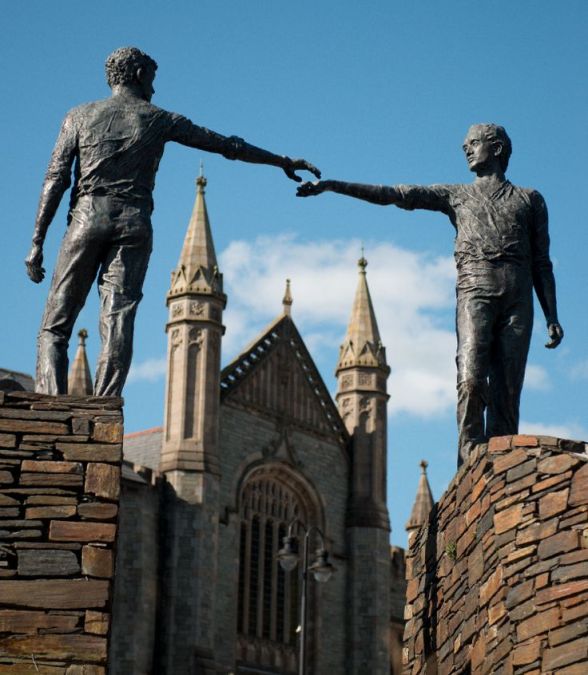
“Londonderry or Derry?,” asked a friend of mine when he was off to the North of Ireland. It’s an age old question and I found myself a little stuck when it came to answering. “That depends” seemed to be the safest bet at the time. However, the next time either of us visit, the question may no longer be an issue since last week Derry city and the Strabane District Council voted in favor of formally losing the London prefix.
Continue reading
 Choosing the Green
You must be logged in to post a comment.