Ireland has always had more than its fair share of feisty women. By 1908 there were already numerous Suffragist groups in Ireland, full of women who wanted equality, the ability to vote, and more freedoms. Many of these groups focused on petitions, publicity, and spreading their message through polite channels and discourse, and they attracted many prominent socialites who used their influence to further the cause. This was not good enough for Hanna Sheehy Skeffington, her husband Francis, and their radical friends. 108 years ago today, they founded the Irish Women’s Franchise League, a group dedicated to equal rights that used agitation and action to spread their message.
Category Archives: Equality
The struggle for equality

Women have been fighting for equality and recognition for centuries. In Irish history, women have always been seen as supporting cast members, fundraisers, nurses, etc. and safely put in the appropriate roles for their gender, whether they could do more or not. This has been the case for years and years and only now is that idea starting to be debunked by historians…but the historians devoting themselves to elevating the roles of women are mostly female. Myself included. Continue reading
The Party’s Over
Reading headlines from Ireland over the last few weeks was strange because I could have sworn I’d read them before…and I have. Hunger Strike commemorations, anger over parades, riot police protecting interlopers over residents, arson fires at community centers, the birth of new political parties, and spies in the IRA have dominated the media of late. The anger, frustration, and general sense of “what the fxck” that came with it all was a bit stronger in the last couple of weeks than it has been in much of the last few decades. The pictures, headlines, and videos gave me a sense of foreboding and a lingering confusion which kind of felt like I was having a bad flashback. Unfortunately, that was not the case.
Josie McGowan
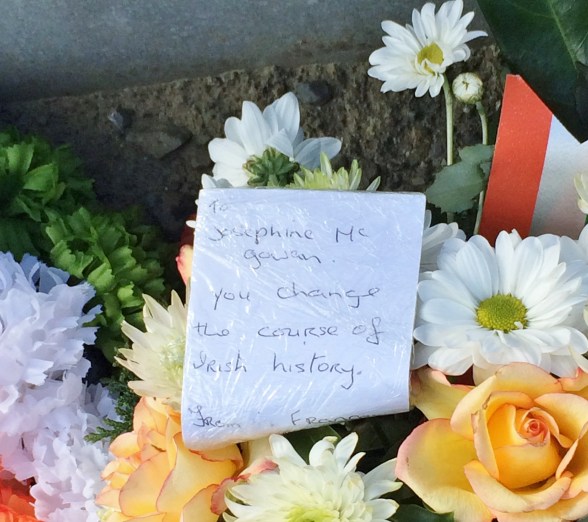
Josephine McGowan was one of the many women who participated in Ireland’s struggle for freedom. She was a member of the Inghinidhe na hEireann branch of Cumann na mBan and was stationed at the Marrowbone Lane garrison during the 1916 Easter Rising. She was one of twenty-five women who reported for duty and according to one witness statement, Marrowbone seemed to have more women than men at the beginning of the fight. Some of the women vanished throughout the week but Josephine stayed until the very end.
Honoring Roger Casement

One hundred years ago today, Roger Casement was executed at Pentonville Prison in London. In record time, Casement had gone from being a world-renowned humanitarian and a Knight in high standing to a treasonous pervert who was shunned by many of those he once called friends. He was hanged on August 3rd, 1916, for his failed attempt to bring German support and weaponry to Ireland for the Easter Rising and for other “crimes” he committed in his pursuit for Irish freedom.
Casement’s knightly betrayal embarrassed the English government and they were not content to simply kill him.They stripped him of his knighthood and thoroughly destroyed his reputation before making him face the noose. He was the only man associated with the Rising who was killed in this fashion and the only one who died on foreign soil. This was an added insult to someone who had devoted many years of his life to Ireland and its fight for independence.
We are Orlando — lightandthunder
It’s not that I haven’t been writing. It’s that I haven’t been able to write about anything until this came out. It’s not about Ireland. It’s about humanity and ‘Merica. It had to happen before I returned to my regularly scheduled program.

My heart has been pretty heavy since the news hit about yet another massacre in the States. I have been quiet and reflective; not sure I was going to say much of anything publicly. After all, I did not know any of the victims and we all already know that it’s a horrible tragedy. However, […]
Bernie vs. Thatcher
Well, you learn something new every day. Yesterday I attended a Bernie Sanders rally in Oakland, CA which was the very last place I thought I’d learn a new tidbit of Irish history but I was mistaken. One of the speakers had just returned from the North of Ireland. He butchered the pronunciation of Sinn Fein but he told the crowd that Bernie Sanders was one of the only politicians in the United States (and the world) who had taken the time to write an angry message directly to Margaret Thatcher in 1981.
April 29, 2016
Don’t forget to look at their feet, and remember that Pearse chose a woman to stand at his side when the Easter Rising came to a close 100 years ago today
An Unrepentant Pagan
On this day inn 1946 Ireland lost a powerful voice when Ms. Hanna Sheehy Skeffington passed away. She was one of the country’s most independent and fierce women who always fought for equal rights, for peace, and for Ireland, even when those beliefs cost her dearly. Hanna was indomitable and as she reminded her son before her death, she was an unrepentant pagan. Continue reading
(London) Derry

My trip to Derry can’t be put into one post. There’s just too much to the city to compress it into one little tale and it is too special to me. It started when I bought a ticket to ‘Derry’ and the bus driver said he didn’t know where that was, but that he’d be happy to drive me to ‘Londonderry.’ This city is a complicated place, full of pride and controversy. Unlike it’s neighbors in the north, it has no towering, man-made “peace” walls, but it remains segregated and even its name is still hotly contested, as I learned that day. Its Loyalist population feels like its culture is under attack and being stripped away, just as they do in other parts of the region. This post is about their side of the river Foyle, in the town that many of them still call Londonderry.
 Choosing the Green
You must be logged in to post a comment.