Her name was Lola and she was a showgirl….except that her name wasn’t Lola and her show wasn’t any good. Her real name was Marie Dolores Eliza Rosanna Gilbert—which was quite the mouthful for a stage name—so Lola Montez it became. She invented the role of a mysterious Spanish entertainer and played it for much of her life but everything about her persona was a lie. She was actually Irish, born in Grange, County Sligo, and by the time she passed away on this day in 1861, she had lived a full, dangerous, and notorious life.
Continue reading
Category Archives: In Memorium
Sinead De Valera
De Valera. Just the name usually conjures up strong feelings in anyone that knows anything about Irish History, and they are always linked to Eamon. However, today is all about the woman behind the man and her name was Sinead. Her sacrifices and determination were often the only things that kept their family alive and like him or no, she helped make him the man he was.
Continue reading
Jennie Wyse Power
It’s rare that a woman can juggle an immense amount of political power, a restaurant of her own and a family of four children. But Jennie Wyse Power did all this and more, at a time when most women weren’t even getting an education. She was an Irish superwoman and an unapologetic suffragist who passed away on this day in 1941.
2016 take 3
now here’s a proper ad for the 2016 centenary. At least this one has the actual thing that is supposed to be celebrated in it.
Joseph Mary Plunkett
On this day in Irish history a mighty warrior poet was born. Joseph Mary Plunkett was born in one of the wealthiest parts of Dublin with the proverbial silver spoon in his mouth. He should have had a wonderful childhood, surrounded by wealth and adventure—and in some ways he did—but a terrible case of Tuberculosis threw a wrench into many roads he may have otherwise wandered. The disease was something that affected him for his whole life, leaving him weak and infirm in many ways but it also gave him focus and determination. Joseph became a journalist and a prolific poet. Later in life his study of languages, the written word, and a love for theater brought him into a close friendship with Thomas MacDonagh, another poet and politically charged man. Thomas was married to a woman named Muriel, who had a charming sister named Grace. She would become the love of Plunkett’s life. Aside from their mutual infatuation with the Gifford girls, the men were also active in the Gaelic League, the Irish Volunteers, and the secretive Irish Republican Brotherhood. In addition, they co-founded the Irish Theatre, bringing their love of drama to the stage.
Continue reading
Remembering Agnes O’Farrelly
Agnes O’Farrelly was a mighty woman in the realm of aademia during a time when that was highly unusual. She was a suffragette committed to improving the role of women in society and a staunch supporter of the Irish language. She has the important distinction of being the first woman to publish multiple novels in Irish. She was not a native speaker and did not learn it until she went to university – in fact, she was the reason that language lessons were revived there. Eoin MacNeill was her mentor in the language and eventually he sent her to the Gaeltacht area in the Aran Islands to further her education in Irish. Though she did not speak it from birth, this trip only reinforced her love for it. Eventually, she became a professor in Modern Irish and she continued speaking, teaching, and writing it for the rest of her life.
Ms. O’Farrelly presided over the inaugural meeting of Cumann Na mBan in Dublin, however she did not stay involved for long. While she was in favor of an independent Ireland and a supporter of Irish Nationalism, she felt that the women’s organization should be dedicated to arming and supporting the men of the Irish Volunteers, rather than joining the fight directly. It may seem like a peculiar stance for someone who wanted equal rights for women but she also believed in peace. As Cumann Na mBan became more militant in their own right, she withdrew from her leadership role and returned to academia – still fighting for women and an independent Ireland in her own ways, such as reviving the language and history, becoming an influential member of the Gaelic League and convincing other women to join her.
In 1916, she used her powerful gift of the written word and her scholarly position in an attempt to save her good friend Roger Casement from execution. She started a petition and sent a lot of correspondence but in the end, she was unable to persuade the authorities to spare his life. In 1922, she was part of a group of women who tried to convince the IRA leadership to avoid the upcoming civil war. That too, failed. Despite these setbacks, Agnes O’Farrelly remained influential in Dublin for many years and continued to be one of the most prominent female activists of the time.
Her devotion to the Irish language, to education, and to peace left little room in her life for romantic attachments. She remained an independent woman her whole life and never married. She died on this day, Nov. 5th, in 1951 and was buried in Deans Grange Cemetery. Her funeral was attended by many former colleagues, students, political activists, authors, rebels and the Taoiseach himself. She is remembered for being one of the most profound advocates for the Irish language in recent memory and has been credited for being one of the reasons that the number of women in academia swelled greatly at the time and ever since.
Remembering Máire Drumm
And now for a different Máire. Máire Drumm was born into a staunchly Republican family. She was lucky enough to have had a mother who was active in the War for Independence and the Irish Civil War, so the concept of strong women who could fight and lead was instilled in her from birth. Perhaps it was also the reason she knew she could grow up to be a commander in Cumann Na mBan and the Vice President of Sinn Fein. She settled in Belfast in 1942 and began fighting on behalf of Republican prisoners, which she did for many years to come. It was in this role that she met Jimmy Drumm, a Republican prisoner who would later become her husband.
Remembering Margaret Skinnider
Margaret Skinnider was a woman who should have died long before she did, but like a cat with nine lives she nearly always landed on her feet. She did not die while learning to shoot weapons and build bombs in her home town of Glasgow. She did not have a fatal accident while smuggling explosives under her hat and detonators under her dress from Scotland to Ireland in 1915. She did not blow herself up while spending many afternoons testing dynamite in the hills around Dublin and she was not killed while acting as a courier between rebel outposts during the Easter Rising of 1916. On the contrary, between delivery missions on her bicycle, she joined the men on a roof over Stephen’s Green with a rifle and took her own deadly aim. She was proud of her sniper abilities and famously said, “More than once I saw the man I aimed at fall.”
Continue reading
Mrs. Tom Clarke
On this day in 1972 Ireland lost a valiant soldier in its continued quest for freedom. Mrs. Tom Clarke was how she preferred to be addressed in spite of being a staunch suffragist. She gave up her fight on September 29th at the ripe old age of 94, after living a life that would have sent anyone else to the grave much sooner.
Gratitude
I just want to take a moment to thank everyone who reads my little ramblings and stories here. When I began it was just a place to put the things I was so passionate about and now it has blossomed into a tiny sparkling gem that makes me so very happy. Today I was given a gift that let me know I had moved someone enough to find and leave flowers on a grave and it damn near made me cry in a wonderful way.
Two things happened last week. I got to write the story of a woman who has been in my head and heart for years and then Scotland took over everything. Between writing about Anne Devlin, one of my passions and heroes, and the heartbreak of Scotland’s no vote, I have felt a little spent. I am still trying to find the words for a Scotland post – which is still coming to be sure – and have been focused on that quest. The radio has been silent for a bit as I puzzle out just what I want to say.
However, today I got a notification from a stranger named Annie (ha!) who had read my story of Anne Devlin on a recommendation from a friend and who is currently visiting Ireland. She let me know that she had gone hunting for Anne’s grave in Glasnevin and then sent a picture of the bright red flowers she had left there for Anne – and for me – because she had been touched by my telling of her tale. It brought tears to my eyes and a giddy smile to my face that has yet to go away. To know someone reads an entry and is inspired by it is amazing. It is motivating me to quit my stumbling and get back into the writing patterns I had started before hitting the roadblock in my brain and heart that is the Scottish Referendum.
So thank you Annie, and everyone else, for occasionally stopping by and reading this silly little dream of a journal. It was just a place for me to ramble on about Ireland and history without driving all of my friends batty and now it is a thing that sometimes brings other people joy and inspiration. For that, I am eternally humbled and grateful.
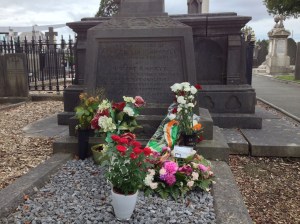
Annie left the red flowers for Anne today
 Choosing the Green
You must be logged in to post a comment.