Helena Molony is born

On this day in 1883, Helena Molony was born in Dublin. She was orphaned when she was young and didn’t have the happiest of childhoods but this made her strong-willed and a survivor. She dreamt of a better life and soon that dream came to include a free Ireland. When she was older, she looked back at that time saying,  “I was a young girl dreaming about Ireland when I saw and heard Maud Gonne speaking by the Custom House in Dublin one August evening in 1903 . . . She electrified me and filled me with some of her own spirit.”

Whether it was Maud Gonne’s spirit that energized Helena or not, one thing is certain – she was immediately and completely devoted to Ireland. She and Maud became fast friends and together they were prominent members of both of Ireland’s Nationalist groups for women, Inghinidhe na hÉireann and Cumann na mBan. Helena founded the first political newspaper specifically for women in 1908 and she started a movement aimed at keeping girls away from English soldiers. She was heavily involved in nearly every suffrage or labor campaign and was assigned to the City Hall garrison during the Easter Rising of 1916. When the authorities came to interview her after she was arrested for her role in the uprising, they found her with torn and bleeding hands and the lock halfway off the door. Similarly, while Molony was imprisoned in Kilmainham Gaol her captors discovered that she was trying to dig her way through the massive stone walls with a rusty spoon. She was indomitable and unapologetic.

These traits carried over into every aspect of her life. Helena fought again in the War of Independence, ferrying messages for Micheal Collins and Liam Mellows and was fiercely opposed to the Anglo-Irish Treaty that partitioned Ireland. She was active in the resulting civil war on the Republican side. She remained loyal to her friends, even when her reputation and political career suffered for it. Molony was unwilling to compromise in nearly every way, including her personal life. She was linked romantically to both males and females in a time when that was considered not only a sin, but illegal- and she refused to be labeled or cornered. All of these things cost her and eventually, Helena was forced out of politics and public life.

Even then, Helena maintained strong friendships, often depending on friends for shelter and care. When she died after a long and full life, she was buried next to many of them in the Republican plot at Glasnevin Cemetery, where she is remembered to this day.

Helena

Addendum: For more about Helena please click here. If you’re looking for even more or other fierce women like her, why don’t you grab a copy of my book? “Petticoats, Patriots, and Partition” is available world-wide in bookstores, on Blurb, and all Amazon markets. (Sorry, it’s been awhile since I indulged in some shameless self-promotion.)


Rosaleen Sands

Almost four years ago I wrote one of my first articles here in this wee blog. It was about the death of John Sands, Bobby Sands’ father. Today I am sad to report that his wife and Bobby’s mother Rosaleen has also passed away.

Gerry Adams had this to say about her this morning. “The dignity and strength she displayed was a testament to her character and her belief in standing up for what was right and just, even if that meant great suffering for herself, Bobby’s father John and their family. In many ways she epitomized what all the mothers of the hunger strikers endured and her sacrifice will never be forgotten.”

Bobby Sands wrote a little poem called Dear Mum. I figured today is the perfect day to highlight it.

Dear Mum by Bobby Sands

Dear Mum, I know you’re always there
To help and guide me with all your care,
You nursed and fed me and made me strong
To face the world and all its wrong.

What can I write to you this day
For a line or two would never pay
For care and time you gave to me
Through long hard years unceasingly.

How you found strength I do not know
How you managed I’ll never know,
Struggling and striving without a break
Always there and never late.

You prayed for me and loved me more
How could I ask for anymore
And reared me up to be like you
But I haven’t a heart as kind as you.

A guide to me in times of plight
A princess like a star so bright
For life would never have been the same
If I hadn’t of learned what small things came.

So forgive me Mum just a little more
For not loving you so much before,
For life and love you gave to me
I give my thanks for eternity.


For more on this breaking story, please click here.

Ar dheis Dé go raibh a hanam. I hope this beaming face greeted her along her way. DSCN1135


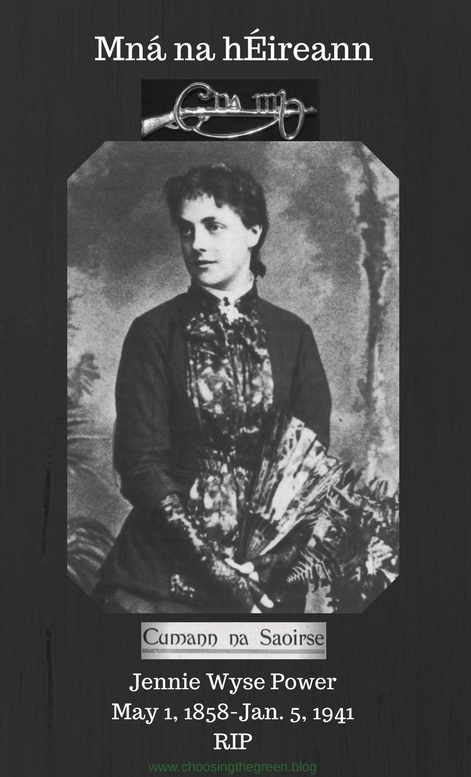
Remembering Jennie Wyse Power

Jennie Wyse Power


On this day in Irish history, Jennie Wyse Power passed away in Dublin. Prior to her death was a mother of four, a restaurant owner, a senator, a rebel, a suffragist, the first president of Cumann na mBan, and a founding member of both Cumann na Saoirse and Sinn Fein.

For more about this super capable woman and her full and crazy life, please click here.

Bridget Brede Connolly

Bridget “Brede” Connolly was one of the many women who took part in Ireland’s Easter Rising of 1916. She navigated through the streets of Dublin ferrying communications between James Connolly in the General Post Office and Ned Daly, in Church Street. Brede didn’t have that far to go as the crow flies but she had to make it through some of the fiercest fighting of the insurrection to deliver these messages and she did it time and time again.

Continue reading

The death of Sheena Fagan Campbell

Sheena Fagan Campbell was an activist, a law student, and a rising star in the Sinn Fein hierarchy. She was a single mother in Belfast who was determined to provide for her young child and at the time of her murder, she was engaged to be married. Sheena stayed on the legal, political side of the Troubles and was not a member of the Irish Republican Army but she did know many who were. The young law students’ growing popularity in Republican circles brought her to the attention of the police, the British Army and the Ulster Volunteer Force (UVF), a deadly Loyalist paramilitary group. The UVF insisted that Campbell was a member of the IRA and on this day in 1992, they executed her very publicly in a hotel bar in Belfast.

Continue reading

PapalGate

It was the tear heard around the world. In one split (ahem) second Sinead O’Connor defiantly threw her figurative middle fingers in the air, lost a record amount of fans, and got banned from Saturday Night Live with her protest of the Catholic church. Many of the flock still haven’t forgiven her even now, twenty-five years later.

Continue reading

Sorcha MacMahon

Over the last few years interest in the roles that women played throughout Irish history has finally picked up. We now know that there were far more women who took part in the Easter Rising than previously thought. Estimates have put their numbers anywhere from seventy-seven to several hundred and many are finally getting the recognition that they have deserved for so long. Sorcha MacMahon was one of those women and without her, the 1916 uprising may have been very different indeed.

Continue reading

The Women of 1916

It is estimated that at least 200 women were involved in the Easter Rising of 1916, many more than previously thought. Their roles varied as widely as the women themselves – and ranged from the traditional fundraisers, cooks, and nurses, to the more unexpected roles of sharpshooters, spies, smugglers, and experts on explosives.  A decent effort has been made over the last few years to give them credit for the part they played in the fight for Irish freedom, but sadly, they are still largely absent from many of the narratives.

Worse still is when a historian refers to the women as “great supporters” or “brilliant fundraisers” or “backbones”. These statements are true, but they still have an air of dismissal even amidst the recognition. They still show women in supportive or secondary roles and ignore the fact that many of them saw themselves as rebels, fighters, and soldiers in their own right – regardless of whether or not there were any men around. Until more historians can acknowledge that, many of the women who continuously risked their lives during Easter Week and in the years that followed, will not get the respect and honor that they are due.

Continue reading

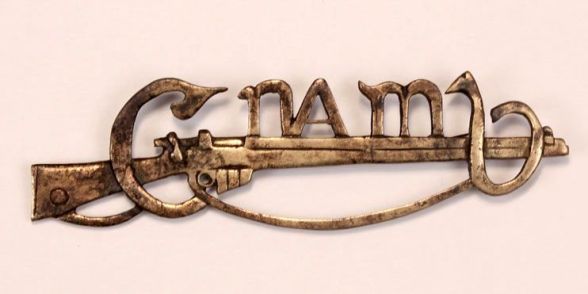
Cumann na mBan is born

On Thursday, April 2nd, 1914, about one hundred women strolled into Wynn’s hotel in Dublin at four o’clock in the afternoon for the first of Cumann na mBan’s many meetings. The Irish Women’s Council had a lot to discuss but the one thing almost all the ladies present had in common was a devotion to Ireland and a desire to serve it.

Continue reading

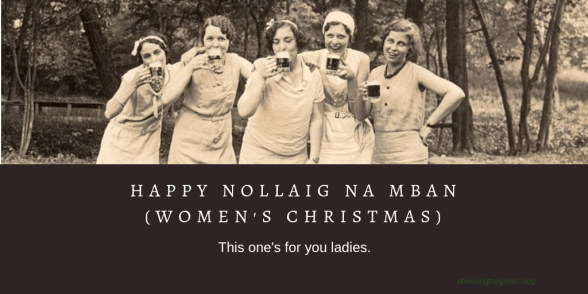
Merry Women’s Christmas!!

Gather the women!!

Jan. 6th marks Nollaig na mBan, also known as little Christmas or Women’s Christmas in Ireland. It’s an old Irish tradition that evolved from celebrating the Epiphany but these days it’s become less about religion and more about fun and frivolity. Traditionally, Irish women were not only responsible for the Christmas time entertaining and feasts but they also had to deal with all the holiday clean up, and every day chores and household duties too for that matter. Except on January 6th, that is. That’s the day they finally got a break. On Women’s Christmas, (12th Night, little Christmas or  whatever you want to call January 6th)  the men took over the chores and the households so that the women could gather and drink, tell stories, kick off their shoes and relax for a moment.

It was a real treat back in the day – so much so that it continues now, even though women’s roles have changed all around the world. In modern times, it’s a day for women to gather and treat themselves to a night out at a bar with friends, a trip to the favorite day spa or salon, or head out for a fancy meal. Nollaig na mBan is the day to play hooky from work (or from the house and kids) to enjoy a day with your ladies, create your own little henhouse, tell stories, catch up, or have a cocktail and relax. No matter what women normally work too hard on, Jan. 6th is the time to take a day off, even if it’s only a mental one.  It’s well deserved.

ladies