Romper Room Murder

For many people a romper room is a play room full of games and toys or a television show that they grew up watching. It evokes a carefree and silly time in childhood that is full of play, puppets, and joy. For others, particularly in the North of Ireland during the Troubles, a romper room is a place of absolute horror, torture, and death – a room that is akin to a slaughterhouse or a snuff film set. These romper rooms were usually derelict homes or businesses where drinking, dancing, torture, and killing could occur without much fear of discovery or interference. One of the more brutal murders of that era took place in a UDA-controlled romper room in the Sandy Row area of Belfast, 41 years ago today. The victim’s name was Ann Ogilby and her killers were all female members of the UDA (Ulster Defence Association). It wasn’t really a political killing even though the murderous women involved were loyalist paramilitaries – it was more of a jealous feud that ended in Ann’s horrific torture and savage beating death. The story was so repulsive and put such a spotlight on the women’s group that it resulted in the total dissolution of their unit.

Continue reading

Heritage of Hate

It’s rare that American news coincides so neatly with news in Ireland. It’s a real treat to write about it when it does unless it is a story full of bigotry and grandstanding which unfortunately, is true today. Often times whenever a group is called out for their bullying traditions or symbols of hatred, their response is always the same. They claim that the behavior isn’t racist or sectarian, that instead it is tradition and heritage – as if the concepts are mutually exclusive. Guess what? It IS tradition and heritage and it IS racist, sectarian and vile. The time has come to accept that and leave horrible traditions behind.
Continue reading

The Saville Report

It was an investigation that took twelve years and over £200m to complete. The Bloody Sunday inquiry, as it was originally called, produced over ten volumes of analysis and led to a comprehensive and glaring report by Lord Saville that was released five years ago today. It caused shockwaves throughout the North of Ireland and it forced the Prime Minister to make a formal and public apology for the actions of the British Army in Derry on one fateful Sunday in 1972.

Continue reading

Crashing into the History Books

On May 21st, 1932, Amelia Earhart became the first woman to fly a plane over the Atlantic ocean by herself. She ended up crashing in a field near Derry, rather than landing safely in France as she had intended, but she earned her title nonetheless and became an important symbol and inspiration to women everywhere. Continue reading

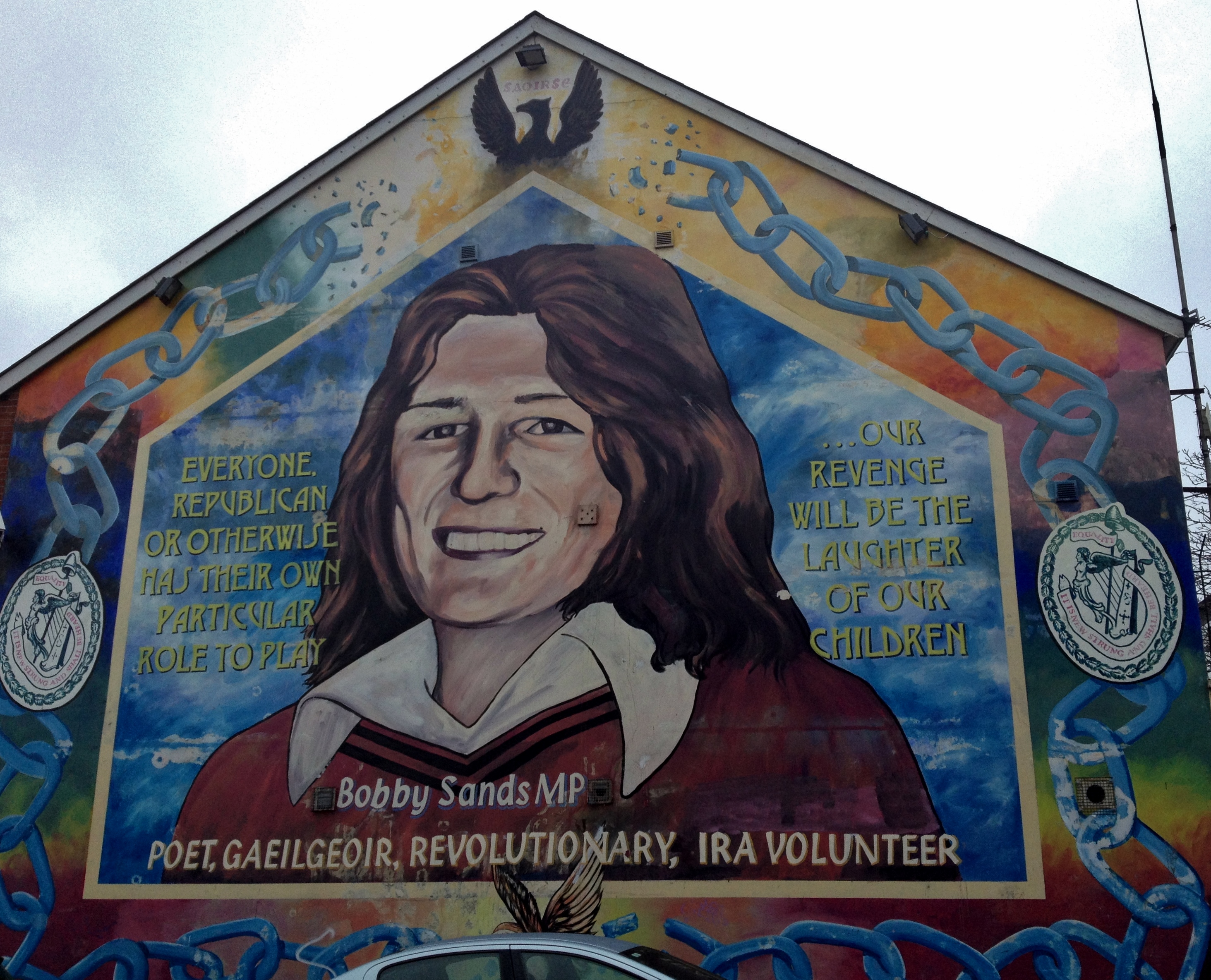
Bobby Sands, MP

They have nothing in the whole imperial arsenal that can break the spirit of one Irishman who doesn’t want to be broken”

– Bobby Sands.

Bobby's smile. Belfast, 12/12/13

Bobby’s smile. Belfast, 12/12/13

Bobby Sands was elected MP while languishing in prison on hunger strike. His newly elected position did not save him from death. He died 34 years ago today on the H blocks in the Maze. His funeral was attended by over 100,000 people and was seen worldwide, sparking international protests against the British government in other countries as well as Ireland. Countless stories, movies, and songs have been inspired by his life, and he remains an icon of Ireland to this day. Here’s a wonderful example of the music inspired by him from the great Black 47. Rest in peace, Bobby.

The Paisley Adams Power Sharing Promise

On this day, March 26th, in 2007, a historic meeting was made in the North of Ireland.  Ian Paisley, an avid Protestant firebrand known for his “Never” phrases sat down with the other side of his coin, Gerry Adams, who led (and leads) Sinn Féin. The two men hammered out an agreement at Stormont that promised to form a power-sharing partnership by May 8th of that year. For the first time, the ideological opposites were able to come together and reach an agreement that was mostly fair for most of their constituents . Both Former Taoiseach Bertie Ahern and Former British prime minister Tony Blair hail this  first meeting and agreement as “a reconciliatory and transforming moment in British-Irish history.”

Continue reading

Haunted and hunted

The New Yorker has just published a surprisingly in-depth article on Jean McConville and Irish history in the North – just in time to take advantage of the 15 minutes that most Americans devote annually to Ireland around St. Patrick’s Day. It’s brilliant timing and the article is very well done, even if it does rehash a lot of old information and it is certainly another strike at Gerry Adams and his past. It is clear yet again that this case will continue to haunt those who may be involved in it. No matter what side of the spectrum politically that you may fall on, this case was undeniably brutal. A single mother of ten, Jean McConville, was dragged out of her home at Divis Flats in front of her children, and wasn’t seen again until her body was discovered decades later. She is one of the “Disappeared” – people who were murdered by the Irish Republican Army whose bodies were never supposed to be discovered. Her story is the albatross around Gerry Adams’ neck and one that will never disappear again.
Continue reading

The Gibraltar Killings

If you somehow knew who Adolph Hitler would become and what he would do, would you murder him before he could do his damage? This rhetorical question is asked by personality tests, psychologists, and Philosophy professors all the time to gauge the morality of their subjects.  Many otherwise peaceful people have quickly answered yes. So then the quandary becomes about where the boundary lies and when we become OK with murder or assassination. When you use someone as horrible as Hitler, the odds are guaranteed to have an emotional and reactionary response. When taken out of the hypothetical realm, odds are that most people would say they are against preemptive murder, no matter what the circumstances are. There are laws against that kind of thing in almost every civilized nation – including Britain – but on this day in 1988, British soldiers ignored them.
Continue reading

Bombs and Potential Bombshells

Remember the idea that the Good Friday Agreement would end the Troubles and bring peace in the North? It’s a tenuous peace at best, and certainly not as tranquil as most Americans believe. There are still shootings, bombs, and more every day in the region. We don’t hear about it in America most of the time because the Good Friday agreement was the jewel of the Clinton administration but it happens more than anyone would hope. In the last week or so, there were at least four pipe bombs planted under cars resulting in mass evacuations and one explosion. There were also at least two “paramilitary-style” shootings, two large protests, a vandalized memorial, another bomb scare in Derry, and an article on the people who are already amassing tires and pallets for their bonfires in July. A Catholic church was spray painted with Sectarian graffiti that supports the Ulster Volunteer Force (UVF) and in other areas you can see an ever increasing number of tags supporting the IRA. The Union Jack will fly on some government buildings for the first time in nearly a decade. Martin McGuinness has been warned of a serious assassination plot against him where he’d be killed with a rocket – not a gun or a bomb, but a rocket. How peaceful does this sound to you?

Continue reading

Mairead Maguire

And now for a modern day Irish woman.  Mairead Maguire was born in Belfast, 71 years ago today. Her entry into the world of political protest did not come without a price. A family tragedy in 1976 fueled her desire to bring change to her war torn community. Her nephews and niece were hit by a car when the driver (a (P)IRA paramilitary) lost control of it after being shot by the authorities. Betty Williams, a witness to the accident, capitalized on the tragedy using it to gather women in the community to march in protest of the ongoing violence and paramilitary activity in their neighborhoods. Mairead joined her. It was a surprising success and “Women for Peace” was spontaneously born. The second march that went to the graves of the children took place only a few days later and it included over 10,000 women—both Catholic and Protestant—an unusual feat in such a polarized place and time. It was attacked by the paramilitaries which only brought the women more press and support for the next march and the movement continued to grow. Mairead and Betty changed the name of their group to the gender-neutral “Peace People” and they continued to parade for peace between Republican and Loyalist factions.

Continue reading