Bloody Sunday

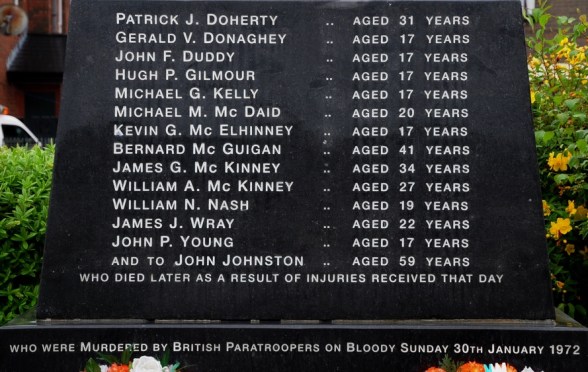
You can’t really be an Irish historian without studying at least a little bit about Bloody Sunday. Many have devoted their whole lives to what happened on that day, forty-five years ago. Many books have been written, movies and documentaries have been filmed and the controversy surrounding the massacre that occurred in Derry is still going strong. The families that were torn apart that fateful Sunday still relive it every day and they all have questions that still need answers. Until the day they finally get justice, I think it is their voices that need to be heard, not mine.

Continue reading

Giuseppe Conlon

There are many questionable convictions and murky instances of enhanced interrogation techniques throughout British and Irish history. Few are better known than those of the Guildford Four and the Maguire Seven. Many members of these groups have written books and papers regarding their long imprisonment for crimes they never committed and the Hollywood film “In the Name of the Father” was based on their plight. Today marks the death of that innocent and determined father, Giuseppe Conlon.

Continue reading

Free Derry Corner

On the night of January 4th (or the wee hours of the 5th) in 1969 a potent Irish landmark was born in The Town I Love So Well. The place that has since been known as Free Derry Corner stands uniquely in between three different busy roadways in the Bogside area of Derry city. At the time of its christening Free Derry Corner was a row of occupied houses but they are long gone these days. All that remains now is the gable wall with its stark black and white message that is still as true as ever. It is a monument to the neighborhood, the residents who have lived and died there, and the struggles and complicated past of Derry.

Continue reading

Dakota Says No – Stand with Standing Rock

In case you can’t tell by now, I’m a little obsessed with Ireland and its history. This includes a lot of reading and writing about the Troubles and the horrific abuses that people suffered throughout that time period. I never had to live through anything like it, but it was easy to connect the dots between the Civil Rights movement in the US and the North of Ireland. I spent a lot of time being grateful that I missed most of the heavy lifting and hard decisions that were made to eventually grant basic human rights and equality for everyone (in theory). Last night that gratitude and privilege vanished as I watched people in my own country being hit with the same brutal tactics and illegal weaponry that defined the Troubles and the Civil Rights movements of the past. They were unarmed and peaceful, and many were nearly killed because they have the gall to believe in people over profit and water over oil.

Continue reading

The struggle for equality

Women have been fighting for equality and recognition for centuries. In Irish history, women have always been seen as supporting cast members, fundraisers, nurses, etc. and safely put in the appropriate roles for their gender, whether they could do more or not. This has been the case for years and years and only now is that idea starting to be debunked by historians…but the historians devoting themselves to elevating the roles of women are mostly female. Myself included. Continue reading

The Party’s Over

Reading headlines from Ireland over the last few weeks was strange because I could have sworn I’d read them before…and I have. Hunger Strike commemorations, anger over parades, riot police protecting interlopers over residents, arson fires at community centers, the birth of new political parties, and spies in the IRA have dominated the media of late. The anger, frustration, and general sense of “what the fxck” that came with it all was a bit stronger in the last couple of weeks than it has been in much of the last few decades. The pictures, headlines, and videos gave me a sense of foreboding and a lingering confusion which kind of felt like I was having a bad flashback. Unfortunately, that was not the case.

Continue reading

The Death of Innocence

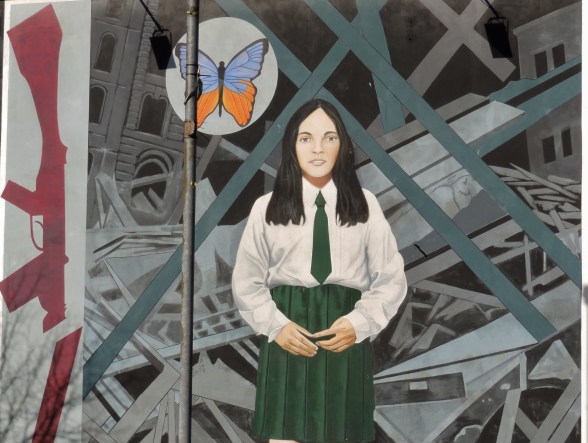
Annette McGavigan was only eleven years old when the Troubles erupted in the North of Ireland. Her home was in Derry, one of the major flashpoints of the Troubles and a stronghold of the Provisional Irish Republican Army. She and the other children of the area witnessed more conflict than any child should within those first few years. She would have seen the British Army rolling into her city, bringing CS gas, rubber bullets, violence and protest with them. Riot after riot broke out and civil rights marches, anti-internment protests, and anti-police incidents were frequent and violent. These things probably became rather commonplace over the next few years for Annette and the other children who were growing up in areas like Creggan, Little Diamond, and the Bogside.

On Sept. 6th, 1971, when Annette was only fourteen, Catholic schools were closed in Derry. Teachers were taking part in a week-long anti-internment program. This left the schoolchildren with free time. Some joined the protests and riots and others stayed in. Once a small riot had ended on the edge of the Bogside, Annette and her friends went out to collect the leftovers of the violence. Children regularly gathered rubber bullets, gas canisters and more after each riot in Derry and this day off from school gave Annette the perfect opportunity to hunt for these dangerous souvenirs. As the young girl in a school uniform picked up an empty cartridge, a shot rang out. She likely never knew what hit her.

Continue reading

John Donaldson, the Baron of Lymington

Who will you believe, the police or the suspects?” Justice John Donaldson is not the first judge to undermine defense lawyers with a question like that but he made this biased statement and others while he was presiding over the trial of Paul Hill, Paddy Armstrong, Carole Richardson, and Gerry Conlon – a group of Irish suspects who were also known as the Guildford Four. The highly publicized case was covered widely and all of the judge’s snide remarks and opinions were too. This pointed question for the jury was the last nail in the coffin for the Guildford Four. When their guilty verdicts came back, Donaldson wished that he could hang the suspects and went on the record saying so during sentencing. The bully judge imposed the longest sentence in the history of English law (at the time) against Paul Hill saying, “Your crime is such that life must mean life, and if the death penalty had not been abolished, you would have been executed.”  The other members of the Guildford Four didn’t fare much better when the sentencing came down and in the subsequent case where many of their friends and family members were accused of bomb making (known as the Maguire Seven) similarly harsh and opinionated sentences were handed down. Donaldson had no pity for one suspect’s serious illness and another being only fourteen years of age. He just handed out lengthy sentences and cruel comments to everyone. He never backtracked from his dubious remarks even after he was heavily criticized for them. In fact, the only times he was silent during this entire ordeal were when the IRA claimed responsibility for the bombs years later, when it was proven that the police had suppressed evidence and lied throughout the trials, and when those he had so gravely threatened were declared innocent fifteen and sixteen years later, respectively. Continue reading

Ballymurphy

Forty-five years ago today the Parachute Regimen of the British Army was sent to Belfast to take part in Operation Demetrius, the fancy codename the government used for internment. They were to detain and arrest anyone who they thought was either involved in or supporting the Provisional IRA, but sending the Paras in to do this was rather like setting off a grenade to stop a fist fight. Over the next few days in the Ballymurphy area alone, eleven civilians were killed. Many who were killed were just trying to get away from the trouble and some were shot while helping others.

Continue reading

Tradition

Tradition is a word that is thrown about a lot. It’s used as justification for both good and bad deeds of the past and it’s a word that is often trotted out by hate groups throughout the world in an attempt to excuse their continuing and horrifying behavior. The KKK uses it as a recruiting tool. The Orange Order uses it as a weapon for blackmail and destruction. Other groups use it as well. Politicians use it to garner votes. Parents use it to pressure their children. But tradition is an outdated ideal that doesn’t exist anymore on many, many levels and it’s time to let some of it go.

Continue reading