Helena Molony

Today in honor of Ms. Helena Molony’s birthday, I give you the bit I wrote about her in my new book; Petticoats, Patriots, and Partition.  She was a pretty awesome lady, and one of many that I celebrate in the first section of the book. I hope it tempts your curiosity about the rest of them too. If it does, the book is available worldwide through Amazon and nationally through Barnes and Noble, other bookstores, Amazon, and Blurb. Enjoy!!

Continue reading

Shameless Self-Promotion

It’s so very close to being finished and I just can’t keep it to myself anymore. I hope you’ll forgive the teasing since it is not available yet, but by December 1st, it will be.

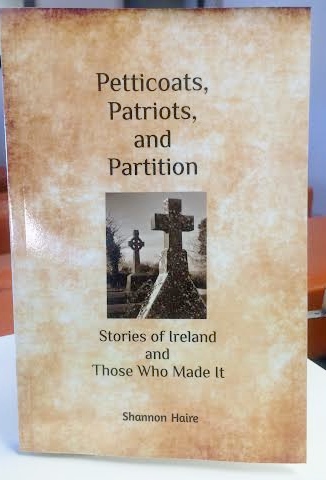
It’s written. It exists. It’s a collection of short histories, and mini-biographies – many that started as blog posts here. In fact, there are only a few that I’ve held back for the book only, but in this form the entries are expanded, edited, and written slightly differently. It’s taken forever and I’m super excited about it – or I would be if I could just stop editing. But now there’s a single, real-life, (albeit marked up) copy in the world and the rest are so very close.

Now you know the title. And my real name for that matter. Hopefully some of you will love this book – and will be OK with me promoting you in it too. I can’t believe it. Coming so very,  very soon!

#nowyouknowmyname

#holycrapIwroteabook

Elizabeth O’Farrell

On this day in 1885, a very brave and unusual woman was born in Ireland. Elizabeth O’Farrell grew up to be a revolutionary in many ways. She had a long term relationship with another woman when that was unheard of, dangerous, and severely frowned upon. She was a great suffragist who championed equality and respect for women during an era when many women couldn’t even get an education at all. She saved many lives but put her own at risk over and over again during the Easter Rising of 1916 – and she rarely gets the credit she deserves for all of her courageous acts. Even now her shoes get more attention than the woman who wore them.
Continue reading

Romper Room Murder

For many people a romper room is a play room full of games and toys or a television show that they grew up watching. It evokes a carefree and silly time in childhood that is full of play, puppets, and joy. For others, particularly in the North of Ireland during the Troubles, a romper room is a place of absolute horror, torture, and death – a room that is akin to a slaughterhouse or a snuff film set. These romper rooms were usually derelict homes or businesses where drinking, dancing, torture, and killing could occur without much fear of discovery or interference. One of the more brutal murders of that era took place in a UDA-controlled romper room in the Sandy Row area of Belfast, 41 years ago today. The victim’s name was Ann Ogilby and her killers were all female members of the UDA (Ulster Defence Association). It wasn’t really a political killing even though the murderous women involved were loyalist paramilitaries – it was more of a jealous feud that ended in Ann’s horrific torture and savage beating death. The story was so repulsive and put such a spotlight on the women’s group that it resulted in the total dissolution of their unit.

Continue reading

Love Will Tear Us Apart

Charles Parnell was the ultimate star of Irish politics in his day. His meteoric rise might have been enough to give Ireland the Home Rule it had longed for. He might have been the man to change the course of Irish history long before the armed militias and secret societies of later years ever had a chance to grow or rise up. He might have done all this and more—or not—but we will never know because his passion for Ireland came second to one other – and that one other was a married woman named Katharine O’Shea.

The two met originally because Katharine’s husband Willie had decided to enter the political arena. Like any smart and supportive wife, Katharine thought to further advance her husband’s career by befriending the most powerful politician at the time and that was Charles Parnell. This plan immediately backfired when the attraction between the two of them grew after their first encounter. Within a matter of months the two were carrying on a passionate and overwhelming affair, to the peril of all else.

It is highly improbable that Willie O’Shea did not know of the affair, given that Katharine had three children with Parnell. He turned a blind eye to his wandering wife for the sake of his political career and all of the Parnell children were given the last name of O’Shea, despite their bloodlines. He used Parnell for his own career advancement and lived comfortably on his wife’s money, staying silent about the affair for years. He held his tongue until it would utterly destroy everything Parnell had been working for. Then and only then did Willie open his mouth, publicly and scandalously.

It was Christmas Eve in 1889 that Willie filed for divorce, and it was motivated by greed since Katharine had just received a large inheritance. She tried to silence him with a large settlement but he would not be satisfied and he continued to petition for divorce. He dubiously claimed that he had known nothing of the near decade-long affair and he named Parnell as a co-respondent in the proceedings, knowing that it would destroy both his wife and the politician. Support for the Home Rule that was Parnell’s dream fell along with him and burned out in scandal. He was accused of bribing Willie in order to sleep with his wife. The Irish Parliamentary Party split down the middle and the only thing they agreed upon was that it was all Katharine’s fault. She was accused of being a manipulative Englishwoman who had designed the affair to take down Parnell. She was called a whore and was told that she was responsible for the defeat of Home Rule. The Irish press took to calling her Kitty – a slang term for a stupid, young, or childish woman and a more subtle, occasional title for prostitutes, or certain parts of the female body. It was an open insult to her and one that stung the lovers deeply.

Parnell fought back, and tried to keep his career from totally imploding. He defended them both and sought to calm the scandal by proving once and for all that their love was real. They were married on this day in 1891 but in spite of his hopes for understanding and respectability, the wedding only made things worse. The press categorically refused to call Katharine by her married name of Mrs. Parnell and they continued to hurl abuse at her, selling paper after paper denouncing the couple. Parnell’s attempts to save them both only put another nail in the coffin and although he tried to resume his work after the wedding, he quickly discovered that the Ireland he had fought for had irrevocably turned against him and the love of his life.

Katharine, or Katie, (but never Kitty,) as she was known to friends and family, was the perfect scapegoat and her notoriety as the woman who harpooned the best chance of Home Rule for Ireland still permeates today, even though many historians feel like Parnell would never have achieved it anyway. She was a woman of scandal, even though her true love had made an honest woman out of her, so to speak. Their marriage only lasted four months before Charles Parnell passed away – and it was fraught with stress and insults all the way through. At least they had the years of joy beforehand, otherwise Katharine Parnell may have lost her mind completely. As it was, she had the first of many breakdowns soon after her husband died but she went on to publish a few books and she lived for another thirty years. Just not in Ireland.
Margaret Skinnider

Margaret Skinnider was a woman like no other, and I take every opportunity that I can to write about her. She is one of my biggest heroes – not just because she was a warrior and an intellectual but also because she was humble and quick. Without her contributions, many aspects of the Easter Rising may never have come to fruition but because she was not born in Ireland and she was a woman, it has been very hard to find anyone who gives her the full recognition she deserves in the history of the Rising.

Continue reading

64 Women

womenmay22

The number of women arrested and questioned in 1916 for their roles in the Easter Rising up until today, 99 years ago, was 64. The paper published their names a week later on the 29th of May, and many believed this number to be the total number of women involved. They could not have been more wrong.

In all, over 200 women are known to have been involved in the Dublin Uprising. More than half are not included on this list – and many more have been lost in time – leaving some to believe that even the higher estimates are lower than they should be. Since many of the documented women are often ignored anyway, we may never have an accurate number altogether but at least there are a few pieces of hard evidence of their involvement, including this tiny clipped article.

In the years leading up to the Centenary celebration, many books and documentaries have made a decent effort to include and acknowledge the female fighters of 1916. I hope they will continue to highlight the women’s fight both for Ireland and for the recognition they deserve in the aftermath. Cheers ladies.

Crashing into the History Books

On May 21st, 1932, Amelia Earhart became the first woman to fly a plane over the Atlantic ocean by herself. She ended up crashing in a field near Derry, rather than landing safely in France as she had intended, but she earned her title nonetheless and became an important symbol and inspiration to women everywhere. Continue reading

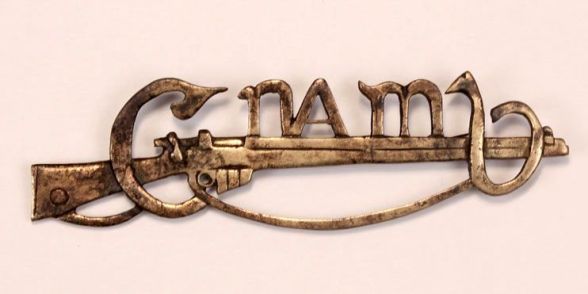
Cumann na mBan is born

On Thursday, April 2nd, 1914, about one hundred women strolled into Wynn’s hotel in Dublin at four o’clock in the afternoon for the first of Cumann na mBan’s many meetings. The Irish Women’s Council had a lot to discuss but the one thing almost all the ladies present had in common was a devotion to Ireland and a desire to serve it.

Continue reading

Mairead Maguire

And now for a modern day Irish woman.  Mairead Maguire was born in Belfast, 71 years ago today. Her entry into the world of political protest did not come without a price. A family tragedy in 1976 fueled her desire to bring change to her war torn community. Her nephews and niece were hit by a car when the driver (a (P)IRA paramilitary) lost control of it after being shot by the authorities. Betty Williams, a witness to the accident, capitalized on the tragedy using it to gather women in the community to march in protest of the ongoing violence and paramilitary activity in their neighborhoods. Mairead joined her. It was a surprising success and “Women for Peace” was spontaneously born. The second march that went to the graves of the children took place only a few days later and it included over 10,000 women—both Catholic and Protestant—an unusual feat in such a polarized place and time. It was attacked by the paramilitaries which only brought the women more press and support for the next march and the movement continued to grow. Mairead and Betty changed the name of their group to the gender-neutral “Peace People” and they continued to parade for peace between Republican and Loyalist factions.

Continue reading