Sheelagh Murnaghan

On this day in 1993, the North of Ireland lost a formidable voice. Sheellagh Murnaghan was a tenacious woman who was dedicated to equality in a world that didn’t have much of it. She never let that stop her though and she championed that fight for decades, despite suffering defeats time and time again. Guess it was the hockey player in her that never let her back away from a good fight.

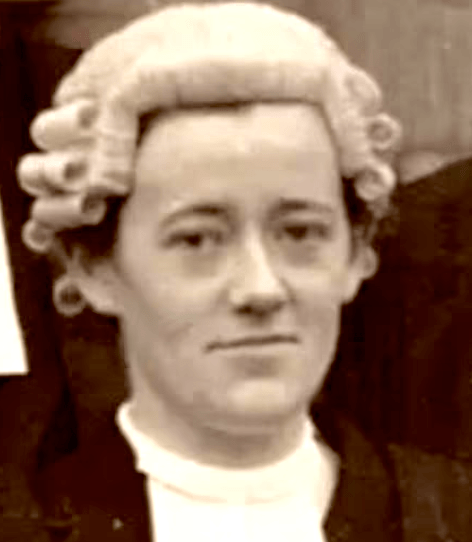
Sheelagh Murnaghan was born in Dublin, but she went to school in Omagh and then studied law at Queen’s University in Belfast. While studying to become a lawyer, she also found the time to join and captain the National Irish Women’s Hockey team. She gave up the sport when she became the region’s first female lawyer and was accepted to the Northern Ireland Bar in 1948. Murnaghan then went into politics. She was one of the first women in Stormont and was the only liberal voice in the chamber at that time. Sheelagh was considered eccentric – she liked cigars and often brought her dog to work. She was a woman, a Catholic, and a liberal in a misogynistic, Sectarian, and conservative climate and she was ferociously dedicated to human rights. Murnaghan introduced legislation to abolish the death penalty and attempted to pass a Northern Bill of Rights at least four times. She also stood for Traveller’s rights, criminalizing discrimination in the workplace, and equal compensation for all, regardless of sex, creed, or political belief. Sheelagh was met with opposition (and probable ridicule) every time she attempted to introduce anything but she did not let that stop her. I’m certain she would have continued her quest if she had been successful in winning another seat once the university’s were abolished in 1969. She stood for election twice more in two different areas, but she lost both times.

Murnaghan was no longer a member of parliament but she still championed equality every day. She sat on several committees, including the Industrial Relations Tribunal, the Belfast Settlement Committee, and the Equal Opportunities Commission. She chaired a tribunal that heard the region’s very first sexual harassment case and her law practice specialized in harassment cases and gender equality from that point on. Murnaghan was not born in the North of Ireland, but it is clear that she devoted her entire career to making it a fairer, more balanced place while others were actively trying to prevent these things. She was absolutely opposed to the violence that erupted in the region and was openly vocal about it, which led to potential peril when her house was bombed by Loyalist paramilitaries in 1970. Luckily, she was not injured or intimidated by this attack and she continued to fight for peace and justice for another twenty-three years.

Sheelagh Murnaghan died on this day in 1993. She did not live to see the North finally adopt many of her ideas, nor did she see the end of the more active conflict in the region, but today, many recognize her as one of the first torchbearers of change and equality in the area. It’s a fitting legacy for a woman who devoted her life to making the world a better place.

Political snowballs

Politics in the north of Ireland are a tricky thing. For generations words, weapons, petrol bombs and more have been tossed from one side of the divide (and the border) to the other in an ongoing struggle for power. On this day in 1967 a different sort of projectile was thrown into the mix (ahem) when Rev. Ian Paisley launched snowballs at Jack Lynch, the Taoiseach of Ireland.

Continue reading

Maura Meehan and Dorothy Maguire

In the wee hours of the morning of October 23rd, 1971, the British Army rolled into the Falls area of Belfast with the intention of raiding houses and arresting anyone they suspected of criminal or “dissident” activities. It was a regular occurrence in the area and the residents had various ways of warning each other when the army was around. Runners would spread the word ahead of the vehicles and the Women’s Action Committee (WAC) would bang trash bin lids on the streets as an early alarm system. Sometimes people would blow whistles or sound horns from their cars as well which was exactly what two sisters, Maura Meehan and Dorothy Maguire, left a party to do on that early Autumn morning. When one of Meehan’s children asked where she was headed she told him that she’d be right back, as she grabbed a handheld horn and headed to a car outside. These words were the last she ever spoke to her family.

Continue reading

Massacre at Ballymurphy

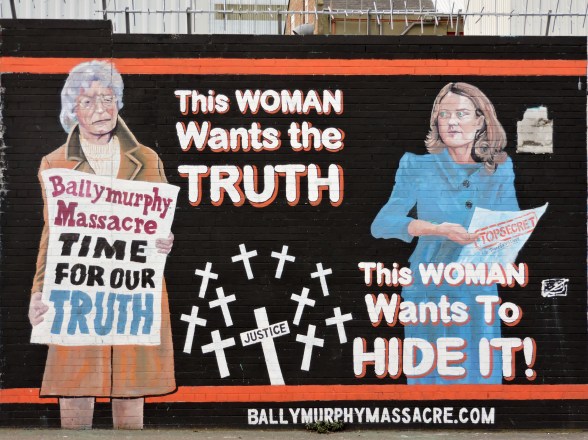
While I’m on the subject of documentaries and links, here’s another one for those who live outside of Ireland or cannot access current news specials from outside the region. “The Massacre at Ballymurphy,” is a shortened version of “The Ballymurphy Precendent,” a new documentary by Callum Macrea. It has been causing quite a stir online since its debut on Channel Four last weekend and has sent massive waves throughout the North of Ireland and beyond.

Continue reading

The twelfth

Well, I almost made it. I almost made it through the season without posting another one of the pieces I write every single year about the sectarianism and the hatred that fuels the flames of bonfires throughout the north of Ireland annually. I guess I was hoping that it was all going to be fine this year, despite knowing it wouldn’t be. I suppose I thought if I didn’t talk about it, then it wouldn’t make me so angry. It doesn’t work like that though. In fact it might be more infuriating to watch it go all down without commenting  – especially when it looks like this marching season buildup has been increasingly worse than those in recent memory.

Continue reading

Bobby Sands Elected

On this day in 1981, Bobby Sands was elected to Parliament. His candidacy was a risky maneuver, given that he was in prison and on hunger strike at the time and while his win ended up being a masterful propaganda tool, it did not save his life.

Continue reading

The death of Sheena Fagan Campbell

Sheena Fagan Campbell was an activist, a law student, and a rising star in the Sinn Fein hierarchy. She was a single mother in Belfast who was determined to provide for her young child and at the time of her murder, she was engaged to be married. Sheena stayed on the legal, political side of the Troubles and was not a member of the Irish Republican Army but she did know many who were. The young law students’ growing popularity in Republican circles brought her to the attention of the police, the British Army and the Ulster Volunteer Force (UVF), a deadly Loyalist paramilitary group. The UVF insisted that Campbell was a member of the IRA and on this day in 1992, they executed her very publicly in a hotel bar in Belfast.

Continue reading

The Harp Bar Bombing

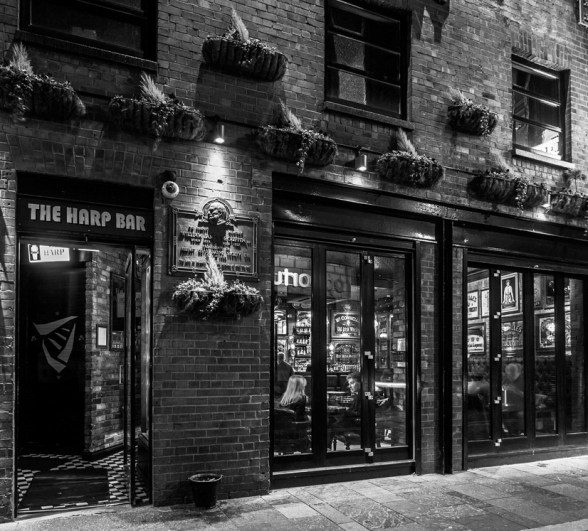
On this day in 1975, John ‘Sean’ Doherty and Denis McAuley were murdered by a bomb that was thrown into the Harp Bar in Belfast. Given the giant explosions of the time period, it was a relatively small attack but it resulted in two deaths and multiple injuries. It was also the second attack on the centrally-located Harp in only ten days.

Continue reading

Patrick Rooney

Patrick Rooney was a good kid. It was 1969 and he had just moved into Divis Flats on the Falls Road in Belfast with the rest of his family. I say kid because he was only nine years old when his life came to an abrupt end forty-eight years ago today. On that fateful night, Patrick became the first child victim in the long struggle that came to be known as Ireland’s Troubles.

Continue reading

Throw away the key

A tasty tidbit of appalling news came across my radar this week that has appeared to be somewhat ignored by many. It turns out that residents living in nine different tower blocks in Belfast had no expectation of privacy in their own homes and they didn’t know it. They were never informed that the police force of Northern Ireland (the PSNI) had been given keys to every single one of their flats and could ostensibly enter them whenever they liked. The Housing Executive was quick to say they’d handed over master keys to the PSNI so that they could be used for health or safety emergencies but they only revealed that agreement after some of the residents at the New Lodge Flats accidentally found out about the breach of privacy. The executive most likely would have never mentioned the keys and the police to any of their tenants if not for this accidental slip of the tongue.

Continue reading