Operation Demetrius was the fancy name the English used when they started rounding up people in the north of Ireland and imprisoning them without charges or trial. It was more commonly known as internment and it was the root cause of many of the worst conflicts and atrocities during the long period of the Troubles in the north of Ireland. The British government insists that the practice was officially ended in 1975 but the citizens of the region know better. Operation Demetrius may have ended but the practice of internment continues to this day and the most blatant proof of this is the continued imprisonment of Tony Taylor, a Republican activist from Derry. Today marks nearly two years that he has been held in the notorious Maghaberry prison, without public charges, bail, or trial.
Tag Archives: Derry
The flames of Justice
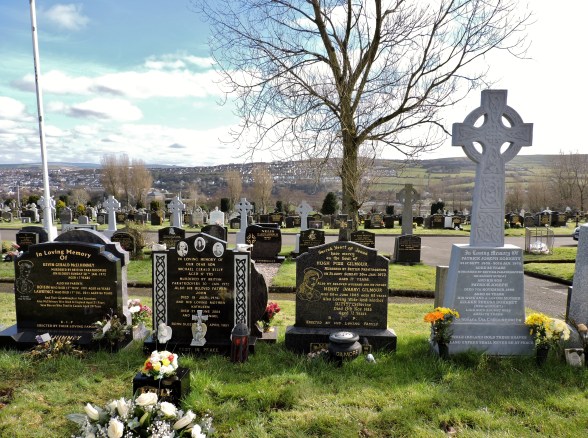
The world reacted with horror after English soldiers fired directly into a Derry crowd of peaceful anti-internment protesters, on what came to be known as Bloody Sunday. The soldiers wounded more than twenty and instantly killed thirteen innocent people. (One more died months later as a result of his injuries). On this day in 1972 a fuse was lit and just days after the killings, the English embassy in Dublin burned to the ground while eleven innocent people were buried in Derry.
The Unknown Heroine of Bloody Sunday

On January 30th, 1972, thirteen innocent people were murdered and twenty-eight were shot during an anti-internment march through the Bogside area of Derry. Another innocent victim died later as a result of his injuries, bringing the total number of fatalities to fourteen. That bleak day became known as Bloody Sunday. At first the soldiers and the English government tried to claim that all who had been shot or killed were armed, dangerous, and/or members of the Irish Republican Army. Witness statements backed up with photographic evidence, forensics, and videos helped disprove their lies but it took nearly forty years and the most expensive inquiry in English history to finally exonerate the victims.
An anonymous teenage girl who would now probably be in her mid-to-late sixties made a quick and pivotal choice on Bloody Sunday that helped set those things in motion and has affected millions of people since. As she and her friends wandered through the aftermath of the Bogside Massacre, a stranger approached them. He quickly explained that authorities had begun searching people nearby and he had some rolls of film he needed to hide. This young girl quickly put the film in her underwear, assuming that her undergarments would not be searched if she were stopped. She was either not stopped or was correct in that assumption because later she met the man, Gilles Peress, at a hotel where she handed over his rolls of film and then promptly vanished. Peress drove straight out of Derry that night with his precious cargo and never saw the blonde girl again.
Danny Doherty and William Fleming
Danny Doherty and William Fleming grew up in Derry. They were from Republican families and each had relatives that were imprisoned at one time or another for their political ideals and paramilitary activities. They followed in their families’ footsteps and each joined Na Fianna Éireann at a young age, before funneling into the Derry Brigade as soon as they were able.
Each man knew what the cost might be. They knew their membership in the IRA could land them in prison or in the grave but they felt it was worth the risk. Danny Doherty was a veteran with six years of active service in the Derry Brigade but Willie Fleming was younger and greener with only two years under his belt when the two men were killed (or overkilled) in a hail of gunfire on this day in 1984.
Exhibit Down

The Museum of Free Derry has temporarily removed its most controversial exhibit and Linda Nash and Helen Deery have brought their around-the-clock protest inside the museum to a close. All parties will meet again next week with a mediator to negotiate how to proceed when it comes to the exhibit that was created to remember the victims of the Troubles from Derry.
The Occupied Museum of Free Derry

The newly revamped Museum of Free Derry has been mired in controversy since before its doors reopened. At issue is an exhibit that includes the names of all the people who were killed in the area during the Troubles. This seems harmless except that the names of British soldiers and police officers are also there, right alongside many innocent victims who were killed by those very same squads. The decision to include those names may seem reasonable from a purely educational viewpoint but the Museum underestimated the emotional response from locals who lost friends and family members during the conflict. For some of them, the inclusion of these government contingents is an affront to the memories of their loved ones and a blatant disregard for their own feelings and their continuing fight for answers and justice.
Flames of Fear

The North of Ireland is a complicated place – especially in July. Every year makeshift towers of debris, old tires, and wooden pallets reach higher and higher into the sky. They are decorated with sectarian slogans, political effigies, Irish flags (or Ivory Coast ones, since some can’t tell the difference between the two), and serious threats against Catholics, opposing politicians, Irish men and women, minorities, and the gay community. These dangerous displays are what they call culture this time of year and they are a horrifying example of the division that continues to exist in the North.
The Iron Lady dies

On this day in 2013 Margaret Thatcher died. I can’t very well write about Irish history without acknowledging her passage, so there it is. I always try to write passionate and fair pieces and I choose my subjects with that in mind which is why I will skip anything more about her at this time. Perhaps there will come a day when I can actually write about her without getting angry, biased, and opinionated, but today is not that day so I’ll let these photos I’ve snapped throughout the North of Ireland speak for me. They’re worth at least a thousand words anyway.

H-Block Memorial, Free Derry Corner.


Still on the walls in 2013

“Our revenge will be the laughter of our children” – Bobby Sands
The complicated legacy of Martin McGuinness

Humans are animals. It’s not something we like to admit, but it is true. Our animalistic instincts come out when we are hurting and angry, when we need to protect ourselves or our loved ones, or when we are desperate and afraid. Over time we learn to control them, not letting that dark side rear its ugly head just because our toy was taken away at the playground and if we’re lucky that animal fades into the background of our minds, never needing to come out.
When James Martin Pacelli McGuinness was growing up in Derry a lot was wrong in his world. The boy who would come to be known as Martin was partially named after a pope in a society that was violently sectarian and discriminatory against Catholic communities like his. He saw things most of us thankfully never will. War raged in the streets as he grew up. He witnessed friends being mowed down by soldiers without consequence. He saw authorities break the law over and over without punishment. That animal inside him grew and raged, like many others in the region and Martin found his way into the Irish Republican Army at a relatively young age. He stayed for a heavily disputed amount of time. Let’s just call it many years.
Bloody Sunday
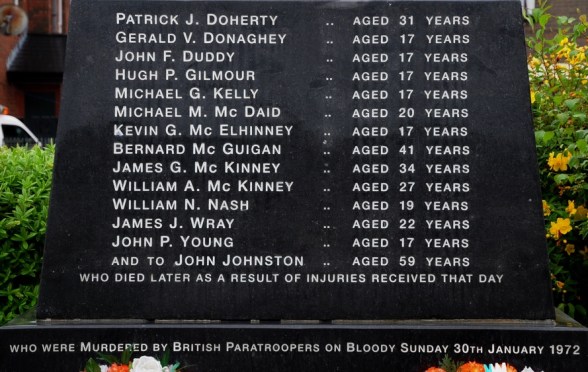
You can’t really be an Irish historian without studying at least a little bit about Bloody Sunday. Many have devoted their whole lives to what happened on that day, forty-five years ago. Many books have been written, movies and documentaries have been filmed and the controversy surrounding the massacre that occurred in Derry is still going strong. The families that were torn apart that fateful Sunday still relive it every day and they all have questions that still need answers. Until the day they finally get justice, I think it is their voices that need to be heard, not mine.
 Choosing the Green
You must be logged in to post a comment.