When Máirín Cregan was born on this day in 1891, her mother made a very important decision. She insisted that her daughter would grow up learning history and the Irish language. As a young adult, this eventually led Máirín right into the Gaelic League where she developed a sort of nationalist fervor. She was also quite a talented vocalist so she ended up moving to Dublin to study at the Leinster School of Music. When she arrived in the city in 1914, she socialized with the Ryan family, a strong Nationalist clan. Máirín was quickly rubbing shoulders with some of the most prominent Nationalists in Dublin including Min Ryan and her fiance, Seán Mac Diarmada, who was one of the future leaders of the Easter Rising.
Tag Archives: Cumann Na mBan
The rebel chanteuse

Many musicians and bands have sung traditional Irish rebel songs throughout the years and one of the most powerful females to do so was Kathleen McCready Largey. She was an amazing songstress and a strong voice both inside and outside of Ireland. Her voice even graced New York’s mighty Carnegie Hall once or twice and audiences on both sides of the ocean loved her.
Irish Women’s Franchise League
Ireland has always had more than its fair share of feisty women. By 1908 there were already numerous Suffragist groups in Ireland, full of women who wanted equality, the ability to vote, and more freedoms. Many of these groups focused on petitions, publicity, and spreading their message through polite channels and discourse, and they attracted many prominent socialites who used their influence to further the cause. This was not good enough for Hanna Sheehy Skeffington, her husband Francis, and their radical friends. 108 years ago today, they founded the Irish Women’s Franchise League, a group dedicated to equal rights that used agitation and action to spread their message.
The struggle for equality

Women have been fighting for equality and recognition for centuries. In Irish history, women have always been seen as supporting cast members, fundraisers, nurses, etc. and safely put in the appropriate roles for their gender, whether they could do more or not. This has been the case for years and years and only now is that idea starting to be debunked by historians…but the historians devoting themselves to elevating the roles of women are mostly female. Myself included. Continue reading
Josie McGowan
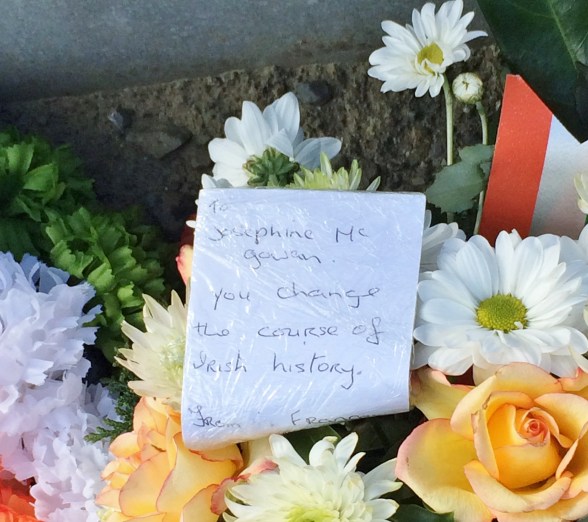
Josephine McGowan was one of the many women who participated in Ireland’s struggle for freedom. She was a member of the Inghinidhe na hEireann branch of Cumann na mBan and was stationed at the Marrowbone Lane garrison during the 1916 Easter Rising. She was one of twenty-five women who reported for duty and according to one witness statement, Marrowbone seemed to have more women than men at the beginning of the fight. Some of the women vanished throughout the week but Josephine stayed until the very end.
Sidney Czira
There was more than one amazing Gifford girl. Grace has been immortalized in the annals of Irish History and song, but her sisters were just as political, in fact more so, than the tragic bride of 1916. Sidney was one of the first Gifford sisters to get involved in politics, even though she did it quietly and under the assumed name of John Brennan. In a world where women weren’t listened to, Sidney made her voice and her opinions heard.
The Lady of Bachelors Walk

On this day 102 years ago, a large shipment of arms landed in Howth, destined for the Irish Volunteers. Many of these guns were used two years later during the Easter Rising of 1916 and without them, the Rising may never have happened at all. When the Asgard came to shore it was met by the Fianna Éireann and other Volunteers who were quick to unload the weapons and begin carting them off. They hoped to avoid the attention of the police, but their mission did not pass unnoticed. The authorities who were watching did not engage the large crowd but they did call for backup. As the Volunteers left the area they were met by the King’s Own Scottish Borderers, a regiment of the British Army. A tussle ensued but in the end, the soldiers were only able to confiscate a mere nineteen of the nine hundred guns brought into Ireland that day.
News spread quickly of the successful smuggling operation and the military’s failure to seize most of the weapons so by the time the Borderers were marching back into Dublin, crowds had already gathered to celebrate and to mock them. They antagonized the soldiers, taunting them and throwing rubbish and fruit at the column (which magically became stones in the official reports). They shouted insults and openly laughed at the troops and their failed mission. Soldiers and police officers never tolerate this kind of behavior for long (as they continue to prove to this day) and by the time they marched onto Bachelors Walk they had had enough of the hostile crowd. The soldiers turned to face the people and seconds later shots were fired directly into the busy street, hitting those who had been following them and innocent civilians alike. They followed the volley of bullets with a bayonet charge. The collective lack of self control from the army resulted in four casualties and nearly forty others were injured.
An Unrepentant Pagan
On this day inn 1946 Ireland lost a powerful voice when Ms. Hanna Sheehy Skeffington passed away. She was one of the country’s most independent and fierce women who always fought for equal rights, for peace, and for Ireland, even when those beliefs cost her dearly. Hanna was indomitable and as she reminded her son before her death, she was an unrepentant pagan. Continue reading
The 1916 Societies Parade
Yesterday’s plan was to observe and walk behind the 1916 Societies’ Easter Commemoration parade, being a proper journalist and chronicling the march. Instead, upon arrival at the GPO, my traveling companion and I were handed the Cumann na mBan flag to hold while the two ladies it belonged to got to know us and socialized with other parade organizers. When the flag was taken up to join the others of the parade, the women invited us to join them in carrying the Constance Markievicz banner, and we were given pride of place near the very front of the march. It was an amazing experience and beyond my wildest imagination of what yesterday could be.
Derry
This city is like nowhere else I’ve ever been. It’s powerful, amazing, and heartbreaking. As a student of Irish history, to stand on Free Derry Corner during a brief break from the rain was potent and awesome.
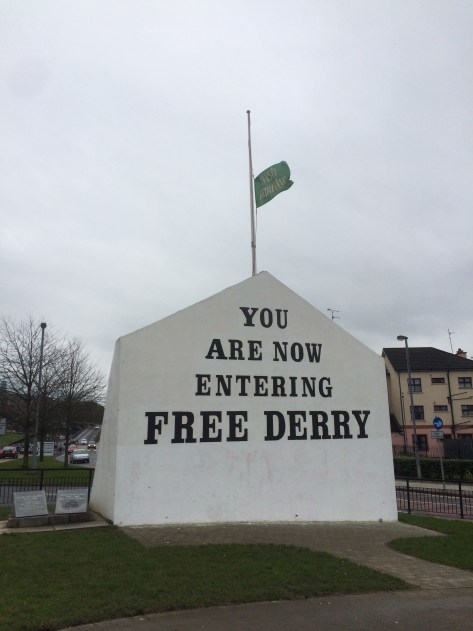
Yesterday I took a long ride with Paul Doherty whose father was murdered on Bloody Sunday. It was an intense afternoon full of laughter and a few silent tears. I have never written about that massacre specifically and I’m still not sure I ever will. His voice and the voices of the other families and survivors are loud enough and more important. But it has been mentioned here because you can’t have an Irish blog with no mention of Bloody Sunday; just like you can’t walk or drive through Derry without seeing those scars and the strength and anger that still remain so many years later. I can’t recommend Paul’s taxi ride highly enough. We went everywhere and he took me to many of the murals off the beaten path. When he found out I write an Irish blog that’s somewhat focused on women, he took me to a couple that honor women specifically.
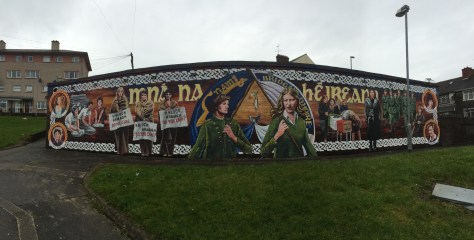
My only complaint thus far is how shoddy the wi-fi is my hotel. Other than that, I may be in love with this region. I have a giant oak tattooed on my body, so I guess it’s no surprise that I’d love Derry considering that its name means Oak Grove. I have a day or so left, so if there’s something I absolutely must do or see here, let me know.
 Choosing the Green
You must be logged in to post a comment.