Sláinte, Mr. Guinness

Today we raise a pint of the good old black stuff to the man himself–Arthur Guinness–whose full life came to a close on this day in 1803.

Arthur Guinness is the founder and creator of Guinness brewery, and though he did not create the dark stout that the company is now famous for, he was responsible for signing a 9,000 year lease, guaranteeing that the brewery would always have a place to operate in Dublin. This permanence allowed for funds to be allocated for experimentation and distribution and he made sure to do both. He was already a master brewer and his creations resulted in a decent porter coming to the city and a load of devoted ale drinkers. They called him Uncle Arthur for much of his life. He and his (poor) wife Olivia had 21 children, half of whom lived, but none of his descendants are directly involved in the brewery business at this time.  Still, his signature flourishes can be seen on every can or bottle that the company produces and his legacy is honored in Ireland and around the world to this day.

A recent offering, the 1759, is a 750ml bottle of Guinness Ale–not Stout–that is based on recipes from that time. It is likely the closest we’ll get to Arthur’s own creations in this day and age. The brewery has been transformed into the number one tourist attraction in Dublin, and though visitors don’t get to see the inky stout being made, they do get the history of the brewery, a look at the longest lease ever, and one of the greatest views in Dublin. Today I’d like to personally thank Uncle Arthur for one of my favorite adult beverages on the planet, because even though it will never taste the same outside of Ireland, without him, it may never have reached our far shores at all.

Sláinte

guinness

Gratitude

Today marks over 100 posts in this wee little dream of a blog. It gives me great pleasure and I’m so happy to keep being inspired enough by my travels and my love of history to keep churning these entries out. I’m also humbled and grateful for those who read them, and who by doing so, keep me on my toes and learning. This blog has grown from a mere place for all my ramblings to a constant cycle of learning, reading, writing, and sharing and I can’t ever seem to find flowery enough words of appreciation for it.

Continue reading

Thomas Ashe

Thomas Ashe was a teacher, a piper, an Irish language enthusiast, a soldier, a devout man of faith and one of the pioneers of the modern Republican Hunger Strike. His life began on this day in 1885.

Thomas Ashe, 1917

Thomas Ashe, 1917

Continue reading

Sinead De Valera

De Valera. Just the name usually conjures up strong feelings in anyone that knows anything about Irish History, and they are always linked to Eamon. However, today is all about the woman behind the man and her name was Sinead. Her sacrifices and determination were often the only things that kept their family alive and like him or no, she helped make him the man he was.
Continue reading

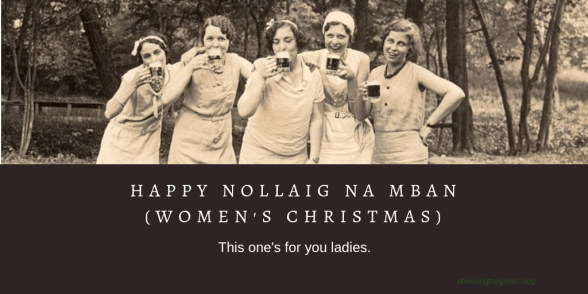
Merry Women’s Christmas!!

Gather the women!!

Jan. 6th marks Nollaig na mBan, also known as little Christmas or Women’s Christmas in Ireland. It’s an old Irish tradition that evolved from celebrating the Epiphany but these days it’s become less about religion and more about fun and frivolity. Traditionally, Irish women were not only responsible for the Christmas time entertaining and feasts but they also had to deal with all the holiday clean up, and every day chores and household duties too for that matter. Except on January 6th, that is. That’s the day they finally got a break. On Women’s Christmas, (12th Night, little Christmas or  whatever you want to call January 6th)  the men took over the chores and the households so that the women could gather and drink, tell stories, kick off their shoes and relax for a moment.

It was a real treat back in the day – so much so that it continues now, even though women’s roles have changed all around the world. In modern times, it’s a day for women to gather and treat themselves to a night out at a bar with friends, a trip to the favorite day spa or salon, or head out for a fancy meal. Nollaig na mBan is the day to play hooky from work (or from the house and kids) to enjoy a day with your ladies, create your own little henhouse, tell stories, catch up, or have a cocktail and relax. No matter what women normally work too hard on, Jan. 6th is the time to take a day off, even if it’s only a mental one.  It’s well deserved.

ladies

Jennie Wyse Power

It’s rare that a woman can juggle an immense amount of political power, a restaurant of her own and a family of four children. But Jennie Wyse Power did all this and more, at a time when most women weren’t even getting an education. She was an Irish superwoman and an unapologetic suffragist who passed away on this day in 1941.

Continue reading

Farewell to 2014

I can’t say I’m sorry to see 2014 go, or that I am naive enough to think that just because it is a new year, things will suddenly be better – but I can say, I’m glad this year is over. Before Auld Lang Sine there was another song that was a popular New Year’s Eve anthem and this year,  I will send 2014 off right with a traditional song by one of my favorite non-traditional singers.

Athbhliain faoi mhaise dhaoibh.

May the best days of 2014 be the worst of 2015 for us all. Sláinte!

The great Maud Gonne

Edith Maud Gonne has been hailed as one of the greatest activists and fighters of her time. Her beauty has been recorded and immortalized by one of Ireland’s greatest poets. History has compared her to Joan of Arc and she’s one of the best known women in the books, in no small part due to her own inflated memoirs and creative storytelling. She is largely considered to be an Irish hero—which is a great feat for a woman—particularly one who wasn’t Irish born and who grew up as a member of a wealthy, loyal, British family. So was she a true revolutionary, or a fraud in it for the fame and her own idea of who she wanted to be? Either way, she did enough to leave her mark on Irish history and one thing is undisputed – Maud Gonne chose the green and was most certainly not born to it.

Continue reading

2016 take 3

now here’s a proper ad for the 2016 centenary. At least this one has the actual thing that is supposed to be celebrated in it.

Remembering Agnes O’Farrelly

Agnes O’Farrelly was a mighty woman in the realm of aademia during a time when that was highly unusual. She was a suffragette committed to improving the role of women in society and a staunch supporter of the Irish language. She has the important distinction of being the first woman to publish multiple novels in Irish. She was not a native speaker and did not learn it until she went to university – in fact, she was the reason that language lessons were revived there. Eoin MacNeill was her mentor in the language and eventually he sent her to the Gaeltacht area in the Aran Islands to further her education in Irish.  Though she did not speak it from birth, this trip only reinforced her love for it. Eventually, she became a professor in Modern Irish and she continued speaking, teaching, and writing it for the rest of her life.

Ms. O’Farrelly presided over the inaugural meeting of Cumann Na mBan in Dublin, however she did not stay involved for long. While she was in favor of an independent Ireland and a supporter of Irish Nationalism, she felt that the women’s organization should be dedicated to arming and supporting the men of the Irish Volunteers, rather than joining the fight directly. It may seem like a peculiar stance for someone who wanted equal rights for women but she also believed in peace. As Cumann Na mBan became more militant in their own right, she withdrew from her leadership role and returned to academia – still fighting for women and an independent Ireland in her own ways, such as reviving the language and history, becoming an influential member of the Gaelic League and convincing other women to join her.

In 1916, she used her powerful gift of the written word and her scholarly position in an attempt to save her good friend Roger Casement from execution. She started a petition and sent a lot of correspondence but in the end, she was unable to persuade the authorities to spare his life. In 1922, she was part of a group of women who tried to convince the IRA leadership to avoid the upcoming civil war. That too, failed. Despite these setbacks, Agnes O’Farrelly remained influential in Dublin for many years and continued to be one of the most prominent female activists of the time.

Her devotion to the Irish language, to education, and to peace left little room in her life for romantic attachments. She remained an independent woman her whole life and never married. She died on this day, Nov. 5th, in 1951 and was buried in Deans Grange Cemetery. Her funeral was attended by many former colleagues, students, political activists, authors, rebels and the Taoiseach himself. She is remembered for being one of the most profound advocates for the Irish language in recent memory and has been credited for being one of the reasons that the number of women in academia swelled greatly at the time and ever since.