Love Will Tear Us Apart

Charles Parnell was the ultimate star of Irish politics in his day. His meteoric rise might have been enough to give Ireland the Home Rule it had longed for. He might have been the man to change the course of Irish history long before the armed militias and secret societies of later years ever had a chance to grow or rise up. He might have done all this and more—or not—but we will never know because his passion for Ireland came second to one other – and that one other was a married woman named Katharine O’Shea.

The two met originally because Katharine’s husband Willie had decided to enter the political arena. Like any smart and supportive wife, Katharine thought to further advance her husband’s career by befriending the most powerful politician at the time and that was Charles Parnell. This plan immediately backfired when the attraction between the two of them grew after their first encounter. Within a matter of months the two were carrying on a passionate and overwhelming affair, to the peril of all else.

It is highly improbable that Willie O’Shea did not know of the affair, given that Katharine had three children with Parnell. He turned a blind eye to his wandering wife for the sake of his political career and all of the Parnell children were given the last name of O’Shea, despite their bloodlines. He used Parnell for his own career advancement and lived comfortably on his wife’s money, staying silent about the affair for years. He held his tongue until it would utterly destroy everything Parnell had been working for. Then and only then did Willie open his mouth, publicly and scandalously.

It was Christmas Eve in 1889 that Willie filed for divorce, and it was motivated by greed since Katharine had just received a large inheritance. She tried to silence him with a large settlement but he would not be satisfied and he continued to petition for divorce. He dubiously claimed that he had known nothing of the near decade-long affair and he named Parnell as a co-respondent in the proceedings, knowing that it would destroy both his wife and the politician. Support for the Home Rule that was Parnell’s dream fell along with him and burned out in scandal. He was accused of bribing Willie in order to sleep with his wife. The Irish Parliamentary Party split down the middle and the only thing they agreed upon was that it was all Katharine’s fault. She was accused of being a manipulative Englishwoman who had designed the affair to take down Parnell. She was called a whore and was told that she was responsible for the defeat of Home Rule. The Irish press took to calling her Kitty – a slang term for a stupid, young, or childish woman and a more subtle, occasional title for prostitutes, or certain parts of the female body. It was an open insult to her and one that stung the lovers deeply.

Parnell fought back, and tried to keep his career from totally imploding. He defended them both and sought to calm the scandal by proving once and for all that their love was real. They were married on this day in 1891 but in spite of his hopes for understanding and respectability, the wedding only made things worse. The press categorically refused to call Katharine by her married name of Mrs. Parnell and they continued to hurl abuse at her, selling paper after paper denouncing the couple. Parnell’s attempts to save them both only put another nail in the coffin and although he tried to resume his work after the wedding, he quickly discovered that the Ireland he had fought for had irrevocably turned against him and the love of his life.

Katharine, or Katie, (but never Kitty,) as she was known to friends and family, was the perfect scapegoat and her notoriety as the woman who harpooned the best chance of Home Rule for Ireland still permeates today, even though many historians feel like Parnell would never have achieved it anyway. She was a woman of scandal, even though her true love had made an honest woman out of her, so to speak. Their marriage only lasted four months before Charles Parnell passed away – and it was fraught with stress and insults all the way through. At least they had the years of joy beforehand, otherwise Katharine Parnell may have lost her mind completely. As it was, she had the first of many breakdowns soon after her husband died but she went on to publish a few books and she lived for another thirty years. Just not in Ireland.

Sinead De Valera is born

Sinéad Ní Fhlannagáin, also known as Jane or Jennie Flannigan, and finally as Sinéad De Valera, was born in Ballbriggan on this day in 1878…I think. There are some conflicting accounts of her actual birth date – but it’s absolutely safe to say that somewhere between June 1st and June 3rd, she was born. While she grew, she developed a keen love of the Irish language – so much so that as a young adult, she joined the Gaelic League and began to teach classes. She also joined Inghinidhe na hÉireann (Daughters of Ireland) but aside from membership in those organizations and a fondness for Irish, Sinéad was not overly political herself. This is probably a good thing in the long run, since she married one of the most politically charged men that Ireland has ever known just a few years later.
Continue reading →

Margaret Skinnider

Margaret Skinnider was a woman like no other, and I take every opportunity that I can to write about her. She is one of my biggest heroes – not just because she was a warrior and an intellectual but also because she was humble and quick. Without her contributions, many aspects of the Easter Rising may never have come to fruition but because she was not born in Ireland and she was a woman, it has been very hard to find anyone who gives her the full recognition she deserves in the history of the Rising.

Continue reading →

64 Women

womenmay22

The number of women arrested and questioned in 1916 for their roles in the Easter Rising up until today, 99 years ago, was 64. The paper published their names a week later on the 29th of May, and many believed this number to be the total number of women involved. They could not have been more wrong.

In all, over 200 women are known to have been involved in the Dublin Uprising. More than half are not included on this list – and many more have been lost in time – leaving some to believe that even the higher estimates are lower than they should be. Since many of the documented women are often ignored anyway, we may never have an accurate number altogether but at least there are a few pieces of hard evidence of their involvement, including this tiny clipped article.

In the years leading up to the Centenary celebration, many books and documentaries have made a decent effort to include and acknowledge the female fighters of 1916. I hope they will continue to highlight the women’s fight both for Ireland and for the recognition they deserve in the aftermath. Cheers ladies.

The Women of 1916

It is estimated that at least 200 women were involved in the Easter Rising of 1916, many more than previously thought. Their roles varied as widely as the women themselves – and ranged from the traditional fundraisers, cooks, and nurses, to the more unexpected roles of sharpshooters, spies, smugglers, and experts on explosives.  A decent effort has been made over the last few years to give them credit for the part they played in the fight for Irish freedom, but sadly, they are still largely absent from many of the narratives.

Worse still is when a historian refers to the women as “great supporters” or “brilliant fundraisers” or “backbones”. These statements are true, but they still have an air of dismissal even amidst the recognition. They still show women in supportive or secondary roles and ignore the fact that many of them saw themselves as rebels, fighters, and soldiers in their own right – regardless of whether or not there were any men around. Until more historians can acknowledge that, many of the women who continuously risked their lives during Easter Week and in the years that followed, will not get the respect and honor that they are due.

Continue reading →

Cumann na mBan is born

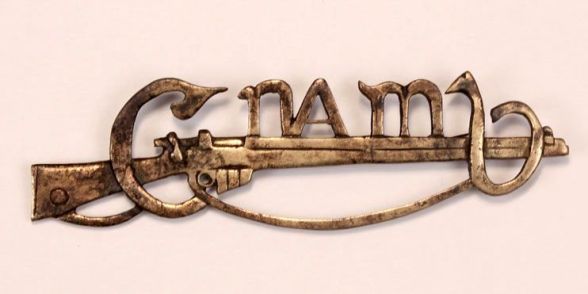
On Thursday, April 2nd, 1914, about one hundred women strolled into Wynn’s hotel in Dublin at four o’clock in the afternoon for the first of Cumann na mBan’s many meetings. The Irish Women’s Council had a lot to discuss but the one thing almost all the ladies present had in common was a devotion to Ireland and a desire to serve it.

Continue reading →

Merry Women’s Christmas!!

Gather the women!!

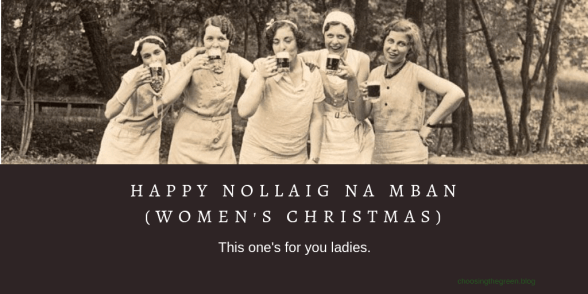
Jan. 6th marks Nollaig na mBan, also known as little Christmas or Women’s Christmas in Ireland. It’s an old Irish tradition that evolved from celebrating the Epiphany but these days it’s become less about religion and more about fun and frivolity. Traditionally, Irish women were not only responsible for the Christmas time entertaining and feasts but they also had to deal with all the holiday clean up, and every day chores and household duties too for that matter. Except on January 6th, that is. That’s the day they finally got a break. On Women’s Christmas, (12th Night, little Christmas or  whatever you want to call January 6th)  the men took over the chores and the households so that the women could gather and drink, tell stories, kick off their shoes and relax for a moment.

It was a real treat back in the day – so much so that it continues now, even though women’s roles have changed all around the world. In modern times, it’s a day for women to gather and treat themselves to a night out at a bar with friends, a trip to the favorite day spa or salon, or head out for a fancy meal. Nollaig na mBan is the day to play hooky from work (or from the house and kids) to enjoy a day with your ladies, create your own little henhouse, tell stories, catch up, or have a cocktail and relax. No matter what women normally work too hard on, Jan. 6th is the time to take a day off, even if it’s only a mental one.  It’s well deserved.

ladies

Jennie Wyse Power

It’s rare that a woman can juggle an immense amount of political power, a restaurant of her own and a family of four children. But Jennie Wyse Power did all this and more, at a time when most women weren’t even getting an education. She was an Irish superwoman and an unapologetic suffragist who passed away on this day in 1941.

Continue reading →