Sheelagh Murnaghan

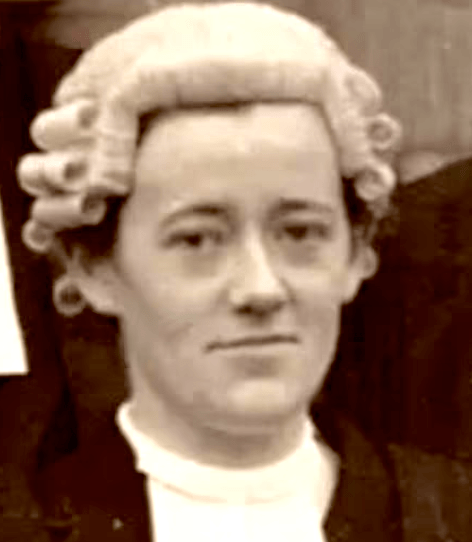
On this day in 1993, the North of Ireland lost a formidable voice. Sheellagh Murnaghan was a tenacious woman who was dedicated to equality in a world that didn’t have much of it. She never let that stop her though and she championed that fight for decades, despite suffering defeats time and time again. Guess it was the hockey player in her that never let her back away from a good fight.

Sheelagh Murnaghan was born in Dublin, but she went to school in Omagh and then studied law at Queen’s University in Belfast. While studying to become a lawyer, she also found the time to join and captain the National Irish Women’s Hockey team. She gave up the sport when she became the region’s first female lawyer and was accepted to the Northern Ireland Bar in 1948. Murnaghan then went into politics. She was one of the first women in Stormont and was the only liberal voice in the chamber at that time. Sheelagh was considered eccentric – she liked cigars and often brought her dog to work. She was a woman, a Catholic, and a liberal in a misogynistic, Sectarian, and conservative climate and she was ferociously dedicated to human rights. Murnaghan introduced legislation to abolish the death penalty and attempted to pass a Northern Bill of Rights at least four times. She also stood for Traveller’s rights, criminalizing discrimination in the workplace, and equal compensation for all, regardless of sex, creed, or political belief. Sheelagh was met with opposition (and probable ridicule) every time she attempted to introduce anything but she did not let that stop her. I’m certain she would have continued her quest if she had been successful in winning another seat once the university’s were abolished in 1969. She stood for election twice more in two different areas, but she lost both times.

Murnaghan was no longer a member of parliament but she still championed equality every day. She sat on several committees, including the Industrial Relations Tribunal, the Belfast Settlement Committee, and the Equal Opportunities Commission. She chaired a tribunal that heard the region’s very first sexual harassment case and her law practice specialized in harassment cases and gender equality from that point on. Murnaghan was not born in the North of Ireland, but it is clear that she devoted her entire career to making it a fairer, more balanced place while others were actively trying to prevent these things. She was absolutely opposed to the violence that erupted in the region and was openly vocal about it, which led to potential peril when her house was bombed by Loyalist paramilitaries in 1970. Luckily, she was not injured or intimidated by this attack and she continued to fight for peace and justice for another twenty-three years.

Sheelagh Murnaghan died on this day in 1993. She did not live to see the North finally adopt many of her ideas, nor did she see the end of the more active conflict in the region, but today, many recognize her as one of the first torchbearers of change and equality in the area. It’s a fitting legacy for a woman who devoted her life to making the world a better place.

Easter Commemorations

It’s pretty shameful how long it has taken to write another post in this blog. I look back and think, how did I have time to write so much just a few years ago? I haven’t lost my passion for Irish history and I continue to visit every chance I get. I still devour every bit of history and culture that I can and I research and learn things all the time but I don’t seem to write about it as much. The idealism and romanticizing of Ireland that I was certainly guilty of at times has evolved into a more realistic, more moderate, and steadfast love of the country and its history. I don’t write about it much anymore and that’s what makes this morning unusual. I got up to go to the Easter Rising Commemoration here in the San Francisco Bay Area as I’ve done in the past, but instead of heading to the grave of a Fenian who was also a corrupt cop and a horrible racist, I am sitting here in the mood to burn bridges and actually writing again. I guess that’s because I find it hard to believe that in one of the most liberal areas in the entire United States, the annual Easter Rising commemoration honoring Ireland’s Patriot Dead is still at the gravesite of a revolutionary but terrible human, who had nothing in common with the leaders of the Rising except for their love of Ireland.

I’ve written about Thomas Desmond before, after the first time I went to the Bay Area commemoration. Back then I cared about fitting into the San Francisco Irish community somehow and my piece on the city’s awfully corrupt and horrendously racist sheriff was timid. It did speak some truth about the man, but I wrote it without calling out their choice of a hero. The Irish Proclamation espouses equality, socialism, and freedom – ideals that Thomas Desmond certainly did not practice in his every day life so many years and commemorations later I feel like it’s time to find a better option. San Francisco has a long history of Irish Republicanism and surely we can find another, less conservative and less controversial person to visit annually, while remembering the Rising. I know that many Fenian heroes and Republican soldiers are often complicated and not always great examples of the idealism that the Proclamation calls for, but in an area that is known for historically supporting the cause and for giving refuge to many immigrants, including the exiled Irish, there has to be a better option than an anti-immigrant, corrupt cop. In my humble opinion, it’s time to look for one.

Until that time, I’ll wear my Easter lily with pride here in the Bay Area and will continue to commemorate the men and women who fought for Irish freedom by learning and occasionally writing about them. For me, how we honor them and where we honor them matters, so Thomas Desmond’s grave is no longer an option for me. Instead, I’ll enjoy some Irish music at my local, tell everyone there who asks why I’m wearing a lily, and I’ll raise a glass or two to the Boys and Girls of the Old Brigade, who fought for a united and free Ireland so bravely during Easter week in 1916 and beyond.

Anne Devlin

There are many, many women in Irish history who never get the recognition they deserve for their contributions to it. Anne Devlin may be the most egregious example of that. Her strength and dedication to the Irish cause was truly like no other.

Continue reading

Civil Rights

In the civil rights arena, America gets a lot of the press and always has. Many of the worst atrocities and biggest conflicts in the movement happened in the United States, and they continue to happen to this day. Hollywood has made plenty of movies chronicling the American fight for civil rights, including one about the fateful march from Selma in 1965 that raised awareness and inspired equality all over the world, especially in the north of Ireland where another civil rights movement was being born.

Continue reading

Fantasy Island

Everyone has that place in their head. One place that they’ve fallen in love with whether or not they’ve ever been there. One place that serves as a goal or a dream and becomes a fantasy location where everything would suddenly be perfect. Many never reach that imagined place or if they do, they quickly find that the perceived nirvana in their head doesn’t match the reality in any way. We often romanticize or fantasize about other places because after all, the grass is always greener on the other side.

Continue reading

The Choice

On May 25th, 2018, Ireland will have the chance to repeal the Eighth Amendment of its constitution in a referendum. This amendment was adopted in 1983 and it asserted that a fetus had the same rights as the woman who carried it. It’s no surprise that this law came into existance, since Ireland was still pretty synonymous with the Catholic faith when the Amendment was passed and while it allowed for pregnancy termination if the life of the mother was shown to be at risk, it made proving that exception more difficult. It also didn’t allow for the mental health of the mother – only the physical. The Eighth strengthened penalties for seeking an abortion both in Ireland and abroad and it ensured that community groups and organizations could not legally help women who wished to explore those options. It took decades of hard work to rectify the latter circumstances but abortion in Ireland was and is still illegal.

This is not to say that women (and girls) don’t get abortions. Recent statistics estimate that more than 150,000 Irish women have had abortions since the eighties. About a dozen have them every day – either by traveling to the U.K. where abortion is legal, by using the outlawed Plan B pill, or getting an illegal (and sometimes unsafe) abortion in Ireland itself.  These women risk a prison sentence of up to fourteen years if they are caught having an abortion on the island, but they do it anyway and that is really the only point that should matter in the upcoming referendum on whether the Eighth should be repealed or not.

Continue reading

International Women’s Day 2018

As a realistic and somewhat pessimistic woman I tend to stay away from international days of anything. One day of focus is not enough to change anything or even learn much of any given subject. That said, as a woman in the male-dominated world of history and a citizen in a country that is regressing horribly I feel like not mentioning International Women’s Day would be a terrible mistake.

Continue reading

The Unknown Heroine of Bloody Sunday

On January 30th, 1972, thirteen innocent people were murdered and twenty-eight were shot during an anti-internment march through the Bogside area of Derry.  Another innocent victim died later as a result of his injuries, bringing the total number of fatalities to fourteen. That bleak day became known as Bloody Sunday. At first the soldiers and the English government tried to claim that all who had been shot or killed were armed, dangerous, and/or members of the Irish Republican Army. Witness statements backed up with photographic evidence, forensics, and videos helped disprove their lies but it took nearly forty years and the most expensive inquiry in English history to finally exonerate the victims.

An anonymous teenage girl who would now probably be in her mid-to-late sixties made a quick and pivotal choice on Bloody Sunday that helped set those things in motion and has affected millions of people since. As she and her friends wandered through the aftermath of the Bogside Massacre, a stranger approached them. He quickly explained that authorities had begun searching people nearby and he had some rolls of film he needed to hide. This young girl quickly put the film in her underwear, assuming that her undergarments would not be searched if she were stopped. She was either not stopped or was correct in that assumption because later she met the man, Gilles Peress, at a hotel where she handed over his rolls of film and then promptly vanished. Peress drove straight out of Derry that night with his precious cargo and never saw the blonde girl again.

Continue reading

Remembering Jennie Wyse Power

Jennie Wyse Power


On this day in Irish history, Jennie Wyse Power passed away in Dublin. Prior to her death was a mother of four, a restaurant owner, a senator, a rebel, a suffragist, the first president of Cumann na mBan, and a founding member of both Cumann na Saoirse and Sinn Fein.

For more about this super capable woman and her full and crazy life, please click here.

Sorcha MacMahon

Over the last few years interest in the roles that women played throughout Irish history has finally picked up. We now know that there were far more women who took part in the Easter Rising than previously thought. Estimates have put their numbers anywhere from seventy-seven to several hundred and many are finally getting the recognition that they have deserved for so long. Sorcha MacMahon was one of those women and without her, the 1916 uprising may have been very different indeed.

Continue reading