It must be agonizing for a parent to outlive their child. It goes against the natural order of the universe and has to be absolutely devastating. For many, it usually involves anger and hopelessness. Margaret Pearse knew that suffering better than most, for she didn’t lose one son, but two—at once—both executed at the hands of the British for their roles in the Easter Rising of 1916. Despite this, she steadfastly refused to give in to despair and she spent the rest of her life fighting for the free Ireland that her sons had died for.
Continue reading
Category Archives: Ireland
2016 take 4
Oh Sinn Fein…
You are making the centenary pretty hard on those of us who live over the puddle and can’t spend 8 weeks in Ireland.
Top ten Favorite Facts about Constance de Markievicz
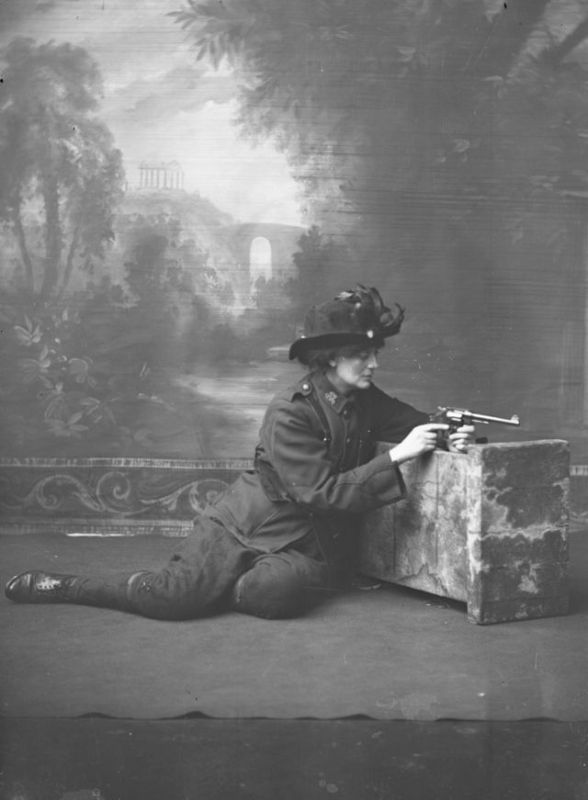
On this date in 1868, one of Irish history’s most famous women was born…in London. Constance Gore-Booth was an aristocratic socialite who fell in love with Irish politics and went on to be one of the most beloved and recognized names in Nationalist history. She fought for women’s rights in Ireland and was a devoted Republican fighter who would have been executed for her role in the Easter Rising, had she not been a woman. Her most famous advice to women was to “Dress suitably in short skirts and strong boots, leave your jewels in the bank and buy a revolver.” In honor of her birthday today, here are my top ten favorite facts you may or may not already know about her life.
The Wilde Lady Jane
Jane Francesca Elgee did a lot of things in her life. She rebelled against her Protestant, Unionist family and became a prolific poet and Nationalist writer. She stood up in court, outing herself as the criminal during a Sedition case to protect the people and the paper she worked for. She spoke at least five languages and translated in each. She threw weekly salons and was known as the most gracious host in all of Dublin. She was a devoted Suffragist and fought for equal rights for women. But what she is best known for is not her prose or her politics. She is best known for being the mother of her children—one in particular—whose works far surpassed those of his mother in a very short time. Indeed, Jane Francesca Elgee will forever be known as Lady Jane Wilde, the woman who gave birth to her son, Oscar.
The Celtic origin of Ground Hog Day
Imbolc, also called Oimealg by the Druids, is the festival of the lactating sheep. Yes, you heard that right. It is derived from the Gaelic word oimelc meaning ewes milk. At this time of the year, many herd animals have either given birth for the first time of the year or they are just about to. It’s the first breath of Spring and it marks the center point of the dark half of the year. It is the festival of the Maiden and from February 1st to March 21st, it is her season to prepare for growth and renewal. On Feb. 1st, Brighid’s snake emerges from the womb of the Earth Mother to test the weather (Ground Hog Day anyone?) and in many places the first flowers begin to pierce the grounds of winter and start to bloom. Brighid’s Crosses are made and exchanged as symbols of protection and prosperity in the coming year. Home hearth fires are put out and re-lit, and candles are lit and placed in each room of the house to honor the re-birth of the Sun. It is a festival of fire and renewal and one of the first celebrations of Spring.
Continue reading
Sláinte, Mr. Guinness
Today we raise a pint of the good old black stuff to the man himself–Arthur Guinness–whose full life came to a close on this day in 1803.
Arthur Guinness is the founder and creator of Guinness brewery, and though he did not create the dark stout that the company is now famous for, he was responsible for signing a 9,000 year lease, guaranteeing that the brewery would always have a place to operate in Dublin. This permanence allowed for funds to be allocated for experimentation and distribution and he made sure to do both. He was already a master brewer and his creations resulted in a decent porter coming to the city and a load of devoted ale drinkers. They called him Uncle Arthur for much of his life. He and his (poor) wife Olivia had 21 children, half of whom lived, but none of his descendants are directly involved in the brewery business at this time. Still, his signature flourishes can be seen on every can or bottle that the company produces and his legacy is honored in Ireland and around the world to this day.
A recent offering, the 1759, is a 750ml bottle of Guinness Ale–not Stout–that is based on recipes from that time. It is likely the closest we’ll get to Arthur’s own creations in this day and age. The brewery has been transformed into the number one tourist attraction in Dublin, and though visitors don’t get to see the inky stout being made, they do get the history of the brewery, a look at the longest lease ever, and one of the greatest views in Dublin. Today I’d like to personally thank Uncle Arthur for one of my favorite adult beverages on the planet, because even though it will never taste the same outside of Ireland, without him, it may never have reached our far shores at all.
Sláinte

Gratitude
Today marks over 100 posts in this wee little dream of a blog. It gives me great pleasure and I’m so happy to keep being inspired enough by my travels and my love of history to keep churning these entries out. I’m also humbled and grateful for those who read them, and who by doing so, keep me on my toes and learning. This blog has grown from a mere place for all my ramblings to a constant cycle of learning, reading, writing, and sharing and I can’t ever seem to find flowery enough words of appreciation for it.
Fatima, Lourdes or just plain Pagan?

There’s a war on in Ireland that doesn’t have a thing to do with water, language, Sectarian violence, or the long history of the Troubles. While all those other battles dominate the press, there is one that slips through the cracks, silently waging on throughout the years and it begs the question, whose rock is it anyway?
Continue reading
Thomas Ashe
Thomas Ashe was a teacher, a piper, an Irish language enthusiast, a soldier, a devout man of faith and one of the pioneers of the modern Republican Hunger Strike. His life began on this day in 1885.

Thomas Ashe, 1917
Merry Women’s Christmas!!
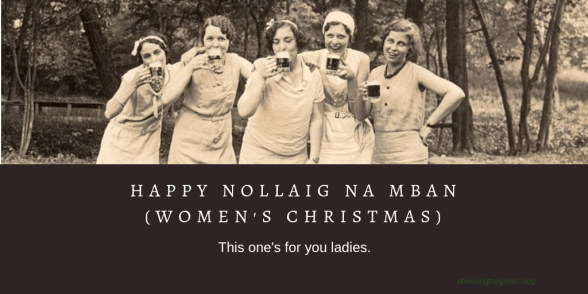
Gather the women!!
Jan. 6th marks Nollaig na mBan, also known as little Christmas or Women’s Christmas in Ireland. It’s an old Irish tradition that evolved from celebrating the Epiphany but these days it’s become less about religion and more about fun and frivolity. Traditionally, Irish women were not only responsible for the Christmas time entertaining and feasts but they also had to deal with all the holiday clean up, and every day chores and household duties too for that matter. Except on January 6th, that is. That’s the day they finally got a break. On Women’s Christmas, (12th Night, little Christmas or whatever you want to call January 6th) the men took over the chores and the households so that the women could gather and drink, tell stories, kick off their shoes and relax for a moment.
It was a real treat back in the day – so much so that it continues now, even though women’s roles have changed all around the world. In modern times, it’s a day for women to gather and treat themselves to a night out at a bar with friends, a trip to the favorite day spa or salon, or head out for a fancy meal. Nollaig na mBan is the day to play hooky from work (or from the house and kids) to enjoy a day with your ladies, create your own little henhouse, tell stories, catch up, or have a cocktail and relax. No matter what women normally work too hard on, Jan. 6th is the time to take a day off, even if it’s only a mental one. It’s well deserved.

 Choosing the Green
You must be logged in to post a comment.