The garden shot

On the second day of the Easter Rising, Kathleen Clarke fretted and wandered around the house, wondering how her husband Tom was doing. He was one of the leaders of the insurrection and was in the General Post Office headquarters with the other commanders, miles away from his wife. Kathleen had been asked to stay out of the fight by her husband who was counting on her to keep their business going, their family healthy, and if necessary, to protect his legacy when the Rising was over. She couldn’t do any of that if she took part in the battle and was arrested or hurt – so as unbearable as it must have been for her, she stayed at home.

Miraculously, the Clarke home wasn’t raided or attacked in any way on the first night of the rebellion. Kathleen spent a restless night in her home and then headed out to the garden in the morning to distract herself from what was happening around her. Planting and tending the garden was one of her favorite hobbies. April 25th, 1916, was a warm day and the ground was parched so she took a can of water with her when she started planting. Kathleen had just put it on the ground when she heard a hissing sound and her instincts kicked in. She ducked and remained still for quite some time. When she finally got up, she looked around to see what had made the sound. The bucket she had been holding seconds before had two bullet holes in it and the water was seeping onto the ground.

The Clarke house was not in the thick of the fighting but there were a lot of bullets flying throughout Dublin that week. In theory one of them could have randomly gone through the backyard at precisely that moment…but many (including the lady herself) think that Kathleen Clarke was deliberately targeted because of her husband’s actions and her own support for a free Ireland. She never found out whether she had been purposely fired on or not – but her own brush with death over Easter week did not stop her from accomplishing all of the plans she and her husband had made before it began. She immediately started a fund for the dependents of Volunteers and she kept her own family afloat, even after the English executed her husband for his role in the Rising. Easter Week cost her a child, a husband, and nearly her own life but she refused to let these losses cripple her and she never wavered in her support and her own fight for a free and independent Ireland.

Nurse Margaret Keogh

On this day in 1916, Ireland’s Easter Rising began. All throughout Dublin men and women made their way to strategic outposts in the city with the hope that they could take them and last long enough for Ireland to be declared an independent nation. They were intent on overthrowing the English control of their homeland and went out with only that purpose in mind. Most other people had no idea of what was to come and they got up in the morning and headed to work as usual, unaware of how different their city was about to be.

Continue reading

Bobby Sands Elected

On this day in 1981, Bobby Sands was elected to Parliament. His candidacy was a risky maneuver, given that he was in prison and on hunger strike at the time and while his win ended up being a masterful propaganda tool, it did not save his life.

Continue reading

Remembering Mary O’Dwyer

Mary O’Dwyer (née Breen) was not a typical Irish Republican woman. She did not have the support of a politically powerful family, in fact they actively discouraged her from joining any political group. She defied them, her parish priest, and others when she began canvassing in County Tipperary for Sinn Fein at age sixteen. Two years later, Mary joined (and eventually commanded) her local branch of Cumann na mBan.

Continue reading

The Last Witch of Ireland

Ireland is steeped in mythology and tales of faeries but these fae have nothing in common with the adorable little Disney-created pixies that flit across the movie screen. Irish faeries have a dark side and many folks still attempt to appease them to this day. You can still find bowls of milk outside certain homes on certain days and many locals who stay away from nearby hills, caves, and mounds. They warn wayward travelers to do the same. Some have iron in their doorways or other superstitious markings to protect against dark creatures of a different world. In the past these beliefs were even more prevalent and tales of changelings and other mischievous things in the night were simply a part of life. These stories also became part of a highly publicized murder after a young woman named Bridget Cleary was burned to death by her husband, her father, and others, on this day in 1895.

Continue reading

Tony Taylor

Operation Demetrius was the fancy name the English used when they started rounding up people in the north of Ireland and imprisoning them without charges or trial. It was more commonly known as internment and it was the root cause of many of the worst conflicts and atrocities during the long period of the Troubles in the north of Ireland. The British government insists that the practice was officially ended in 1975 but the citizens of the region know better. Operation Demetrius may have ended but the practice of internment continues to this day and the most blatant proof of this is the continued imprisonment of Tony Taylor, a Republican activist from Derry. Today marks nearly two years that he has been held in the notorious Maghaberry prison, without public charges, bail, or trial.

Continue reading

A Tale of Two Fenians

Stephen O’Donohoe was a poor law clerk in Dublin. He was a family man with four children who struggled to get ahead but only barely managed to scrape by. Like many, he blamed the English rule in Ireland for his woes. He was one of thousands of men who joined the Fenian Brotherhood, a group dedicated to overthrowing the government and getting the English out of his country.

Thomas Farrell was from Williamstown and was a confectioner by trade. He joined the Fenian Brotherhood as well, and while it’s not clear if these two men knew each other, what is certain is that they are now tied together for all of eternity.

Continue reading

John O’Mahony

Many of Ireland’s great Fenians scattered to the wind to avoid prison when their various uprisings failed. More than few of them ended up on America’s shores and promptly set about creating organizations that furthered the Irish cause within the United States. One of those powerful men was John O’Mahony, the founding member of the Fenian Brotherhood in America.

Continue reading

The flames of Justice 

The world reacted with horror after English soldiers fired directly into a Derry crowd of peaceful anti-internment protesters, on what came to be known as Bloody Sunday. The soldiers wounded more than twenty and instantly killed thirteen innocent people. (One more died months later as a result of his injuries). On this day in 1972 a fuse was lit and just days after the killings, the English embassy in Dublin burned to the ground while eleven innocent people were buried in Derry.

Continue reading

Remembering Jennie Wyse Power

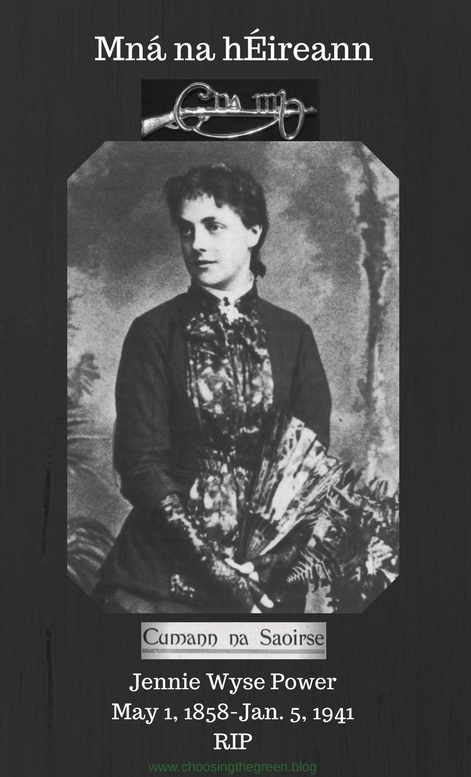
Jennie Wyse Power


On this day in Irish history, Jennie Wyse Power passed away in Dublin. Prior to her death was a mother of four, a restaurant owner, a senator, a rebel, a suffragist, the first president of Cumann na mBan, and a founding member of both Cumann na Saoirse and Sinn Fein.

For more about this super capable woman and her full and crazy life, please click here.