Today marks over 100 posts in this wee little dream of a blog. It gives me great pleasure and I’m so happy to keep being inspired enough by my travels and my love of history to keep churning these entries out. I’m also humbled and grateful for those who read them, and who by doing so, keep me on my toes and learning. This blog has grown from a mere place for all my ramblings to a constant cycle of learning, reading, writing, and sharing and I can’t ever seem to find flowery enough words of appreciation for it.
Tag Archives: Ireland
Fatima, Lourdes or just plain Pagan?

There’s a war on in Ireland that doesn’t have a thing to do with water, language, Sectarian violence, or the long history of the Troubles. While all those other battles dominate the press, there is one that slips through the cracks, silently waging on throughout the years and it begs the question, whose rock is it anyway?
Continue reading
Merry Women’s Christmas!!
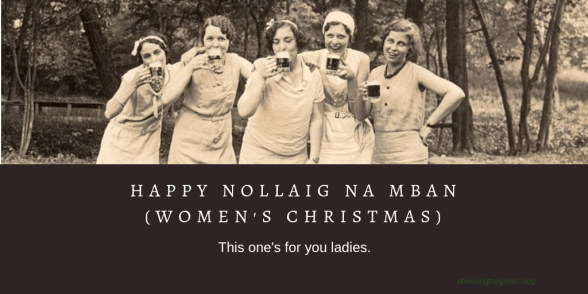
Gather the women!!
Jan. 6th marks Nollaig na mBan, also known as little Christmas or Women’s Christmas in Ireland. It’s an old Irish tradition that evolved from celebrating the Epiphany but these days it’s become less about religion and more about fun and frivolity. Traditionally, Irish women were not only responsible for the Christmas time entertaining and feasts but they also had to deal with all the holiday clean up, and every day chores and household duties too for that matter. Except on January 6th, that is. That’s the day they finally got a break. On Women’s Christmas, (12th Night, little Christmas or whatever you want to call January 6th) the men took over the chores and the households so that the women could gather and drink, tell stories, kick off their shoes and relax for a moment.
It was a real treat back in the day – so much so that it continues now, even though women’s roles have changed all around the world. In modern times, it’s a day for women to gather and treat themselves to a night out at a bar with friends, a trip to the favorite day spa or salon, or head out for a fancy meal. Nollaig na mBan is the day to play hooky from work (or from the house and kids) to enjoy a day with your ladies, create your own little henhouse, tell stories, catch up, or have a cocktail and relax. No matter what women normally work too hard on, Jan. 6th is the time to take a day off, even if it’s only a mental one. It’s well deserved.

Jennie Wyse Power
It’s rare that a woman can juggle an immense amount of political power, a restaurant of her own and a family of four children. But Jennie Wyse Power did all this and more, at a time when most women weren’t even getting an education. She was an Irish superwoman and an unapologetic suffragist who passed away on this day in 1941.
Kilgobbin Burial Grounds
There’s more than one Kilgobbin in Ireland. There’s one in Dublin and one on the edge of Tralee Bay in the shadows of the Slieve Mish mountains. If you’re heading down the scenic route toward Dingle there’s a tiny little road near the village of Camp that leads to a stunning old church, a cemetery and an unbelievable view of the bay.
Red Hugh
It is thought that on this day in 1602, at a dinner in Spain far away from his beloved Ireland, Red Hugh O’Donnell took a sip of his wine. That last indulgence ended the life of one of the most famous and admired chieftains in Irish history.
Continue reading
A hidden castle in Ireland
On the last day of our recent journey in Ireland, it was pouring down rain and we were headed back toward Shannon from Belfast. We were on the main highway and getting cranky because of the storm and from the bigger roads, there’s not a lot of super beautiful scenery or many interesting things to see . It was not the way we wanted to leave, so once we were in the west, we picked an exit at random and started exploring it. There were a few ruins here and there. There were a few historical signs pointing off in random directions and we found ourselves in the middle of nowhere on a country road hunting for castles. A tractor was coming at us from the other direction and as we pulled over to let him pass, we asked him if there were castles nearby. He told us about 3 or 4 of them and ended with “but you know it’s raining, right?” He shook his head when we said we didn’t care, muttering something about crazy girls. Then he began to give us directions to the one that wasn’t a hotel saying, “Well then, just go up the road a few miles, look for the dog at the top of the hill, pull into the driveway of the stone house, knock on the door, and ask for the key to the castle.” We thanked him and continued on down the lane. We found the dog, shivering and wet. We pulled into the drive, and knocked on the door of the stone house. When a very startled man answered and we asked for the key to the castle, he too responded with “You know it’s raining, right?” while he frantically looked for it. After a phone call or two and a reasonably thorough search, this is what he gave us – there’s no mistaking that it is the key to a castle, with that kind of key chain.

Minister of State
Since my return from Ireland I have been trying to figure out what I could do for work in order to move there. Unfortunately, I do not have a background in Tech which seems to be one of the only fields where business is thriving in the Emerald Isle, so I have been hunting for other ways. It turns out that I just needed to apply for the Minister of State/Gaeltacht affairs position, since apparently the job requires very little knowledge of Irish and does not require fluency in the language.
Seriously?! It is my impression that if you are put in charge of Gaeltacht Affairs, you should be able to conduct business or resolve conflict in Irish, since you are representing that language and the people who speak it. Perhaps I have that wrong and Joe McHugh will do just fine but I don’t think I’m mistaken in what the job requirements should be.
If I am though, I would like to formally announce that I am applying for the job. After all,
Tá beagán Gaeilge agam.
:head hits desk:
Ireland in the Atlas Obscura
I write for a few places – one of my longtime favorites is the Atlas Obscura which is a combination of an obscure travel guide and a historical Atlas. Their Irish section was woefully sparse before I filled it out (which I am still doing) and sometimes I like to share the entries.
The deserted village of Slievemore was one of the first I knew I had to add when I went to Ireland. We were there in the early hours of the morning and it was pouring down rain but we explored it anyway.
Interesting fact: When you’re deep into the Gaeltacht island of Achill in December, it is important to note that there are no off season accommodations. In fact the Annexe Pub was the only place we could find anyone and the amazing bartender had to call a friend who owns the summer hostel to turn on the heat and give us a room for the night. It was a much appreciated and really lovely thing for him to do for the crazy tourists who were traveling without an itinerary. If you make it out that way, have a pint – the Guinness was perfect – and give him some love from the crazy American ladies that he saved from a freezing storm.

The deserted village of Slievemore
Tom Barry’s Birthday
On this day in 1897 Thomas Bernadine Barry was born in Killorglin, Co. Kerry, one of a whopping 14 children. Eighteen years later or so he joined the British Army – an unlikely move that would aid in his future as one of the most respected and strategic IRA commanders in history. While serving in the British army he received news of the 1916 Rising but was unable to return to Ireland until the war he was fighting for Britain had come to an end in 1919.
Upon his return, he got involved in the Volunteer movement. One year later became the commander of the Flying Column 3rd West Cork brigade. He had asked for total autonomy in decision-making and it was given, with a warning that any success or failure would be his responsibility alone. (No pressure!) He then began planning the Kilmichael ambush, a significant political and strategic move that became a touchstone in the War of Independence.
The ambush occurred one week after the first Bloody Sunday. (Yes, I said the first – there have been multiple, unfortunately) It boosted IRA morale and garnered even more respect for Tom Barry and his tactics. It also brought him to the attention of Michael Collins, who was suddenly aware that he had both a strong ally and some fierce competition.
Michael Collins called for Barry to come to both Dublin and London during the Treaty negotiations. It is said that one of the first things the British wanted was Tom Barry himself. Michael Collins refused, though he later claimed that he had been tempted to give Barry to them. When the treaty was ratified – over Barry’s objections due to the partitioning of the Island – he continued to fight on the behalf of the Anti-Treaty IRA until he was imprisoned by Collins’ Irish Free State Army. He escaped and continued to command in various locations until the Anti-Treaty IRA was defeated and he was captured once again.
Upon his release, he spent a term as the IRA Chief-of-Staff and served as general superintendent of the Cork Harbor Commission for nearly 40 years. Still an unrepentant Republican, at the age 62 he traveled to the United States in the hopes of gaining funds and support for a united Ireland. His one wish and lifetime goal was to end the partition of Ireland. He died in 1980 and was buried at St. Finbarr’s Cemetery in Cork. Though St. Finbarr’s cemetery has one of the largest Republican plots in the area, Tom Barry is not interned in it but instead is buried nearby.
 Choosing the Green
You must be logged in to post a comment.